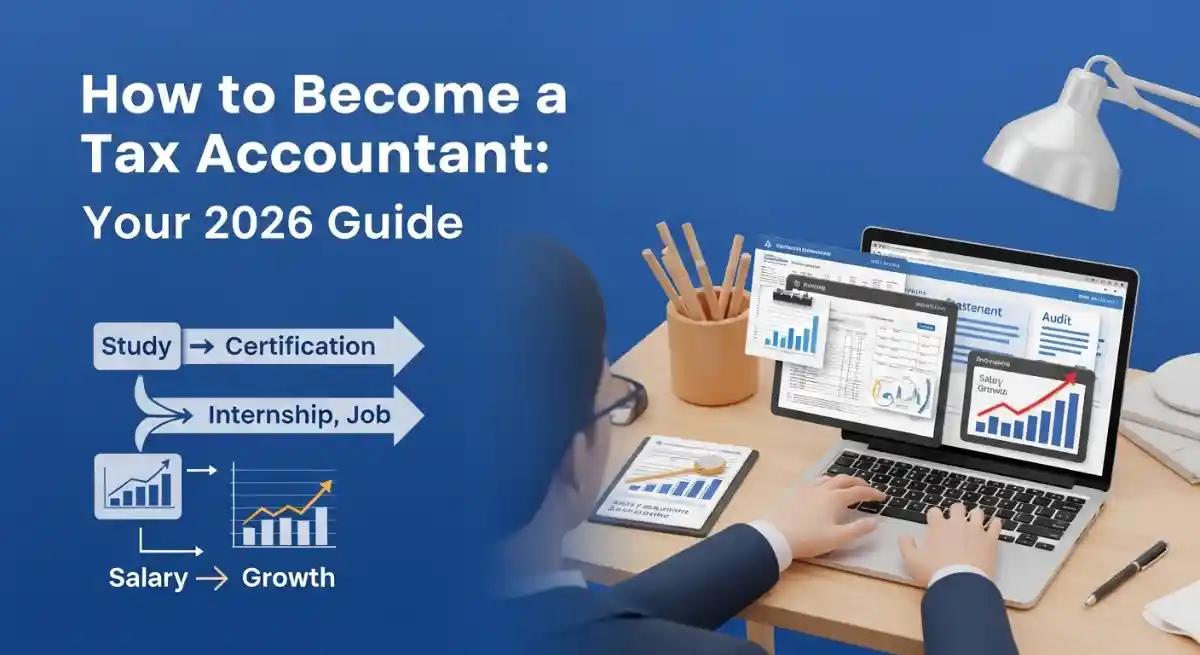
How to Become a Tax Accountant: Your 2026 Guide
If you've ever wondered how businesses stay legally compliant with tax laws, or how individuals manage to save money on their tax returns — the answer almost always involves a skilled tax accountant. In 2026, the demand for qualified tax professionals in Pakistan and globally has never been higher. Whether you're a fresh graduate, a career switcher, or someone already working in accounting and finance, this guide walks you through everything you need to know about building a successful tax accountant career — step by step.
What Is a Tax Accountant and What Do They Actually Do?
A tax accountant is a financial professional who specializes in preparing, filing, and managing tax returns for individuals and businesses. But the role goes far beyond just filing papers. Tax accountants also advise clients on tax strategies, help businesses remain compliant with ever-changing tax legislation, and work to legally minimize tax liabilities.
In Pakistan, a tax accountant typically works within the framework set by the Federal Board of Revenue (FBR), ensuring that clients meet their obligations under the Income Tax Ordinance 2001 and Sales Tax Act.
Here's what a typical tax accountant does on a daily basis:
- Prepares and files income tax and sales tax returns
- Reviews financial statements to ensure GAAP compliance
- Advises clients on long-term tax planning strategies
- Represents clients before tax authorities during audits
- Keeps clients updated on changes in Pakistan tax laws
- Manages bookkeeping and financial records
- Assists multinational companies with corporate tax planning
The role of a tax accountant is not just reactive — it's deeply strategic. Many tax accountants also provide advisory services that directly shape how a business grows and makes financial decisions.
Why Becoming a Tax Accountant Is a Smart Career Choice in 2026
According to the Bureau of Labor Statistics, employment for accountants and auditors is expected to grow steadily through the late 2020s. In Pakistan specifically, the taxation system is undergoing rapid digitization through the FBR's IRIS 2.0 portal, making trained tax professionals more essential than ever.
Here's why this career path makes sense right now:
Growing demand: The Securities and Exchange Commission of Pakistan (SECP) has tightened corporate compliance rules, creating a surge in demand for qualified tax specialists.
Lucrative salary potential: A tax accountant salary in Pakistan ranges from PKR 60,000 for entry-level staff accountants to over PKR 300,000 per month for senior tax accountants working with accounting firms or multinational companies.
Global opportunities: With the right qualifications, Pakistani tax professionals are being hired by UAE, UK, Canadian, and US-based firms. The international market is wide open.
Entrepreneurship: Many experienced tax accountants go on to launch their own tax consultancy, offering a range of services to businesses and individuals.
If you're serious about a career as a tax accountant, 2026 is genuinely the right time to start.
Step-by-Step: How to Become a Tax Accountant in Pakistan
Step 1 — Get the Right Educational Foundation
Most tax accountants begin with a degree in accounting, finance, or business administration. Common academic paths include:
- B.Com or M.Com (Bachelor's or Master's in Commerce)
- BBA/MBA with Finance or Accounting major
- CA (Chartered Accountancy) through ICAP — Institute of Chartered Accountants of Pakistan
- ACCA — Association of Chartered Certified Accountants (globally recognized)
- PIPFA — Pakistan Institute of Public Finance Accountants
A degree gives you the foundation in financial accounting, accounting principles, and business law. But in 2026, a degree alone is often not enough. Employers want practical, verified skills — and that's where professional certification changes everything.
Step 2 — Get Certified in Taxation
This is where many aspiring tax accountants fall short. They have the degree but lack hands-on, practical knowledge of how to actually file tax returns, handle FBR audits, or advise clients on tax strategies under Pakistan's current tax law.
The solution? A specialized taxation certification.
The Certified Tax Advisor course at ICT is one of the most recognized practical taxation programs in Pakistan right now. It covers everything from income tax return filing to sales tax compliance, audit preparation, and FBR IRIS portal navigation — the exact skills employers and clients are looking for.
ICT — the Institute of Corporate and Taxation — is widely regarded as the No. 1 institute for taxation training in Islamabad, offering courses that are built for real-world application, not just theory. You can explore their full course catalog here.
Step 3 — Master Accounting Software and Digital Tools
In 2026, tax accountants use accounting software as a core part of their daily work. You need to be comfortable with:
- QuickBooks — for small and medium business bookkeeping
- SAP — used widely by multinational companies
- Xero — popular with international clients
- FBR IRIS Portal — Pakistan's primary online tax filing system
- Microsoft Excel — still essential for financial planning and analysis
If you want to level up your Excel skills, ICT's Master Advanced Excel course is a practical add-on that many tax professionals use to improve their data analysis capabilities.
Step 4 — Understand Pakistan's Tax Framework Inside Out
A good tax accountant doesn't just know how to file — they understand why. You need deep knowledge of:
- Income Tax Ordinance 2001 and its amendments
- Sales Tax Act 1990
- FBR Active Taxpayer List (ATL) requirements
- NTN (National Tax Number) and STRN (Sales Tax Registration Number) registration
- Withholding tax rules for individuals and businesses
- Corporate tax Pakistan obligations for registered companies
ICT's blog on income tax return filing and common mistakes is a great free resource to start building this knowledge base.
Step 5 — Build Practical Experience
Theory and certification get you in the door — experience is what keeps you there. Start by:
- Interning at public accounting firms or tax consultancy firms in Pakistan
- Offering freelance tax filing services on platforms like Fiverr or Upwork
- Assisting a senior tax accountant or auditor
- Volunteering to handle tax compliance for small businesses in your network
ICT has a helpful guide on how to start a tax freelancing business in Pakistan that walks you through this process in detail.
Step 6 — Consider International Specializations
If you want to dramatically increase your earning potential, consider specializing in international taxation. Pakistani professionals who understand UK, UAE, US, or Canadian tax systems are in extremely high demand.
ICT offers dedicated courses for each of these markets:
- USA Taxation Course — Learn IRS rules and US tax filing systems
- UK Taxation Course — Master HMRC compliance and UK tax law
- UAE Taxation Course — Cover VAT and corporate tax in the UAE
- Canadian Taxation Course — Learn CRA guidelines and GST/HST filing
These international specializations can open doors to remote freelancing clients and positions at multinational companies — all without leaving Pakistan.
Key Skills Every Tax Accountant Needs in 2026
Beyond qualifications, here are the core skills that separate good tax accountants from truly trusted tax advisors:
Knowledge of tax laws and legislation: Tax law changes constantly. Accountants who stay updated — through FBR notifications, SECP updates, and continuing education — are the ones clients and employers trust most.
Analytical and critical thinking: Tax accountants must analyze financial data, identify deductions, and spot compliance risks. This requires sharp attention to detail and problem-solving ability.
Communication skills: You're translating complex tax legislation into plain language for clients. Whether you're advising a freelancer or a corporate board, clarity matters.
Time management: Tax season is intense. Managing multiple clients, meeting filing deadlines, and maintaining accuracy simultaneously is a daily challenge.
Ethical judgment: Tax professionals handle sensitive financial matters. Integrity is non-negotiable. Clients trust you with information that can make or break their businesses.
Digital literacy: From accounting software like QuickBooks to AI-assisted tax filing tools, the modern tax accountant must be tech-forward.

How to Become a Tax Accountant 2026
Tax Accountant vs Tax Consultant — What's the Difference?
This is one of the most common questions asked by people entering the field. Here's a simple breakdown:
A tax accountant primarily focuses on preparing and filing tax returns, maintaining financial records, ensuring compliance with tax laws, and conducting financial audits. They work with the numbers.
A tax consultant focuses more on strategy — advising clients on how to structure their finances, investments, and business entities to minimize tax liabilities and maximize growth. They work with decisions.
In practice, many experienced tax professionals do both. After a few years as a tax accountant, many move into tax advisory services — becoming trusted business advisors who shape long-term tax strategies for their clients.
ICT's article on Certified Tax Advisor vs Accountant explains this distinction in detail and helps you decide which path suits your goals.
Tax Accountant Salary in Pakistan — What to Expect in 2026
Salary ranges vary depending on experience, qualifications, and the type of employer:
- Entry-level / Staff Accountant: PKR 50,000 – PKR 80,000/month
- Mid-level Tax Accountant: PKR 80,000 – PKR 150,000/month
- Senior Tax Accountant: PKR 150,000 – PKR 300,000+/month
- Tax Consultant (Self-employed): PKR 200,000 – PKR 500,000+/month depending on clientele
- International Tax Specialist (remote): $800 – $3,000+/month working with global clients
Working with multinational companies, accounting firms, or building your own tax consultancy significantly boosts your earning potential. For a detailed breakdown, read ICT's blog on tax professional salary in Pakistan.
Career Opportunities After Becoming a Tax Accountant
The career path for a qualified tax accountant is wide and varied. Here are some of the directions you can take:
- Staff Accountant at an accounting and tax firm
- Corporate Tax Manager at a large company or MNC
- FBR-registered Tax Practitioner handling individual and business clients
- Internal Auditor reviewing financial compliance within an organization
- Enrolled Agent (for US tax specialization) representing clients before the IRS
- Freelance Tax Consultant serving clients on Fiverr, Upwork, or directly
- Tax Advisory Partner at a public accounting firm
- Financial Advisor combining tax planning with broader financial planning
For a full look at where this career can take you, check out ICT's guide on career opportunities after becoming a certified tax advisor.
Why Choose ICT for Your Taxation Training?
If you're serious about becoming a tax accountant in Pakistan, choosing the right institution matters enormously. The Institute of Corporate and Taxation (ICT) stands apart for several reasons:
- Courses are designed around practical, real-world tax scenarios — not just textbook theory
- Instructors are active tax professionals with hands-on FBR experience
- ICT is the No. 1 rated institution for taxation training in Islamabad
- Programs cover both domestic and international taxation — from FBR to IRS to HMRC
- Students receive recognized certification that is accepted by employers and accounting firms across Pakistan
Thousands of students have transformed their careers through ICT's programs. Read real student stories in how our students transformed their careers with tax education.
You can also explore ICT's Advanced Taxation and Litigation course — one of the most comprehensive programs available for those who want to handle complex tax matters and represent clients before tax authorities.
Frequently Asked Questions (FAQs)
What does a tax accountant do? A tax accountant prepares and files tax returns, ensures compliance with tax laws, advises clients on tax strategies, and may represent clients during FBR audits. They help both individuals and businesses manage their tax liabilities efficiently and legally.
How long does it take to become a tax accountant? With a relevant degree (2–4 years) combined with a practical taxation certification like ICT's Certified Tax Advisor program (3–6 months), you can be working as a tax accountant within a year of focused effort. Career switching with just a short certification course is also possible.
Can I become a tax accountant in Pakistan without a CPA? Yes. In Pakistan, the CPA designation is not a mandatory requirement. A degree in accounting or finance combined with certifications from ICAP, ACCA, PIPFA, or a recognized institution like ICT is sufficient to begin a professional tax accountant career.
What is the difference between a tax accountant and a tax consultant? A tax accountant focuses primarily on preparing returns, bookkeeping, and compliance. A tax consultant is more advisory — helping clients with strategic tax planning and business decision-making. Many professionals do both as their career advances.
What software do tax accountants use in Pakistan? Most commonly: FBR's IRIS portal for tax filing, QuickBooks and Xero for bookkeeping, SAP for corporate-level accounting, and Microsoft Excel for financial analysis and reporting.
Is taxation a good career in Pakistan in 2026? Absolutely. With FBR's push for broadening the tax base, SECP tightening compliance rules, and businesses of all sizes needing qualified tax professionals, the demand — and salaries — for tax accountants in Pakistan are on a strong upward trajectory.
Conclusion — Your Next Step Starts Here
Becoming a tax accountant in 2026 is one of the most practical, high-demand, and financially rewarding career decisions you can make — especially in Pakistan's fast-evolving taxation landscape. The path is clear: build your educational foundation, get a practical certification, master the right tools, understand Pakistan's tax framework deeply, and never stop learning.
The difference between someone who reads this article and someone who actually builds this career is one decision — taking action.
Book your seat today in the Advanced Taxation Course offered by ICT — Pakistan's No. 1 Institute of Corporate and Taxation. Whether you're a student, an accountant looking to specialize, or a professional wanting to switch careers, ICT has a program designed for exactly where you are right now.
👉 Explore all courses at ict.net.pk/courses and take the first real step toward becoming a certified, confident, and in-demand tax professional in 2026.
Comments (0)
No comments yet. Start the conversation!
Leave a Reply
Your email address will not be published. Required fields are marked *