
Will AI Replace Tax Consultants? The Real Answer for 2026
Will AI Replace Tax Consultants? The Real Answer for 2026
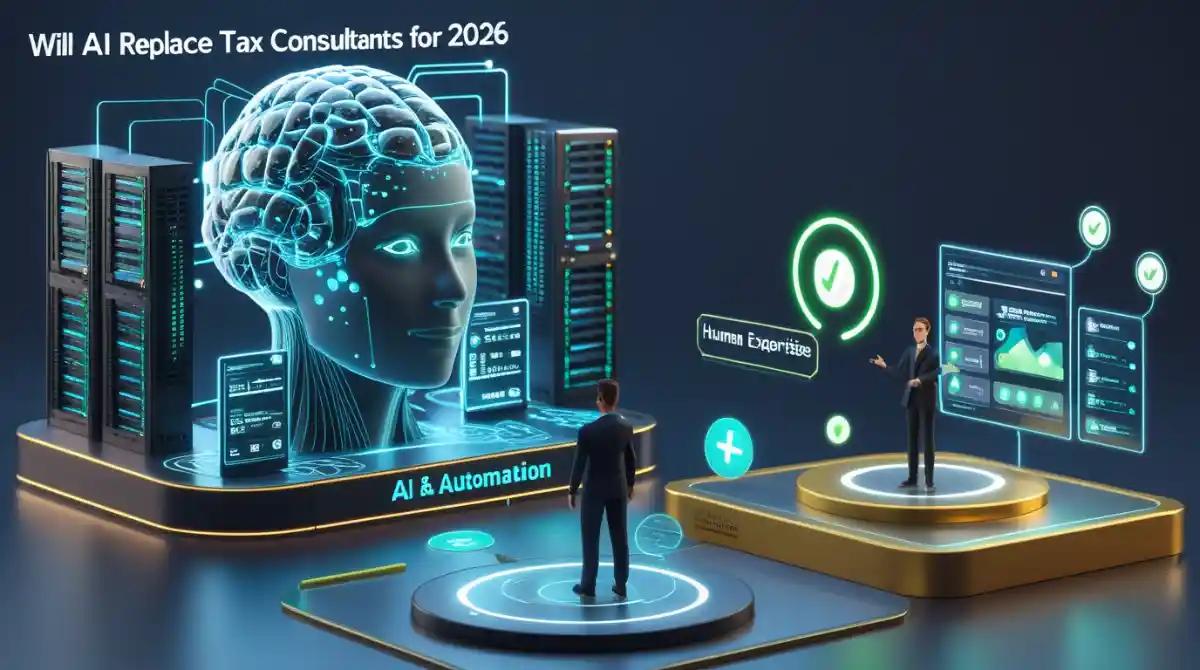
No, AI will not fully replace tax consultants in 2026. While artificial intelligence is rapidly transforming tax preparation, compliance automation, and data processing, the strategic thinking, client relationship management, and complex judgment calls that define real tax advisory work remain deeply human. AI is a powerful tool — not a replacement. The tax professionals who will struggle are those who refuse to adapt. The ones who thrive are those who learn to use AI as a force multiplier for their expertise.
Let's break down exactly what AI can do, what it cannot do, and what this means for your career in 2026 and beyond.
What Is AI's Role in Tax Preparation Today?
Artificial intelligence in taxation is not a future concept. It is happening right now across every major market — from the IRS in the United States to HMRC in the UK, CRA in Canada, and the FTA in the UAE.
Here is what AI is already doing in the tax industry:
- Automating data extraction from invoices, receipts, and financial statements
- Flagging audit risks using predictive tax analytics and machine learning models
- Running digital tax filing workflows that reduce manual entry errors
- Detecting fraud patterns using AI fraud detection systems at the IRS level
- Assisting with tax code monitoring and regulatory change alerts
- Performing AI transfer pricing analysis for multinational corporations
- Generating first drafts of tax returns using natural language processing on uploaded documents
Tools like TurboTax AI, Intuit AI, TaxGPT, Bloomberg Tax AI, and Koinly AI for crypto taxes are already handling millions of straightforward tax cases with minimal human involvement.
According to industry data, AI efficiency gains in tax workflows are estimated at 30 to 50 percent for routine compliance tasks. That is significant. And yes, it means some entry-level tax work is being automated.
But here is the critical distinction most people miss.
What AI Cannot Do in Tax Consulting
AI is very good at processing structured data, identifying patterns, and executing predefined workflows. It is not good at the things that actually make a tax consultant valuable to their clients.
1. Complex Tax Scenario Analysis
When a business owner is deciding whether to restructure their company, spin off a division, or make a major cross-border investment, they need a human brain that understands context, risk appetite, and long-term strategy. AI can pull data. It cannot weigh human priorities.
2. Client Relationship and Trust
Tax consulting is a relationship business. Clients share sensitive financial information. They need to trust the person giving them advice. Emotional intelligence in accounting and tax advisory is irreplaceable — no chatbot can replicate the confidence a skilled tax advisor builds over years.
3. Judgment Under Uncertainty
Tax law is often ambiguous. The Income Tax Ordinance 2001, the US Internal Revenue Code, and HMRC's guidance all have grey areas. A tax professional exercises judgment informed by experience and ethical responsibility. AI hallucination in tax advice is a real documented risk — AI systems sometimes generate confident but incorrect tax guidance. Human oversight of AI-generated work is not optional; it is a professional and legal requirement.
4. Audit Representation
When FBR sends a notice, when the IRS initiates an audit, or when HMRC challenges a return, a human advocate fights for the client. AI cannot appear before a tax tribunal. It cannot negotiate. It cannot respond to an officer's follow-up questions with contextual judgment.
5. Tax Planning vs Tax Preparation
This distinction is everything. Tax preparation is looking backward — filing what happened. Tax planning is looking forward — structuring decisions to minimize future liability legally. AI handles preparation reasonably well. Strategic tax planning for high-net-worth individuals, growing businesses, and cross-border operations requires a certified, experienced tax professional.
The Real Numbers: What the Data Says
Let's look at actual statistics because this conversation should be grounded in evidence, not fear or hype.
- 37% of taxpayers in a 2025 survey said they would trust AI for basic tax filing — but only 11% would trust it for complex tax planning
- 72% of companies are piloting AI in financial reporting — but almost all retain human tax advisors for strategic decisions
- 71% of employers in accounting and finance now prefer candidates with demonstrated AI tool literacy
- The US accounting workforce has seen approximately 340,000 fewer CPAs over the past decade — but this is due to retirement and career shifts, not AI displacement
- AI tax market growth projections show the market doubling by 2027 — but this growth is in AI-assisted tools, not AI replacing professionals
The takeaway is clear. AI is growing. But so is the demand for skilled tax professionals who know how to use it.
AI vs Human Tax Consultant: A Clear Comparison
What AI does better:
- Processing large volumes of data quickly
- Consistency in routine filings
- 24/7 availability for basic queries
- Reducing calculation errors in standard returns
- Real-time tax law monitoring and alerts
What humans do better:
- Strategic tax planning and advisory
- Representing clients in disputes and audits
- Handling ambiguous or novel tax situations
- Building long-term client trust and relationships
- Ethical judgment and responsible decision-making
- Cross-border and multi-jurisdictional tax structuring
The future belongs to what experts are calling the hybrid intelligence model — a tax professional who combines deep expertise with AI tool fluency. This is not the tax consultant of 2010. This is a new professional category, and the training required to join it is available right now.
How AI Is Changing the Role of Tax Advisors in Pakistan
In Pakistan, the impact of AI on tax work is following the same global pattern — but with unique local dimensions.
The FBR's push toward digital invoicing, the IRIS 2.0 portal, and automated e-filing systems are all incorporating AI-driven compliance checking. This means that basic FBR return filing, NTN registration assistance, and routine withholding tax calculations are increasingly automated.
But the demand for certified tax advisors who understand the Income Tax Ordinance 2001, can navigate FBR audit notices, and can advise businesses on tax-efficient structuring is growing — not shrinking.
Pakistani freelancers offering tax services to international clients in the UAE, USA, Canada, and UK are also finding that AI tools help them serve more clients efficiently, not that AI is replacing their role.
Read more: Future of Tax Advisory in Pakistan 2026–2030
Also see: AI in Taxation — Tools, Risks, and Opportunities
Calculate your current tax position using the Pakistan Income Tax Calculator before making any career or planning decisions.
Best AI Tools for Tax Professionals in 2026
If you are a tax consultant today, these are the AI tools reshaping the industry — and the ones you should know:
- TurboTax AI / Intuit AI — Automated personal and small business return preparation in the US
- TaxGPT — AI-powered tax research and query answering for professionals
- Bloomberg Tax AI — Legislative monitoring and advanced tax research for firms
- Koinly AI — Cryptocurrency tax calculation and reporting
- Pennylane AI — European accounting and VAT compliance automation
- Basis AI — Automated accounting workflows for mid-sized firms
- ChatGPT / Claude for tax research — Used by professionals for quick statutory lookups and draft document creation

Will AI Replace Tax Consultants The Real Answer for 2026
The professionals using these tools are billing more per hour — not billing less. Because they handle higher volumes, produce cleaner work, and spend their time on what clients actually pay a premium for: judgment, strategy, and advocacy.
Use the Pakistan Business Tax Calculator to handle quick business tax estimations while focusing your expertise on higher-value advisory work.
Should You Still Study Taxation in 2026?
Absolutely yes. In fact, the case for studying taxation in 2026 is stronger than it has ever been — precisely because AI is raising the floor for what clients expect from their tax advisors.
A client who used to be satisfied with someone who knew how to file a return now expects their tax advisor to also understand AI tools, provide proactive tax planning advice, and be able to explain complex regulatory changes clearly.
This is not a threat to the profession. It is an upgrade filter.
The tax professionals who invest in structured, certified training — covering not just basic compliance but advanced tax strategy, international taxation, FBR procedures, and modern tax technology — will dominate the next decade.
At the Institute of Corporate and Taxation (ICT), this is exactly the education model being delivered. ICT's programs cover everything from FBR income tax and sales tax to UAE corporate tax, US taxation with IRS frameworks, Canadian taxation with CRA compliance, and UK taxation under HMRC.
These are not just academic programs. They are career transformation tools for the AI era.
Find out: New Tax Careers in 2026 — Digital Compliance Roles
Also explore: Tax Careers Evolution 2026 — Technology and AI
How to Future-Proof Your Tax Career Against AI
Here is a practical roadmap for tax professionals and students in 2026:
Step 1: Get certified in a specialized tax domain. General tax knowledge is commoditized. Specialize in UAE VAT, US Enrolled Agent work, Canadian CRA compliance, or FBR litigation. Specialization is AI-proof.
Step 2: Learn the AI tools your clients and employers use. You do not need to be a programmer. You need to know how TaxGPT, Bloomberg Tax AI, or Intuit's AI suite works well enough to use it and audit its outputs.
Step 3: Build your advisory skills. Communication, client trust, strategic planning, and audit representation are the skills AI cannot replicate. Invest in them deliberately.
Step 4: Stay current on tax law changes. The OECD Pillar Two global minimum tax, evolving BEPS compliance requirements, FBR digital invoicing mandates, and UAE corporate tax refinements are all creating ongoing advisory demand. The advisor who understands today's law is invaluable.
Step 5: Use AI to scale, not to coast. The freelance tax consultant who uses AI tools to serve 40 clients instead of 15 — at the same quality — earns dramatically more. AI is your leverage, not your competition.
Use the Pakistan Freelance Tax Calculator to plan your freelance tax obligations as you scale your client base.
Read: AI Tools Every Freelance Tax Consultant Will Use in 2026
Also see: Taxation 2026 — AI Impact on Tax Consultants
Frequently Asked Questions
Will AI replace tax accountants? No. AI will automate routine tax preparation tasks but cannot replace the strategic advisory, audit representation, and complex judgment work that defines professional tax consulting. The role is evolving, not disappearing.
Can ChatGPT do my taxes? ChatGPT can answer general tax questions and help you understand concepts, but it cannot file your taxes, access your financial records, or represent you before the IRS, FBR, or CRA. It is a research assistant, not a tax professional.
What can AI do in tax preparation? AI can extract data from financial documents, run compliance checks, flag audit risks, automate data entry, generate draft returns for review, and monitor tax law changes. It performs best on structured, routine tasks.
Can AI make tax mistakes? Yes. AI hallucination — generating confident but incorrect information — is a documented risk in tax contexts. AI tools require professional human review before any output is acted upon. This is why certified human oversight remains essential.
Is it safe to use AI for tax filing? For simple personal tax returns, AI-powered tools like TurboTax are generally safe and accurate. For complex business taxes, cross-border situations, or cases involving significant assets, a certified human tax consultant should always be involved.
What are the limitations of AI in taxation? AI cannot exercise judgment in ambiguous legal situations, cannot represent clients in disputes, cannot build trust-based client relationships, cannot account for undocumented context, and is limited by the quality of the data it receives.
Conclusion — The Future Belongs to Skilled, AI-Literate Tax Professionals
The question is not whether AI will replace tax consultants. It will not. The real question is whether you will be the kind of tax professional that clients and employers seek out in an AI-driven world.
The answer lies in structured, expert-level training that builds both deep tax knowledge and modern tool fluency.
That is what ICT — Institute of Corporate and Taxation delivers. Recognized as Pakistan's leading taxation training institute, ICT prepares professionals for real-world advisory careers across Pakistan, UAE, USA, Canada, and the UK.
Whether you are a fresh graduate, an experienced accountant, or a freelancer building a global client base, there is a program at ICT designed for your goals.
Read why students choose ICT: Why ICT Is No. 1 for US Taxation | No. 1 Institute of Corporate and Taxation in Islamabad
Book your seat today at the Advanced Taxation Course offered by ICT — and position yourself as the tax professional AI cannot replace.
Explore All Courses | Read the ICT Blog | Contact ICT Today.