
Can I Specialize in International Tax Without Going Abroad?
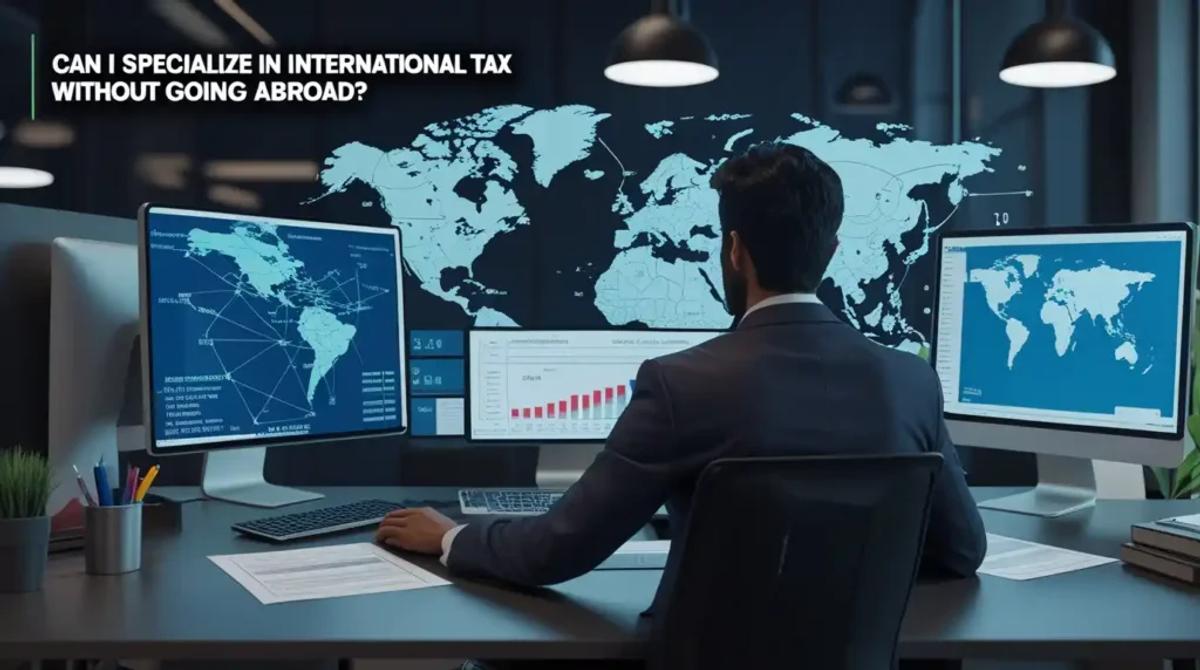
Can I Specialize in International Tax Without Going Abroad?
The complete guide to building a global tax career from anywhere in the world
If you've ever wondered whether you can build a serious career in international tax without packing your bags and relocating to New York, London, or Dubai — the answer is a confident yes. International tax specialization is one of the fastest-growing remote career paths in the world of finance and law, and the good news is that geography no longer limits your ambitions.
Whether you're a CPA, a law graduate, or an accountant looking to level up, you can study international tax from home, earn globally recognized certifications, and land high-paying roles — all without ever leaving your country. Let's break down exactly how.
What Is International Tax Specialization?
International tax is the branch of taxation that deals with cross-border financial activities — how governments tax businesses and individuals that operate in multiple countries. It covers areas like:
- Double taxation avoidance agreements (DTAAs)
- Transfer pricing and the arm's length principle
- BEPS (Base Erosion and Profit Shifting) rules by OECD
- FATCA (Foreign Account Tax Compliance Act) compliance
- GILTI (Global Intangible Low-Taxed Income) provisions
- Controlled Foreign Corporation (CFC) rules
- Permanent establishment concepts
- Withholding tax compliance
- Tax treaty specialist work
- Country-by-country reporting
An international tax specialist helps multinational corporations, foreign investors, expats, and high-net-worth individuals navigate these complex rules across different jurisdictions. It's technical, in-demand, and very well-compensated.
Can I Specialize in International Tax Without Living Abroad?
Yes, absolutely. The idea that you must live or work in a foreign country to specialize in international tax is outdated. Here's why:
International tax law is studied through books, regulations, OECD publications, and case law — none of which require a passport stamp. The rise of online education, remote work culture, and digital collaboration tools has made it completely possible to:
- Study international taxation without relocation through online LL.M. programs, certificate courses, and self-study
- Work as a global tax consultant work from home for clients in the USA, UK, UAE, or anywhere
- Earn OECD tax rules certification and other globally recognized credentials online
- Build expertise in US international tax law, EU tax directives, and BEPS frameworks from your home office
Thousands of professionals in Pakistan, India, Bangladesh, and other countries are already doing exactly this — and earning in dollars while sitting in Lahore, Karachi, or Islamabad.
Why International Tax Is a Smart Career Choice (Especially in Pakistan)
Pakistan's economy is deeply connected to global trade, foreign investment, and remittances. With the FBR (Federal Board of Revenue) constantly evolving its international compliance requirements through IRIS, and with businesses increasingly filing cross-border transactions, the demand for professionals who understand international taxation is growing fast.
Here's what makes this career path exceptional:
- High earning potential: International tax consultants typically earn significantly more than domestic tax professionals, with remote roles paying in foreign currency
- Remote-first demand: Big 4 accounting firms — Deloitte, PwC, EY, KPMG — actively hire remote international tax professionals
- Future-proof skills: Digital services tax regulations, OECD Pillar Two rules, and BEPS compliance are reshaping global business permanently
- Freelance opportunity: Pakistani freelancers can serve international clients and calculate their earnings using tools like the Pakistan Freelance Tax Calculator
What Does an International Tax Specialist Do?
An international tax specialist advises businesses and individuals on tax-efficient structures across borders. Their day-to-day responsibilities typically include:
- Analyzing tax treaty provisions between two or more countries
- Structuring transactions to minimize double taxation
- Preparing transfer pricing documentation using the arm's length principle
- Advising on FATCA and BEPS compliance
- Reviewing Subpart F income and GILTI tax provisions for US multinationals
- Calculating foreign tax credit positions
- Advising on tax residency rules for expats and digital nomads
- Filing advance pricing agreements with tax authorities
- Monitoring OECD Pillar Two global minimum tax developments
You don't need to be located in a foreign country to do any of this. You need knowledge, certification, and reliable internet.
Do You Need a Law Degree for International Tax?
Not necessarily. While an LL.M. in Taxation (Master of Laws) is a prestigious path — and programs like the NYU international tax LL.M. online or Georgetown online tax law program are highly regarded — it is not the only route.
Many successful international tax professionals come from:
- Accounting backgrounds (CPA, ACCA, CA)
- Finance degrees with additional tax certifications
- LLB or law degrees with specialized tax training
- Self-study combined with professional certifications
What matters more is your knowledge of international tax frameworks, your ability to interpret tax treaties, and your practical experience with tools like Bloomberg Tax, Thomson Reuters Checkpoint, and country-specific tax filing systems.
How to Become an International Tax Specialist Online
Here's a practical, step-by-step path for anyone who wants to specialize in international tax from home:
Step 1: Build Your Foundation
Start with a solid understanding of domestic tax law — income tax, sales tax, corporate tax. If you're in Pakistan, this means mastering FBR regulations, IRIS filing, and the Income Tax Ordinance 2001. You can explore foundational courses at the Institute of Corporate and Taxation (ICT).
Step 2: Enroll in an International Tax Course
Choose from globally recognized platforms and programs:
- IBFD online tax courses — the gold standard for international tax education worldwide
- Coursera international tax course — accessible and affordable
- edX international taxation program — university-backed content
- Bloomberg Tax online training — practical and tool-focused
- AICPA international tax certificate — ideal for CPAs
- PLI international tax courses — excellent for attorneys
- LinkedIn Learning international tax — great for beginners
Step 3: Earn a Recognized Certification
International tax professional certification signals credibility to employers and clients. Consider:
- AICPA's International Tax Certificate
- IBFD's Advanced Professional Certificate in International Tax
- CIOT (Chartered Institute of Taxation) for UK-based practitioners
- Online LL.M. in International Tax for those pursuing academic credentials
Step 4: Specialize in a Sub-Area
International tax is vast. Narrow your focus:
- Transfer pricing specialist online — one of the highest-demand sub-specialties
- FATCA compliance training — critical for financial institutions
- BEPS certification remote learning — increasingly required by multinationals
- Expat tax consultant career — serving individuals living abroad
Step 5: Build Practical Experience Remotely
Apply your knowledge by:
- Consulting for small businesses with cross-border transactions
- Assisting Pakistani exporters and importers — you can explore cross-border trade taxation through ICT's Master Import and Export Course
- Freelancing for international clients as a global tax consultant
- Using tools like the Pakistan Business Tax Calculator to serve local businesses going global
Key Concepts Every International Tax Specialist Must Know
Before you consider yourself competent in international tax, you should be able to explain and apply these core concepts confidently:
BEPS (Base Erosion and Profit Shifting): An OECD initiative to prevent multinational companies from shifting profits to low-tax jurisdictions. The 15 BEPS Action Plans are the backbone of modern international tax reform.
GILTI (Global Intangible Low-Taxed Income): A US tax provision that targets profits earned by US multinationals through foreign subsidiaries. Specialists who understand GILTI are in very high demand.
FATCA (Foreign Account Tax Compliance Act): A US law requiring foreign financial institutions to report on accounts held by US persons. FATCA compliance training online is offered by multiple platforms.
Transfer Pricing: The rules governing the prices charged between related entities in different countries. The arm's length principle ensures these prices reflect market rates.
Permanent Establishment (PE): A key concept that determines when a foreign business has enough presence in a country to be taxed there.
Double Taxation Avoidance Agreements (DTAAs): Bilateral treaties between countries that prevent the same income from being taxed twice.
OECD Pillar Two: The global minimum tax framework (15% minimum corporate tax rate) that is reshaping international tax planning for every multinational.
Is International Tax Harder Than Domestic Tax?
Yes — but manageable with the right training. International tax involves multiple overlapping legal systems, frequent regulatory changes, and complex treaty interpretation. However, the concepts are learnable, and the higher complexity is exactly why international tax specialists are paid more.
The learning curve is steeper, but so is the reward. With consistent study and the right mentorship — such as the advanced taxation programs available at ICT — you can reach competency faster than you think.
Can a CPA Specialize in International Tax Without Going Abroad?
Absolutely yes. A CPA can specialize in international tax entirely through online education, certifications, and remote client work. The AICPA offers a dedicated international tax certificate program. Many CPAs in Pakistan, India, and Canada serve US-based multinationals remotely, handling everything from GILTI calculations to transfer pricing documentation.
For Pakistani professionals with ACCA or CA credentials, adding international tax expertise through institutions like ICT can transform your career trajectory and client base overnight.
Remote Jobs and Freelance Opportunities in International Tax
The remote job market for international tax professionals is real and growing. Opportunities exist across:
- Big 4 accounting firms (Deloitte, PwC, EY, KPMG) — all offer remote international tax roles
- Law firms with international practices
- Corporate tax departments of multinationals
- Boutique tax advisory firms operating globally
- Freelance consulting for SMEs with cross-border operations
Platforms like LinkedIn, Upwork, and Toptal regularly list entry-level international tax jobs remote as well as senior advisory roles. Specializations in transfer pricing and BEPS compliance are particularly in demand.
For Pakistani freelancers earning in foreign currency through international tax consulting, understanding your tax obligations at home is equally important — the Pakistan Income Tax Calculator can help you stay compliant while growing your income.
Why Choose ICT for International Tax Training in Pakistan?
The Institute of Corporate and Taxation (ICT) is Pakistan's leading institution for professional tax and corporate training. Whether you're starting from scratch or advancing an existing career, ICT offers structured, practical, and career-focused programs.
Key reasons to choose ICT:
- Expert faculty with real-world tax practice experience
- Courses covering Pakistani tax law alongside international frameworks
- Programs aligned with FBR regulations and global tax standards
- Practical training in areas like sales tax, company secretary work, import/export taxation, and advanced corporate taxation
- Strong alumni network across top firms and government institutions
Explore ICT's full course offerings at ict.net.pk/courses, or learn more about their Master Sales Tax Course and Company Secretary Course to complement your international tax journey.
Frequently Asked Questions (FAQs)
Can I specialize in international tax without living abroad? Yes. You can fully specialize in international tax through online courses, remote certifications, and digital client work without relocating. Thousands of professionals do this successfully from Pakistan, India, and other countries.
What certifications do I need for international tax? The most recognized certifications include the AICPA International Tax Certificate, IBFD Advanced Professional Certificate, CIOT credentials, and online LL.M. programs from universities like NYU or Georgetown. For Pakistan-based professionals, ICT's advanced taxation programs provide an excellent starting point.
Is international tax a good career? Yes — international tax is one of the highest-paying and most future-proof specializations in finance and law. With OECD Pillar Two, BEPS reforms, and FATCA compliance driving demand, qualified specialists are consistently sought after globally.
How long does it take to specialize in international tax? With focused study, you can gain foundational competency in 6–12 months. Deeper specialization — such as transfer pricing or BEPS advisory — typically takes 2–3 years of study and practice.
Can a CPA do international tax work? Absolutely. CPAs can specialize in international tax through additional certifications and training. The AICPA offers a dedicated international tax certificate. Adding this credential to a CPA qualification opens doors to global advisory roles.
What is BEPS and why does it matter? BEPS stands for Base Erosion and Profit Shifting. It's an OECD framework of 15 action plans designed to stop multinational companies from exploiting gaps in tax rules to shift profits to low-tax locations. BEPS compliance is now a core requirement for any international tax professional.
Conclusion: Your International Tax Career Starts Here
You don't need a plane ticket to build a career in international tax. You need knowledge, the right certifications, practical experience, and a commitment to staying current with frameworks like BEPS, GILTI, FATCA, and OECD Pillar Two.
The global tax landscape is evolving rapidly, and professionals who master international tax from anywhere in the world — including Pakistan — are positioning themselves for careers that pay in dollars, euros, and pounds while they work from home.
The first step is the most important one: get trained properly.
👉 Book your seat in the Advanced Taxation Course at the Institute of Corporate and Taxation (ICT) today. Visit ict.net.pk to explore all available programs, or contact ICT directly to find the right course for your career goals. For more information about ICT's mission and faculty, visit the About ICT page.
Your international tax career doesn't start abroad. It starts with the right training, right now.
Comments (0)
No comments yet. Start the conversation!
Leave a Reply
Your email address will not be published. Required fields are marked *