
Common Tax Mistakes Pakistani Businesses Still Make in 2026
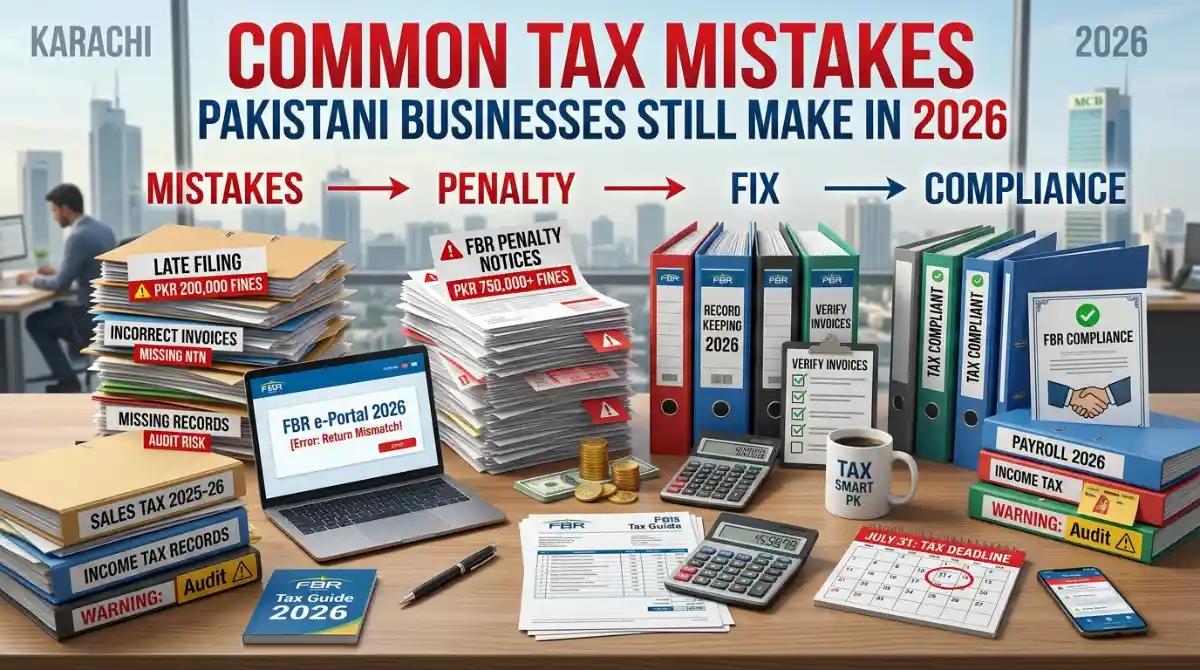
If you run a business in Pakistan, taxes are probably the one thing that keeps you up at night. And honestly? That stress is not without reason. Every year, thousands of businesses — from small shops in Lahore to growing startups in Islamabad — end up paying heavy penalties, receiving FBR audit notices, or losing money simply because of avoidable tax mistakes.
The frustrating part is that most of these mistakes are not complicated. They are not about tricky tax loopholes or obscure legal clauses. They are basic errors — wrong filing, missed deadlines, poor bookkeeping — that any business can fix with the right knowledge and guidance.
In this article, we are going to walk through the most common tax mistakes Pakistani businesses still make in 2026, why they happen, and exactly what you can do to avoid them. Whether you are a startup founder, an SME owner, or a finance professional looking to serve clients better, this guide is for you.
What Is Tax Compliance and Why Does It Matter for Pakistani Businesses?
Tax compliance in Pakistan means fulfilling all your legal obligations under the Income Tax Ordinance 2001 and the Sales Tax Act 1990. This includes registering with FBR, getting your NTN number, filing income tax and sales tax returns on time, maintaining proper financial statements, and deducting withholding tax where required.
When businesses skip or mishandle any of these steps, the Federal Board of Revenue (FBR) has the authority to levy penalties, freeze accounts, blacklist businesses, or send audit notices through the IRIS FBR portal.
Here is the truth: tax compliance is not just a legal requirement. It is a business survival strategy. Being on the FBR Active Taxpayer List opens doors — better banking terms, government contracts, lower withholding tax rates, and a stronger reputation with clients and investors.
The Most Common Tax Mistakes Pakistani Businesses Make in 2026
1. Not Registering for NTN or STRN on Time
This is where it all begins — and where many businesses already fall behind. Thousands of small businesses in Karachi, Lahore, and Islamabad still operate without a valid NTN (National Tax Number) or STRN (Sales Tax Registration Number).
Some business owners think they are too small to register. Others simply do not know the process. But here is the reality: if your business turnover exceeds PKR 10 million, you are legally required to register for sales tax. And anyone earning income in Pakistan should be registered with FBR.
Without an NTN, you cannot file returns, claim tax deductions, or appear on the Active Taxpayer List. You are essentially invisible to the formal economy — and that invisibility has a price.
Fix it: Register through the IRIS FBR portal at iris.fbr.gov.pk. The process is online and straightforward. If you need help, a certified tax advisor in Islamabad, Karachi, or Lahore can walk you through it in a single session.
2. Missing Tax Return Filing Deadlines
Ask any tax consultant in Pakistan and they will tell you — missed deadlines are the number one cause of unnecessary penalties. The income tax return filing deadline for businesses in Pakistan is typically September 30 of each year, though FBR sometimes extends it.
But here is what many business owners do not realise: even if you have no taxable income, you still need to file a nil income tax return. Skipping it puts you off the Active Taxpayer List, which means higher withholding tax on your banking transactions, property purchases, and vehicle registrations.
Missing the sales tax return deadline — which is the 18th of every month for the previous month — also invites a penalty of PKR 10,000 per default under the Sales Tax Act.
Fix it: Set calendar reminders for every major FBR tax return deadline. Better yet, work with a professional tax accountant who tracks these dates for you. You can also read ICT's detailed guide on steps to filing an income tax return in Pakistan 2026 to understand the full process.
3. Poor Bookkeeping and Messy Financial Records
Here is a mistake that quietly destroys businesses: not maintaining proper books of accounts. Bookkeeping and accounting are the foundation of accurate tax filing. Without clean records, you cannot calculate your actual taxable income, you end up overpaying or underpaying tax, and you have nothing to present if FBR sends an audit notice.
Many SMEs in Pakistan still rely on manual registers or basic Excel sheets. Transactions go unrecorded. Cash sales are not logged. Expenses are mixed with personal spending. When tax season arrives, they are scrambling to reconstruct months of financial data.
This chaos leads directly to tax filing mistakes — wrong income figures, missed deductions, incorrect sales tax calculations, and ultimately, penalties.
Fix it: Use accounting software from day one. Maintain a proper profit and loss statement, balance sheet, accounts payable, and accounts receivable records. Follow GAAP accounting principles. If you cannot manage this in-house, hire a bookkeeping service or a staff accountant. The cost of good bookkeeping is always less than the cost of an FBR penalty.
4. Ignoring Withholding Tax Obligations
Withholding tax in Pakistan is a pay-as-you-earn system where certain businesses are required to deduct tax at source from payments they make — whether to suppliers, contractors, employees, or service providers — and deposit it with FBR.
The mistake most businesses make is either not deducting withholding tax at all, deducting it at the wrong rate, or failing to deposit it within the prescribed time. This is one of the most common reasons businesses receive audit notices from FBR.
Under the Income Tax Ordinance 2001, withholding agents who fail to deduct or deposit the correct amount face penalties and can even be held personally liable.
Fix it: Understand which of your payments require withholding tax deductions. Keep a withholding tax schedule. File your monthly withholding tax statements with FBR on time. If this feels overwhelming, ICT's blog on withholding tax in bank transactions 2026 is an excellent starting point.
5. Wrong or Incomplete Sales Tax Return Filing
Sales tax errors are incredibly common, especially among businesses that are newly registered or operating across multiple provinces. The common errors include:
- Reporting incorrect turnover figures
- Claiming input tax adjustment on ineligible purchases
- Not attaching the correct Annexure J for sales tax returns
- Filing returns for the wrong tax period
- Not reconciling sales tax with income declared in income tax returns
Provincial Revenue Authorities — including PRA in Punjab and SRB in Sindh — also have their own sales tax return requirements for services, and businesses operating in multiple provinces often get confused about which authority they need to file with.
Fix it: Make sure your sales tax return filing is done by someone who actually understands the Sales Tax Act 1990. A certified tax advisor or tax accountant with practical training will know how to handle input-output reconciliation, provincial obligations, and FBR's digital invoicing requirements. You can also explore ICT's Master Sales Tax course at ict.net.pk/courses/master-sales-tax to build your own knowledge.
6. Not Paying Advance Tax
Many business owners in Pakistan do not realise they are required to pay advance tax in quarterly instalments throughout the year — not just at the end. Under the Income Tax Ordinance, if your tax liability in the previous year exceeded a certain threshold, you are required to pay advance tax.
Skipping advance tax payments leads to interest charges under Section 205 of the Income Tax Ordinance and creates a large tax liability at the time of filing that many businesses are not prepared to handle.
Fix it: Work with a tax consultant to calculate your advance tax liability at the beginning of each tax year. Build these payments into your cash flow planning. This is basic tax planning for businesses in Pakistan — something that certified tax advisors do as part of their core service.
7. Mixing Personal and Business Finances
This is especially common among sole proprietors and small business owners. Personal expenses get charged to the business account. Business income goes into a personal account. Loans between the owner and the business go unrecorded.
From a tax perspective, this creates serious problems. FBR looks at your bank statements during an audit. Unexplained deposits can be treated as undeclared income. Personal expenses claimed as business deductions can be disallowed, leading to a higher tax liability.
Fix it: Open a separate business bank account. Keep all business transactions separate from personal ones. Document everything — loans, transfers, drawings — properly. This single habit will save you enormous trouble during tax filing and in the event of an FBR audit.
8. Failing to Declare All Sources of Income
Some business owners declare only their main business income and forget — or deliberately avoid — declaring income from rental properties, dividends, capital gains on property sales, freelancing, or interest income on bank accounts.
FBR has been increasingly aggressive in cross-matching data from SECP, banking institutions, property registration authorities, and the Pakistan Telecommunication Authority. In 2026, with FBR's digital transformation well underway, hiding income is significantly riskier than it was even three years ago.
Fix it: Declare all income honestly. Remember that different income types are taxed differently — rental income, dividend income, capital gains on property, and business income all have their own tax slabs and treatment under the Income Tax Ordinance. A certified tax advisor can help you structure your declarations correctly and legally minimise your tax liabilities through legitimate tax planning.
9. Not Responding to FBR Audit Notices
Receiving an FBR audit notice is stressful, and many business owners' first instinct is to ignore it and hope it goes away. It does not. Ignoring an audit notice under Section 114 or a show-cause notice leads to ex-parte assessments, where FBR makes its own estimates of your income — often significantly higher than your actual figures — and raises a demand accordingly.
You have the right to respond to every audit notice, present your documents, and challenge any incorrect assessment. But you need to do this within the prescribed timeframes.
Fix it: Never ignore an FBR audit notice. Gather your financial statements, bank statements, tax returns, and invoices immediately. Engage a tax consultant or tax lawyer to represent you. Read ICT's practical guide on how FBR audit notices work in Pakistan to understand your rights and obligations.

Common Tax Mistakes Pakistani Businesses Still Make in 2026
10. Not Using Professional Tax Advisory Services
Perhaps the biggest mistake of all: trying to handle complex tax matters without professional help. Tax law in Pakistan is detailed, frequently amended, and increasingly digital. What was true in 2023 may not be true in 2026. Tax legislation changes with every budget. FBR introduces new requirements — like digital invoicing and e-filing mandates — regularly.
A certified tax advisor in Islamabad, Karachi, or Lahore does not just file your returns. They help you with tax planning, ensure compliance with the latest tax legislation, advise on corporate structure for tax efficiency, and represent you before FBR when needed. The fee you pay a tax professional is almost always far less than the penalties you avoid.
If you want to understand what professional tax advisory really looks like, explore the Certified Tax Advisor course at ICT — the Institute of Corporate and Taxation — which trains professionals to handle exactly these situations.
Tax Compliance Checklist for Pakistani Businesses in 2026
Before we get to the FAQs, here is a quick checklist every business should review:
- NTN registered and active on FBR portal
- STRN obtained if turnover exceeds PKR 10 million
- Annual income tax return filed before September 30 deadline
- Monthly sales tax returns filed by the 18th of each month
- Withholding tax deducted from applicable payments and deposited on time
- Monthly withholding statements filed with FBR
- Advance tax paid in quarterly instalments if applicable
- Proper books of accounts maintained throughout the year
- All income sources declared — business, rental, dividend, capital gains
- FBR audit notices responded to within prescribed time
- Super tax paid if applicable (for large businesses)
- Appearing on the FBR Active Taxpayer List
Why Pakistani Businesses Struggle With Tax Compliance
The honest answer is: lack of knowledge and lack of professional support.
Many business owners in Lahore, Islamabad, Rawalpindi, Karachi, and other cities grew their businesses on hustle and hard work — not formal financial training. Tax law was never part of their education, and they often rely on informal advice from accountants who themselves may not be up to date with the latest FBR requirements.
This is why institutions like ICT (Institute of Corporate and Taxation) exist. ICT offers Pakistan's most comprehensive tax training, including the Certified Tax Advisor course, Advanced Taxation and Litigation, and Master Sales Tax programs — all taught with practical, hands-on FBR filing experience. Whether you want to manage your own business taxes or build a career as a tax professional, ICT's programs give you real-world skills.
According to the World Bank, countries with stronger tax compliance systems see better economic development outcomes — and Pakistan's tax-to-GDP ratio has historically been among the lowest in the region, which is directly linked to widespread non-compliance and filing errors.
The Role of a Certified Tax Advisor in Avoiding These Mistakes
A certified tax advisor in Pakistan does far more than file paperwork. They serve as your financial compliance partner — someone who understands tax law, monitors changes in tax legislation, helps you plan your taxes strategically, and stands by your side if FBR ever comes calling.
Businesses that work with professional tax consultants in Islamabad, Karachi, and Lahore consistently report fewer penalties, smoother audits, and better financial planning outcomes. The role of a tax accountant extends to financial advisory, compliance management, and strategic business guidance.
If you want to understand what the career of a tax professional looks like from the inside, ICT's blog on how to become a tax accountant is a great read — whether you are a business owner or someone considering a career shift.
Frequently Asked Questions (FAQs)
What are the most common tax mistakes Pakistani businesses make in 2026?
The most common tax mistakes include missing FBR filing deadlines, not maintaining proper bookkeeping records, ignoring withholding tax obligations, filing incorrect sales tax returns, mixing personal and business finances, and failing to declare all income sources. These errors lead to FBR penalties, audit notices, and removal from the Active Taxpayer List.
What happens if a business makes a tax filing mistake in Pakistan?
FBR can levy a penalty of PKR 10,000 per default for late sales tax returns, charge default surcharge on unpaid taxes, initiate an audit, or in serious cases blacklist the business. Responding proactively to any FBR notice is critical — ignoring it almost always makes the situation worse.
How can Pakistani businesses avoid FBR audit notices?
File all returns on time, maintain clean and accurate financial records, declare all income sources, pay withholding tax correctly, and reconcile your sales tax with your income tax declarations. Hiring a certified tax advisor to review your filings before submission is the single most effective way to avoid triggering an audit.
What is the deadline for business tax returns in Pakistan 2026?
The general deadline for income tax return filing for businesses in Pakistan is September 30 each year. Monthly sales tax returns are due by the 18th of the following month. FBR sometimes grants extensions — stay updated through the FBR IRIS portal or follow ICT's blog for timely announcements.
Do I need a tax consultant to file my business taxes in Pakistan?
You are not legally required to hire a consultant, but for businesses with any level of complexity — multiple income sources, employees, sales tax registration, or import/export activities — professional guidance is strongly recommended. The cost of a tax consultant is negligible compared to the penalties and lost opportunities that come from tax errors.
What is the role of a tax accountant in Pakistan for businesses?
A tax accountant in Pakistan prepares your financial statements, calculates your tax liability, files your income tax and sales tax returns, manages withholding tax obligations, advises on tax planning strategies, and represents you before FBR if needed. Senior tax accountants at larger firms also provide advisory services on corporate structure, transfer pricing, and tax-efficient business strategies.
Conclusion: Stop Losing Money to Avoidable Tax Mistakes
Tax compliance in Pakistan in 2026 is not optional — it is foundational to running a legitimate, sustainable business. The mistakes we have covered in this article are not rare or unusual. They happen to businesses every single day, in every city from Islamabad to Karachi, from Lahore to Peshawar.
The good news is that every single one of these mistakes is preventable with the right knowledge and the right support.
If you are a business owner who wants to stop worrying about FBR penalties and start making smarter financial decisions, consider working with a certified tax advisor. And if you want to build that expertise yourself — whether to manage your own business taxes or to launch a career as a tax professional — there is no better investment than proper training.
Book a seat in the Advanced Taxation Course offered by ICT — the Institute of Corporate and Taxation. ICT is Pakistan's number one tax training institute, with programs in Islamabad and available online across Pakistan. Their Certified Tax Advisor course, Advanced Taxation and Litigation program, and Master Sales Tax course are trusted by thousands of students and professionals nationwide.
Visit ict.net.pk/courses today and take the first step toward complete tax compliance and a stronger financial future for your business.
Comments (0)
No comments yet. Start the conversation!
Leave a Reply
Your email address will not be published. Required fields are marked *