Do You Need an Accounting Background for Tax Courses?
The honest answer might surprise you — and it could change your entire career path.
Every week, dozens of people ask the same question before enrolling in a tax course: "Do I need an accounting degree first?" Some are fresh graduates, some are career switchers, and some are working professionals in Pakistan, the UK, Canada, or the US who simply want to add a high-income skill. The fear of not having the "right" background holds too many people back from a genuinely rewarding career.
Let's clear the air completely — with facts, real examples, and a clear roadmap for anyone starting from zero.
What Exactly Is a Tax Course — and What Does It Teach?
Before we answer the big question, it helps to understand what tax preparation courses actually cover.
A tax course teaches you how to understand tax laws, calculate taxable income, file returns, and advise individuals or businesses on compliance and planning. Depending on the level, you'll learn about income tax, sales tax, deductions, credits, payroll tax, and business tax fundamentals.
In Pakistan, tax courses offered by institutes like the Institute of Corporate and Taxation (ICT) cover practical skills like FBR IRIS portal usage, income tax return filing, sales tax registration, and withholding tax management. Internationally focused courses dive into IRS rules in the US, HMRC regulations in the UK, CRA guidelines in Canada, or ZATCA rules in Saudi Arabia.
What these courses don't require? A four-year accounting degree.
Do You Really Need an Accounting Background for Tax Courses?
No — and this is not just a motivational statement. It is the practical reality of the tax profession worldwide.
Tax preparation is a specialized field that is related to accounting but is not the same thing. Accounting deals with recording, classifying, and summarizing financial transactions. Taxation, on the other hand, focuses on applying tax laws to those financial records to ensure compliance and minimize liability.
Think of it this way: a doctor and a pharmacist both work in healthcare, but you don't need a medical degree to become a pharmacist. Similarly, you don't need a full accounting degree to become a competent tax preparer or certified tax advisor.
The IRS itself confirms this through programs like the Annual Filing Season Program (AFSP) and the VITA (Volunteer Income Tax Assistance) program, both of which allow individuals without formal accounting education to become certified tax professionals after completing approved training.
In Pakistan, the FBR (Federal Board of Revenue) does not mandate an accounting degree to register as a tax practitioner. What matters is demonstrated knowledge of tax law, compliance procedures, and practical filing skills — all of which you gain through a structured tax certification course.
Who Actually Enrolls in Tax Courses? (Real-World Profiles)
To make this more concrete, here are the types of people who successfully complete tax courses every year without any accounting background:
Commerce and Arts Graduates — Students from non-accounting fields like business administration, economics, journalism, or even fine arts enroll in tax courses and go on to build successful practices.
Freelancers and Self-Employed Professionals — A graphic designer or software developer who wants to manage their own taxes or offer bookkeeping adjacent services to international clients.
Homemakers Re-entering the Workforce — Many women in Pakistan and elsewhere have used short tax certification programs to start home-based tax consultancy services.
Government Employees Seeking Promotion — Civil servants who want to move into taxation departments within FBR, excise, or revenue bodies.
Career Switchers from Unrelated Fields — Teachers, engineers, and former retail workers who want higher-income, knowledge-based careers.
Small Business Owners — Shopkeepers, traders, and entrepreneurs in Islamabad, Lahore, and Karachi who want to manage their own FBR compliance without paying a consultant for every small task.
All of these people started without accounting backgrounds. Many are now certified tax advisors running their own practices or working with international clients online.
What Skills Do You Actually Need Before Starting a Tax Course?
If accounting knowledge isn't required, what is? Here's an honest, practical breakdown of what helps:
Basic Numeracy — You don't need advanced mathematics. If you can work with percentages, add columns of numbers, and understand ratios, you have enough math for most tax courses. The real skill is logical thinking, not calculus.
Reading Comprehension — Tax law is written in precise language. The ability to read carefully and understand what a clause means in practical terms is genuinely valuable.
Computer Literacy — Most modern tax preparation is done through software like TurboTax, TaxAct, Drake Tax, or Pakistan's FBR IRIS portal. Being comfortable with a computer and online forms is necessary.
Attention to Detail — Errors in tax filing can lead to penalties. A careful, methodical mindset matters more than any academic qualification.
Willingness to Learn Tax Law — Tax codes change every year. The most successful tax professionals are those who commit to continuous learning, whether through continuing education credits, online updates, or professional memberships.
That's the entire prerequisite list. Notice what's not on it: a CPA certification, an accounting degree, bookkeeping experience, or any formal financial qualification.
Accounting vs Taxation — Understanding the Real Difference
One of the biggest misconceptions is that accounting and taxation are the same field. They overlap, but they are distinct disciplines with different skill sets, career paths, and educational requirements.
Accounting (GAAP-based) is about recording what happened financially — tracking income, expenses, assets, and liabilities according to standardized rules. A CPA spends years learning financial reporting, auditing, and management accounting.
Tax accounting focuses specifically on how tax law applies to those financial records. A tax preparer or certified tax advisor understands tax codes, deductions, exemptions, and compliance procedures. You work with the output of accounting records, not necessarily creating those records yourself.
The CPA vs tax preparer difference is significant. A CPA takes years of university education, passes a demanding multi-part exam, and maintains licensure through continuous education. A certified tax preparer can be licensed and working in months, often through a focused tax certification course.
This doesn't make tax preparation easier — it makes it differently specialized. And for many career goals, the tax preparer route offers faster entry, lower upfront cost, and strong income potential.
What Types of Tax Courses Are Available for Beginners?
The good news is that the tax education landscape has expanded enormously. Whether you're in Islamabad or New York, you have access to structured programs that start from absolute basics.
Certificate Programs in Taxation — Short-term, focused courses that cover core tax concepts and lead to a recognized credential. ICT's Certified Tax Advisor course is a strong example for Pakistani students, covering everything from NTN registration to advanced tax planning. You can explore it at Certified Tax Advisor Course.
Diploma in Taxation — More comprehensive programs that cover multiple tax types (income, sales, corporate) and often include practical filing practice.
International Taxation Courses — For those targeting global clients or overseas jobs, specialized programs cover US taxation, UK taxation (HMRC), Canadian taxation (CRA), UAE VAT, and Saudi ZATCA rules. ICT offers dedicated courses for all of these markets, including USA Taxation , UK Taxation, and Canadian Taxation course.
Advanced Taxation and Litigation — For those who want to move beyond filing into dispute resolution, audit response, and tax planning. ICT's advanced program is designed for professionals ready to handle complex cases.
Self-Paced Online Tax Courses — Platforms like Coursera, Udemy, and H&R Block's Tax Institute offer self-paced programs for learners worldwide. These are excellent for supplementary learning but may not replace locally accredited certification for practicing in regulated markets.
The Tax Preparer Career Path — No Degree Needed
Let's talk about what you can actually do after completing a tax certification course, even without an accounting background.
Tax Preparer (Entry Level) — File individual and small business tax returns for clients. In the US, you need a PTIN (Preparer Tax Identification Number) from the IRS, which has no educational prerequisites. In Pakistan, you can register with FBR and begin offering services immediately after completing recognized training.
Enrolled Agent (EA) — In the US, this is a federally licensed tax professional who can represent taxpayers before the IRS. You earn this by passing the IRS Special Enrollment Examination — no accounting degree required, just study and preparation.
Certified Tax Advisor (CTA) — In Pakistan and many other markets, completing a recognized CTA program from an institute like ICT gives you the credential to practice professionally and command higher fees.
Tax Consultant for Freelancers — One of the fastest-growing niches in Pakistan is helping freelancers registered on Upwork, Fiverr, and similar platforms manage their FBR compliance, filer status, and foreign income declarations.
International Tax Professional — With courses in US, UK, Canadian, or UAE taxation, Pakistani professionals are increasingly working with overseas accounting firms and international clients remotely. ICT's blog on working with US accounting firms covers this opportunity in detail.
Tax Department Jobs — Government positions in excise and taxation departments, FBR, and provincial revenue authorities often value practical tax knowledge and formal certification over accounting degrees specifically.
As for salary, the tax professional salary in Pakistan ranges from PKR 50,000 per month for entry-level roles to well over PKR 300,000 for experienced consultants. Internationally, tax preparers in the US earn between $40,000 to $80,000 annually, while Enrolled Agents and senior specialists earn significantly more. ICT's detailed breakdown is available at Tax Profession Salary In Pakistan.
Why Pakistan Is a Particularly Strong Market for Tax Professionals Right Now
If you're based in Pakistan, the timing for entering the tax profession has rarely been better. The FBR's ongoing digital transformation, including the IRIS 2.0 portal rollout, mandatory e-invoicing, and stricter enforcement of the Active Taxpayer List (ATL), means that millions of individuals and businesses urgently need qualified tax help.
The non-filer penalty escalation in 2026 (covered extensively at FBR non filer panelties 2026) has pushed even reluctant taxpayers to seek professional assistance. The government's push for broadening the tax base means this demand is structural, not temporary.
For students and professionals in Islamabad, Lahore, and Karachi specifically, local institutes like ICT provide practical, hands-on training in FBR systems that online international platforms simply cannot replicate. The combination of FBR-specific knowledge and practical IRIS portal skills makes locally trained tax professionals highly employable immediately after completing their course.

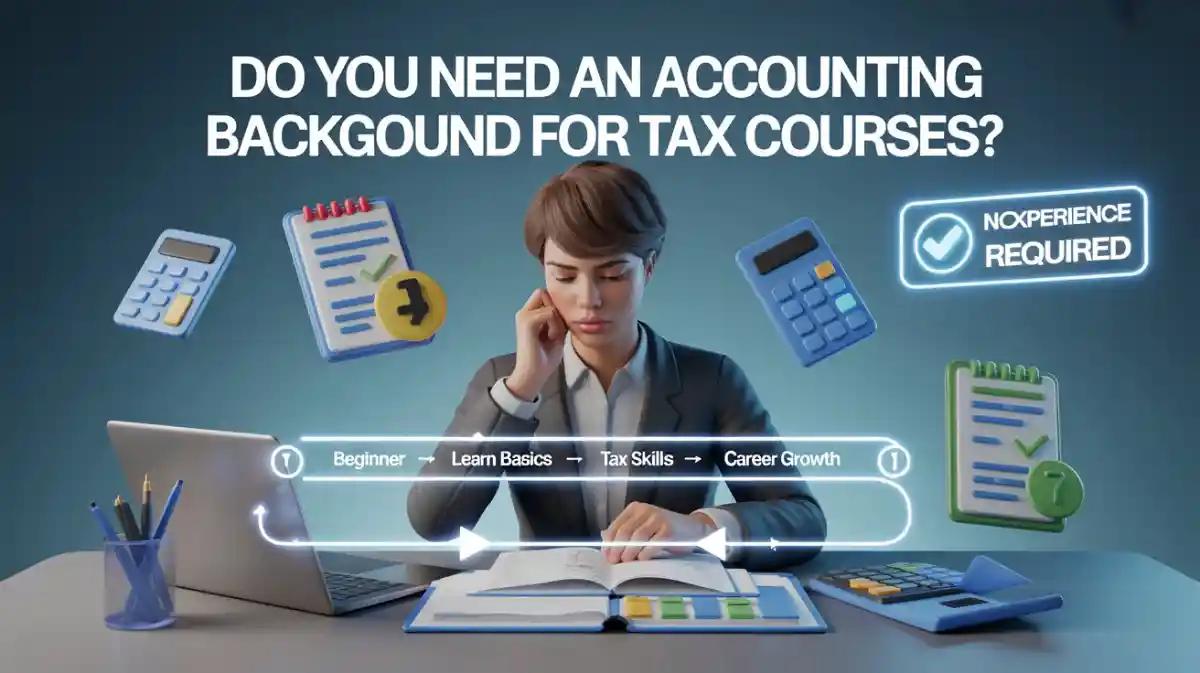
Do You Need an Accounting Background for Tax Courses
How to Start a Tax Career With No Experience — A Practical Roadmap
Here is a clear, step-by-step path for someone starting from zero:
Step 1 — Choose Your Market Focus. Decide whether you want to specialize in Pakistan taxation (FBR), US taxation (IRS), UK taxation (HMRC), Canadian taxation (CRA), or UAE/Saudi taxation. Each has its own regulatory framework and career opportunities.
Step 2 — Enroll in a Structured Certification Course. Don't try to learn from scattered YouTube videos and blog posts. A structured program gives you a curriculum, expert instruction, and a recognized credential. ICT's range of courses covers all major markets under one roof.
Step 3 — Practice With Real Cases. The difference between a course graduate and a confident professional is hands-on practice. Choose programs that include practical filing exercises, real case studies, and software training.
Step 4 — Get Registered. In Pakistan, register with FBR and ensure your own filer status is active. In the US, apply for your PTIN. In the UK, register with HMRC as a tax agent. This legitimizes your practice immediately.
Step 5 — Build Your Client Base. Start with your network — family businesses, freelancer friends, local shops. Offer your services at competitive rates initially to build reviews and referrals. ICT's guide on starting a tax freelancing business at Start Tax Freelancing In Pakistan is an excellent resource for this phase.
Step 6 — Continue Learning. Tax laws change annually. Continuing education for tax preparers is not optional — it's the foundation of long-term credibility and career growth.
Why Choose ICT for Your Tax Education?
The Institute of Corporate and Taxation (ICT) stands out in Pakistan's tax education landscape for several reasons that directly benefit students without accounting backgrounds.
The curriculum is built for practical competence, not academic theory. From day one, you work with real FBR portals, actual tax forms (income tax returns, sales tax returns, withholding statements), and real-world case scenarios. You learn by doing, not by memorizing.
The faculty includes active tax practitioners, not just teachers. This means the knowledge you receive is current, tested in the field, and directly applicable.
ICT covers more markets than any comparable institute in Pakistan — from FBR taxation to US IRS rules, Canadian CRA guidelines, UK HMRC compliance, UAE VAT, and Saudi ZATCA — all under one roof with dedicated courses and practical training. This breadth means you can specialize or diversify as your career demands.
And crucially, ICT actively supports students without accounting backgrounds. The courses are designed with progressive difficulty — starting from taxation basics and building toward advanced tax planning and litigation. You don't need prior knowledge. You just need the commitment to learn.
Explore the full range of courses and find the program that matches your goals.
Frequently Asked Questions
Do I need a degree to become a tax preparer? No. In most countries, including Pakistan, the US, UK, and Canada, you do not need a university degree to become a tax preparer. What you need is recognized training and, depending on your jurisdiction, registration with the relevant tax authority (FBR in Pakistan, IRS in the US, HMRC in the UK).
Can I take tax courses without prior accounting knowledge? Yes, absolutely. Most reputable tax certification programs — including those offered by ICT — are designed to start from the fundamentals. No prior accounting, bookkeeping, or financial knowledge is assumed. The curriculum builds your understanding progressively from basic tax concepts to advanced compliance skills.
Is tax preparation the same as accounting? No. Accounting involves recording and reporting financial transactions according to standardized rules (GAAP). Tax preparation focuses specifically on applying tax law to financial data to calculate tax liability and ensure compliance. They are related but distinct disciplines requiring different skills and training.
How long does a basic tax course take? Most certificate-level tax courses run between 4 to 12 weeks, depending on the program intensity and scope. ICT's core certification courses are structured to be completed in a focused period, with both weekday and weekend options to accommodate working professionals and students.
How much math is required in tax courses? Less than most people expect. Tax preparation involves arithmetic — addition, subtraction, percentages, and ratios — rather than advanced mathematics. If you're comfortable with basic calculations on a calculator or spreadsheet, you have sufficient math skills for tax course work.
What is the IRS Annual Filing Season Program? The AFSP is a voluntary IRS initiative that allows non-credentialed tax preparers in the US to complete a set number of continuing education hours each year and receive an Annual Filing Season Program Record of Completion. It establishes limited representation rights before the IRS and helps preparers demonstrate professionalism to clients — all without requiring an accounting degree or CPA license.
Can bookkeepers take tax courses? Yes — and bookkeepers are often excellent candidates for tax courses because they already understand financial records and business transactions. Their bookkeeping background complements tax training well, and many bookkeepers use tax certification to expand their service offerings and increase their income significantly.
Conclusion — Your Accounting Background Is Not Your Limit
The question "do I need an accounting background for tax courses?" has a clear answer: No, you don't.
What you need is curiosity, consistency, and a willingness to learn a skill that the world — including Pakistan's rapidly expanding formal economy — desperately needs right now. Tax knowledge is one of those rare skills that is immediately monetizable, professionally respected, and impossible to outsource to automation entirely.
Whether you're a fresh graduate in Islamabad, a freelancer in Karachi, a career switcher in Lahore, or a Pakistani professional exploring remote work for US or UK clients, a tax certification course is one of the smartest investments you can make in your career right now.
Don't wait for the "perfect" background that doesn't actually exist.
Book a seat in the Advanced Taxation Course offered by ICT today. Visit Courses and take the first step toward a career that pays well, grows consistently, and gives you real independence — regardless of what you studied before.
The Institute of Corporate and Taxation (ICT) is Pakistan's leading tax education provider, offering certified programs in Pakistan taxation, US taxation, UK taxation, Canadian taxation, UAE taxation, Saudi taxation, and more. All courses are designed for beginners and experienced professionals alike.
Comments (0)
No comments yet. Start the conversation!
Leave a Reply
Your email address will not be published. Required fields are marked *