
Why Pakistani Students Choose Import Export Careers in 2025
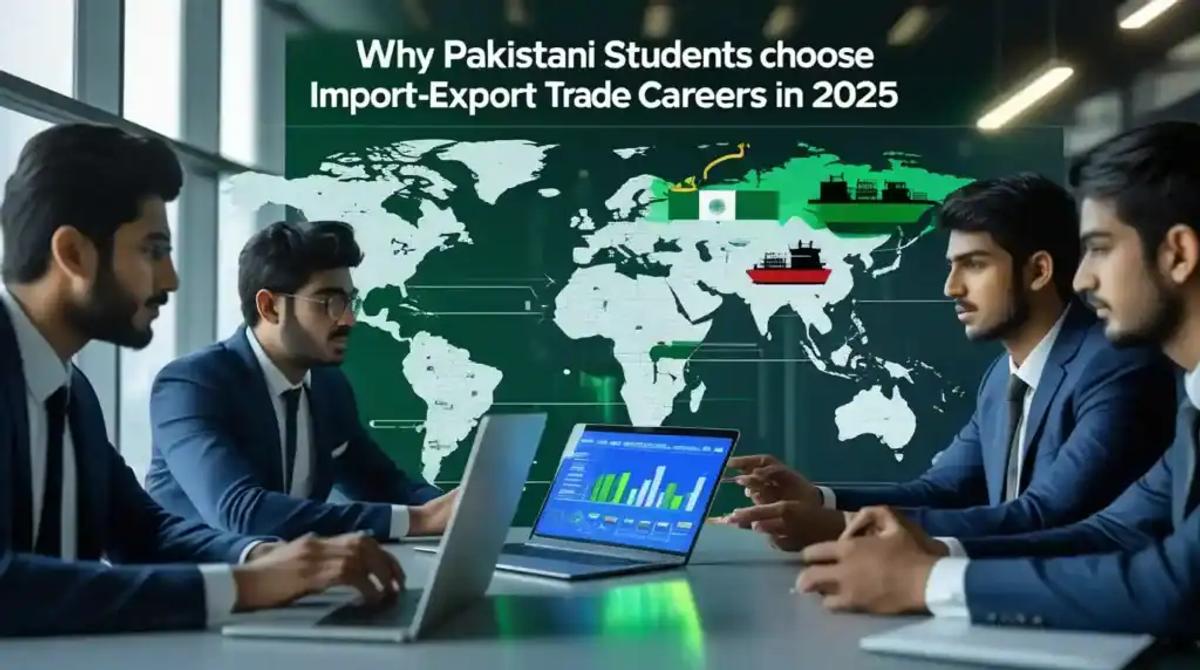
Why Pakistani Students Choose Import Export Careers in 2025
Pakistan is changing fast — and so are the career choices of its students. In 2025, thousands of young Pakistanis are stepping away from the conventional doctor-engineer path and entering the exciting world of international trade. An import export career in Pakistan 2025 is no longer reserved for business tycoons or old-school traders. It is now a full-blown professional field with real jobs, competitive salaries, and an extraordinary future.
Whether you are a fresh graduate from Karachi, a commerce student in Lahore, or a young entrepreneur in Sialkot, this career path has something massive to offer. The global trade market is worth trillions of dollars, and Pakistan is sitting right at its gateway — especially with CPEC expansion, Gwadar port development, and rapidly growing e-commerce exports. This article breaks down exactly why import export jobs for Pakistani students are becoming one of the top career choices in 2025.
What Is Import Export as a Career?
Import export is the business of buying and selling goods across international borders. As a professional career, it covers everything from trade documentation and customs clearance to logistics, freight forwarding, trade finance, and supply chain management.
When professionals talk about an international trade career in Pakistan, they refer to roles such as Import/Export Manager, Customs Clearance Agent, Freight Forwarding Executive, Trade Finance Officer, Logistics Coordinator, Supply Chain Analyst, Commercial Attaché, and Export Documentation Officer. These are real, in-demand positions that companies across Karachi, Lahore, Islamabad, Sialkot, and Faisalabad are actively hiring for right now.
To understand the full picture of this industry, explore the Master Import and Export Course at ICT — one of the most comprehensive and practical trade training programs available in Pakistan today.
Why Is the Scope of Import Export So Strong in Pakistan in 2025?
Pakistan's trade landscape in 2025 is more promising than at any point in recent history. Pakistan's total exports have crossed $30 billion, and the government is aggressively pushing to grow this number further. Key export products include textiles, rice, leather goods, surgical instruments, and sports goods — industries that are constantly hiring trained professionals.
The CPEC (China-Pakistan Economic Corridor) has added an entirely new dimension to trade careers. Gwadar port jobs in 2025 are rising sharply, and Torkham border trade careers are receiving serious investment. Peshawar-based trade career opportunities connected to CPEC are multiplying because of Central Asian market access. These developments mean that the demand for skilled trade professionals is now spreading far beyond Karachi.
Digital trade is also exploding. Amazon FBA Pakistan sellers and Alibaba sourcing operations are creating thousands of new roles for young, tech-savvy students who understand international trade alongside e-commerce. Add to this the government's trade support mechanisms — TDAP Pakistan, the Export Promotion Bureau, State Bank of Pakistan export policy reforms, the EFS (Export Facilitation Scheme), and the DLTL (Duty and Tax Remission for Exporters) — and you have a market that is actively rewarding people who enter this field with proper training.
Top Reasons Pakistani Students Are Choosing Import Export Careers
1. High Salary Potential
Let us talk money. Import export job salaries in Pakistan per month vary by role and experience, but here is a realistic overview:
Entry-level Export Documentation Officers typically earn between PKR 40,000 and PKR 70,000 per month. Import/Export Executives earn PKR 60,000 to PKR 120,000. Senior Trade Managers command PKR 150,000 to PKR 350,000 per month. Freelance trade consultants working with international clients can earn USD 500 to USD 2,000 per month.
For students planning their financial future, the Pakistan Freelance Tax Calculator and Pakistan Income Tax Calculator are free, practical tools that help you understand your tax obligations as your income grows.
2. CPEC Is Creating Thousands of New Trade Jobs
CPEC is not just an infrastructure project. It is an economic revolution that is actively reshaping Pakistan's job market. New industrial zones, Gwadar port expansion, and trade corridors connecting Pakistan to China, Central Asia, and the Middle East have opened entire sectors of employment — from customs clearance and trade finance to freight forwarding and supply chain management. How CPEC is creating trade jobs for Pakistani youth is now one of the most searched career topics in the country.
3. Pakistan's Export Sector Is Actively Expanding
Pakistan's top export industries in 2025 — textiles, rice, leather, surgical instruments, and sports goods — are always hiring. Faisalabad textile export careers, Gujranwala export industry jobs, and import export jobs in Sialkot are growing every quarter. These cities have been export powerhouses for decades, and they need fresh talent to sustain and scale their growth.
4. Global Trade Opportunities Are Now Digital
Pakistan's e-commerce export market is young and full of potential. Students today can set up Amazon FBA operations, source products through Alibaba, and sell globally — all from a laptop. This has made import export business in Pakistan incredibly accessible to young entrepreneurs who have the right knowledge and training.
5. Multiple Career Paths Under One Field
Unlike many professions with a single career ladder, an international trade career in Pakistan offers multiple directions. You can specialize in customs and regulatory compliance, freight forwarding and logistics, trade finance and letter of credit operations, export management and documentation, supply chain management, or international trade consulting. This variety means you are never locked into one path — you move based on your strengths, interests, and opportunities.
Key Skills Required for Import Export Jobs in Pakistan
Employers hiring for export management jobs, supply chain roles, and logistics positions in Pakistan look for candidates who understand Incoterms 2020 and trade documentation, can work with HS codes and tariff and customs duty structures, understand letter of credit (LC) and bill of lading processes, are familiar with WTO Pakistan trade rules and SAFTA regional trade frameworks, know SBP foreign exchange regulations, and have strong communication and negotiation skills for dealing with international buyers and suppliers.
These skills are not typically covered in depth by a conventional university degree alone. That is exactly why specialized import export diploma courses and professional training programs have become the preferred path for serious students.
Which Degree or Course Is Best for Import Export in Pakistan?
Students frequently ask which degree is best for import export in Pakistan. Formal degrees that support this career include BBA with a Finance or Supply Chain specialization, B.Com, MBA in International Business, and BS Logistics and Supply Chain Management. Several Pakistani universities now offer relevant programs, including IBA Karachi, LUMS Lahore, NUST Islamabad, and Virtual University campuses across the country.
However, many working professionals have found that a focused import export diploma course gives them the practical, job-ready edge that a general university degree cannot. Programs that teach trade documentation, customs clearance procedures, freight forwarding, and export financing from a real-world perspective are often far more valuable to employers.
If you want to enter this field quickly and confidently, explore the complete professional courses offered by ICT — including the Master Import and Export Program, which is designed to make you industry-ready in weeks, not years.
You can also explore ICT's Mastering the Stock Market Course if you want to build financial market knowledge alongside your trade expertise.
Import Export Career by City: Where Are the Best Opportunities?
Karachi — Pakistan's Trade Capital
Karachi is the undisputed heart of Pakistan's trade economy. Import export jobs in Karachi are the highest in number across the country. Karachi port logistics jobs, Karachi customs clearance roles, and hundreds of active trading companies mean fresh graduates here have a serious advantage. The Export Promotion Bureau Pakistan also has its strongest presence in Karachi.
Lahore — Growing Fast
Trade career opportunities in Lahore are expanding rapidly. With a strong manufacturing base and proximity to the Wagah border crossing, import export companies in Lahore are actively recruiting fresh graduates with practical trade skills.
Sialkot — Surgical and Sports Export Hub
Import export business in Sialkot is legendary. This city exports hundreds of millions of dollars in surgical instruments and sports goods annually. Import export jobs in Sialkot are highly specialized and consistently well-paying for candidates with proper training.
Faisalabad — Textile Export Powerhouse
Faisalabad textile export careers are among the most stable in the country. As Pakistan's textile capital, Faisalabad needs a constant supply of export documentation officers, logistics coordinators, and trade managers.
Islamabad, Gwadar, and Peshawar — Emerging Trade Cities
Logistics jobs in Islamabad are growing as more regulatory and trade bodies are headquartered in the capital. Gwadar port jobs in 2025 are set to multiply as CPEC projects reach maturity. Peshawar trade career opportunities tied to CPEC are significant given the city's role as a gateway to Afghanistan and Central Asia.
How to Start an Import Export Career After Graduation
Here is a practical roadmap for how to start an import export career in Pakistan after graduation:
Step 1 — Get the right education through a relevant degree or a focused import export diploma course.
Step 2 — Learn trade documentation fundamentals including HS codes, LC, bill of lading, and Incoterms 2020.
Step 3 — Understand Pakistani trade policy including SBP foreign exchange rules, TDAP Pakistan guidelines, and customs duty structures.
Step 4 — Gain practical experience through internships with import export companies in Karachi, Lahore, or Sialkot.
Step 5 — Learn the process of how to get an import export license in Pakistan, which involves NTN registration and Export Promotion Bureau enrollment.
Step 6 — Stay current by attending trade exhibitions in Pakistan 2025, following FPCCI updates, and monitoring TDAP announcements.
Step 7 — Enroll in a structured professional program. A course from ICT — Institute of Corporate and Taxation gives you both verified knowledge and industry-recognized credibility.
For entrepreneurs planning to launch their own import export business, the Pakistan Business Tax Calculator is a free tool that helps you calculate your tax liabilities before you begin trading.
Why Choose ICT for Your Import Export Career Training?
The Institute of Corporate and Taxation — ICT has built a strong reputation as one of Pakistan's most trusted professional training institutes. ICT offers practically designed courses that match real industry requirements, delivered by expert trainers with hands-on trade experience. Programs are affordable, flexible, and suitable for both fresh students and working professionals looking to upskill.
The Master Import and Export Course at ICT covers everything from trade documentation and customs procedures to freight forwarding, trade finance, and international market access strategies — in a format built around real job requirements.
To learn more about ICT's training philosophy and institutional background, visit the ICT About Page. For enrollment details and to speak directly with a course advisor, visit the ICT Contact Page.
Frequently Asked Questions
What is the scope of import export in Pakistan 2025? The scope is exceptionally strong. With CPEC expanding, e-commerce exports growing, and government schemes like EFS and DLTL actively promoting trade, professionals in this field are in high demand across Karachi, Lahore, Sialkot, Faisalabad, Gwadar, and beyond.
How much do import export professionals earn in Pakistan? Salaries range from PKR 40,000 per month for entry-level roles to PKR 350,000 or more for senior managers. Freelance trade consultants working with international clients earn USD 500 to USD 2,000 per month.
What qualifications are needed for import export jobs in Pakistan? A commerce or business degree is helpful, but specialized import export diploma courses are often more valued by employers. Practical skills in trade documentation, Incoterms 2020, HS codes, and customs clearance are essential.
Is international trade a good career choice for students in Pakistan? Yes, without question. Pakistan's export sector is growing, CPEC is creating new trade corridors, and digital trade is opening global markets. Skilled trade professionals enjoy strong job security, high earning potential, and genuine international career opportunities.
What role does CPEC play in import export careers in Pakistan? CPEC has created new trade routes, industrial zones, and port facilities — particularly at Gwadar. This directly translates into thousands of new roles in logistics, customs, freight forwarding, supply chain management, and trade finance tied to CPEC commerce.
How do I get an import export license in Pakistan? You need to obtain an NTN (National Tax Number), register your business, and enroll with the Export Promotion Bureau or the relevant product-specific body. ICT's trade courses walk you through this entire process in practical detail.
Which universities offer trade and logistics degrees in Pakistan? IBA Karachi, LUMS Lahore, NUST Islamabad, and the University of Karachi all offer relevant programs. For faster, more practical training, professional institutes like ICT are highly regarded across the industry.
What skills are required for import export jobs in Pakistan? Essential skills include trade documentation, letter of credit handling, bill of lading preparation, Incoterms 2020 knowledge, customs duty calculations, HS code classification, SBP forex regulation awareness, and supply chain coordination.
Conclusion: Your Trade Career Starts in 2025
Pakistan's import export industry is not just surviving in 2025 — it is growing at a pace that is creating genuine career opportunities for thousands of young professionals every year. From Karachi port to Gwadar, from Sialkot's surgical exports to Faisalabad's textile industry, the demand for trained trade professionals has never been higher.
The combination of CPEC expansion, digital trade growth, government export promotion schemes, and Pakistan's increasing global trade connections means this career will only become stronger in the years ahead. Whether you want to work in a corporate trading firm, launch your own import export business, or build an international consultancy, the time to take action is right now.
The most important step you can take today is enrolling in a course that prepares you with real, practical, industry-relevant knowledge. The Master Import and Export Course at ICT is built exactly for students and professionals who want to enter this field with confidence and competence.
Book your seat today. Visit the ICT Institute Website to explore all programs, or reach out directly through the ICT Contact Page to speak with a course advisor. Your global trade career is waiting — and 2025 is the year to start.
Comments (0)
No comments yet. Start the conversation!
Leave a Reply
Your email address will not be published. Required fields are marked *