Sales Tax vs Income Tax: Difference Explained for Beginners
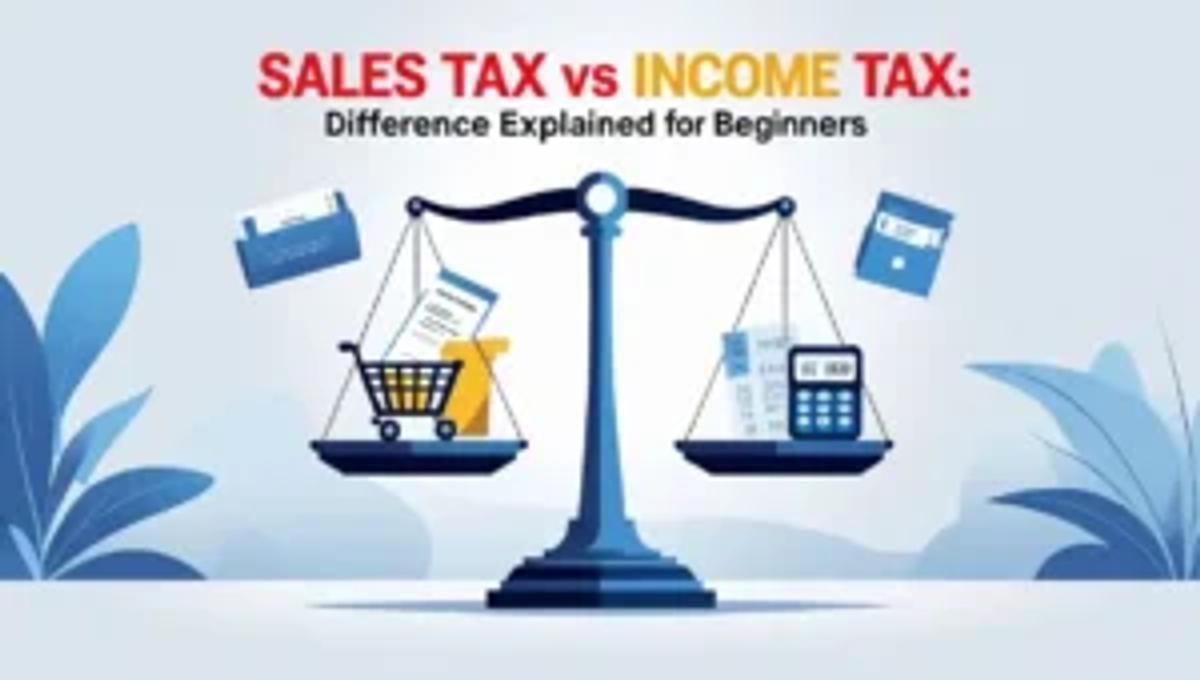
Sales Tax vs Income Tax: Difference Explained for Beginners
If you've ever looked at your paycheck and wondered why your take-home amount is less than what your employer promised — or noticed an extra charge at the checkout counter — you've already experienced two of the most common types of taxes: income tax and sales tax. Most people pay both without fully understanding how they work or why they're different.
This beginner-friendly guide breaks down the difference between sales tax and income tax in plain English. No jargon, no confusion — just clear, practical explanations that actually make sense.
What Is a Tax, and Why Do We Pay It?
Before diving into the sales tax vs income tax debate, let's quickly cover the basics. A tax is a mandatory financial contribution collected by the government — federal, state, or local — to fund public services like roads, schools, hospitals, defense, and social programs.
Every working adult and every consumer in the tax system contributes in some way. The two most common ways governments collect this money are through income tax (taxing what you earn) and sales tax (taxing what you spend). Understanding the difference between these two is one of the most important parts of tax basics every beginner should know.
What Is Income Tax? (Direct Tax Explained)
Income tax is a direct tax — meaning it's charged directly on the money you earn. Whether you're a salaried employee, a freelancer, a business owner, or an investor, the government takes a percentage of your income based on how much you make.
In the United States, income tax is collected by the IRS (Internal Revenue Service) at the federal level, and by the State Department of Revenue at the state level. You report your earnings annually using Form 1040, and employers withhold estimated taxes from every paycheck throughout the year using your W-2 form.
How Income Tax Is Calculated Step by Step
Here's a simplified version of how your income tax liability is calculated:
- Start with your gross income (total earnings before deductions)
- Subtract eligible deductions — either the standard deduction or itemized deductions
- This gives you your Adjusted Gross Income (AGI) or taxable income
- Apply the correct tax bracket based on your income level
- The result is your tax liability — what you owe
The U.S. uses a progressive tax system, meaning higher earners pay higher tax rates. For 2025, federal income tax brackets range from 10% (for the lowest earners) up to 37% (for the highest). This is the marginal rate, while your effective rate is the actual average percentage you pay on all your income.
On top of federal income tax, most employees also pay FICA taxes — which include Social Security tax (6.2%) and Medicare tax (1.45%) — automatically deducted from each paycheck.
Income Tax in Different Countries
Income tax exists in nearly every country, though the rules vary:
- In Pakistan, income tax is governed by the Income Tax Ordinance 2001 (amended up to 2024), administered by the FBR (Federal Board of Revenue). Salary slabs, withholding tax rules, and filing deadlines are defined under this law.
- In India, income tax is governed by the Income Tax Act 1961, with slab rates updated each financial year.
- In the UK, income tax rates range from 20% to 45% depending on income level.
- In Australia, the tax year runs July to June with progressive rates applied by the ATO.
- In Canada, both federal and provincial income taxes apply.
If you want to estimate your tax obligations in Pakistan, you can use this free Pakistan Income Tax Calculator to get an accurate picture of what you owe.
What Is Sales Tax? (Indirect Tax Explained)
Sales tax is an indirect tax — meaning it's not charged on what you earn, but on what you buy. Every time you purchase a product or service (in most states and countries), a percentage is added to the price at the point of sale.
The key difference here: with income tax, you pay it directly to the government. With sales tax, the seller collects it from you and then passes it on to the government. That's why it's classified as an indirect tax.
Sales tax is calculated as a percentage of the purchase price. For example, if you buy a $100 item in California (where the statewide base sales tax is 7.25%), you'll pay $107.25 at checkout. Local county taxes can push that number even higher.
How Sales Tax Works in the U.S.
Unlike income tax, which has a federal layer, sales tax in the United States is entirely a state and local matter. There is no federal sales tax. Each state sets its own rate, and local governments can add on top of that.
Some important facts about the U.S. sales tax system:
- States with no sales tax: Oregon, Montana, New Hampshire, Delaware, and Alaska (no statewide tax, though some localities charge one)
- States with no income tax: Texas, Florida, Nevada, Washington, and South Dakota — but they often make up for it with higher sales tax rates
- California has one of the highest combined sales tax rates, reaching over 10% in some counties
- New York combines state (4%) and local taxes, making the effective rate in New York City around 8.875%
- Texas charges up to 8.25% in sales tax to compensate for having zero state income tax
This is a critical concept: states that don't charge income tax often rely more heavily on sales tax to fund public services.
Sales Tax vs Income Tax: Side-by-Side Comparison
Feature
Income Tax
Sales Tax
What is taxed
Your earnings/income
Goods and services purchased
Type of tax
Direct tax
Indirect tax
Who pays
The earner
The consumer
Who collects
IRS / FBR / Revenue Dept.
Seller (retailer)
Federal level (US)
Yes
No
Rate structure
Progressive (varies by income)
Flat rate per transaction
Filing required
Yes (annually)
No (handled by seller)
Affects
Paycheck / earnings
Everyday purchases
Can be avoided legally
Via deductions/exemptions
Buy exempt items or in no-tax states
Is Sales Tax Regressive? The Fairness Debate
One of the most important policy discussions around the difference between sales tax and income tax is fairness. Income tax is progressive — meaning the more you earn, the higher percentage you pay. This is designed to reduce inequality.
Sales tax, on the other hand, is widely considered regressive. Here's why: a 10% sales tax hits a low-income earner much harder than a wealthy person. If someone earns $20,000 a year and spends $15,000 on goods, they're paying tax on 75% of their income. A millionaire spending the same $15,000? That's just 1.5% of their income. Same dollars spent, very different impact.
This is why many states exempt essential items like groceries, prescription medications, and children's clothing from sales tax — to ease the burden on lower-income families.
Do You Pay Both Sales Tax and Income Tax at the Same Time?
Yes — and most people do, every single day. You pay income tax on your salary each paycheck, and you pay sales tax every time you make a purchase. They are completely separate systems operating simultaneously.
This is also true for self-employed individuals and freelancers, who must also pay self-employment tax (covering both employer and employee portions of FICA) in addition to regular federal and state income taxes. Pakistan-based freelancers can use this Pakistan Freelance Tax Calculator to understand their obligations, and businesses can refer to this Pakistan Business Tax Calculator for corporate tax estimates.
Sales Tax vs VAT: What's the Difference?
In many countries, including Pakistan, India, the UK, and most of Europe, there is no traditional "sales tax" — instead, they use a Value-Added Tax (VAT) or Goods and Services Tax (GST).
- Sales tax is applied only at the final point of sale (when the end consumer buys)
- VAT/GST is collected at every stage of production and distribution, with businesses claiming back what they paid along the chain
In Pakistan, the equivalent is the General Sales Tax (GST), administered by the FBR. In India, the unified GST replaced multiple indirect taxes in 2017. In the UK, VAT is set at 20% on most goods and services.
How to Reduce Your Tax Burden Legally
Both taxes can be minimized through legal means:
For income tax, you can reduce your taxable income by claiming tax deductions such as mortgage interest, student loan interest, charitable contributions, and business expenses. Contributing to retirement accounts like a 401(k) also lowers your AGI.
For sales tax, you can legally avoid it by purchasing tax-exempt items, shopping in states with no sales tax, or buying certain goods through tax-exempt organizations.
Understanding these strategies is part of smart financial planning — and it's exactly the kind of practical knowledge taught in professional taxation programs.
Want to Master Taxation? Here's What You Should Do
Understanding sales tax vs income tax is just the beginning. If you're in Pakistan and want to build a real career in taxation, accounting, or finance — or if you're a business owner who wants to stop overpaying taxes — professional training can make a huge difference.
ICT — Institute of Corporate and Taxation offers Pakistan's most comprehensive taxation and corporate finance education. Whether you're a fresh graduate or an experienced professional, ICT helps you understand the Pakistani tax system inside and out.
You can explore all available programs on the ICT Courses page, including specialized programs in advanced taxation, corporate law, and import/export management. Their flagship Master Import and Export Course is especially valuable for business owners dealing with customs duties, sales tax on imports, and cross-border transactions.
Learn more about ICT or contact their team directly to book your seat today.
Frequently Asked Questions (FAQs)
What is the difference between sales tax and income tax? Income tax is a direct tax on what you earn — wages, salary, business profit. Sales tax is an indirect tax on what you buy — goods and services at the point of sale. Income tax is filed annually; sales tax is collected automatically by sellers.
Is sales tax a direct or indirect tax? Sales tax is an indirect tax. The seller collects it from the buyer and remits it to the government. The buyer bears the cost, but the seller is legally responsible for collection and payment.
Is income tax a direct or indirect tax? Income tax is a direct tax. It is levied directly on the individual's or business's income and paid directly to the government — typically through payroll withholding or annual tax filing.
Who pays sales tax — buyer or seller? The buyer pays sales tax at the point of purchase, but the seller is responsible for collecting it and sending it to the state's Department of Revenue.
Do all states charge both sales tax and income tax? No. Some states like Texas and Florida have no state income tax. States like Oregon and Montana have no sales tax. A few states have neither. Each state structures its tax system differently.
What is a regressive tax, and is sales tax regressive? A regressive tax takes a larger percentage of income from lower-income earners than from higher-income earners. Sales tax is considered regressive because everyone pays the same flat rate regardless of how much they earn, placing a proportionally heavier burden on those with less income.
What is the federal income tax rate for 2025? For 2025, U.S. federal income tax rates range from 10% to 37% across seven tax brackets, depending on your filing status and taxable income. Always verify the latest brackets on the official IRS website.
How does income tax work if you're self-employed? Self-employed individuals pay both the employee and employer portions of FICA (Social Security and Medicare), known as self-employment tax. They must also make quarterly estimated tax payments to the IRS and can deduct legitimate business expenses to reduce their taxable income.
Conclusion: Two Taxes, One Goal
At the end of the day, both sales tax and income tax serve the same fundamental purpose — funding the government and public services that society depends on. But they work in completely different ways, affect different behaviors, and carry different implications for fairness and financial planning.
Income tax rewards you for earning less and encourages investment through deductions. Sales tax is simple and automatic but can disproportionately affect lower-income households. Understanding both is the foundation of smart financial literacy — whether you're a student, employee, freelancer, or business owner.
If you're serious about mastering taxation in Pakistan, don't leave it to guesswork. Book a seat in ICT's Advanced Taxation Course today and gain the skills that employers and businesses actually need. The tax system won't simplify itself — but the right education can make it simple for you.
Comments (0)
No comments yet. Start the conversation!
Leave a Reply
Your email address will not be published. Required fields are marked *