
Module Breakdown: Your Journey from Tax Basics to Expert-Level Strategy
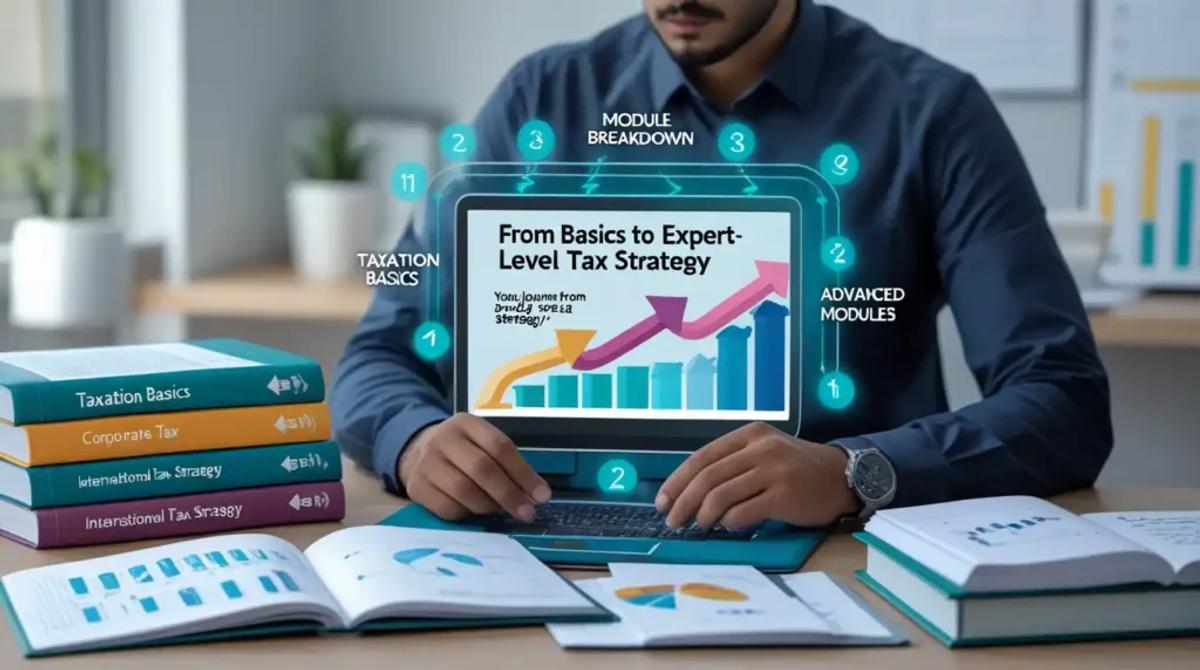
Your Tax Knowledge Journey Starts Here
Most people treat taxes like a mystery they'd rather avoid. But here's the truth — taxes are not complicated by nature. They only feel overwhelming because no one ever walked you through them properly, step by step.
Whether you're a salaried professional in Islamabad, a small business owner in Karachi, or a freelancer trying to understand your FBR obligations, this guide is your roadmap. This module breakdown covers everything from understanding tax fundamentals to mastering expert-level tax strategy — the same journey students take at the Institute of Corporate & Taxation (ICT), one of Pakistan's most trusted taxation institutes.
Let's break it down, module by module.
Why Tax Education Matters More Than Ever in Pakistan
Pakistan's tax landscape is evolving rapidly. With FBR's IRIS 2.0 portal, the updated Income Tax Ordinance 2001 (amended up to 2025), new withholding tax rules, and tightening compliance requirements, being tax-illiterate is no longer just inconvenient — it's financially dangerous.
Here's what the numbers say:
- Only 2.5 million Pakistanis file income tax returns out of a population of 240 million
- FBR collected over PKR 7.1 trillion in revenue in 2024–25
- Non-filers pay up to double the withholding tax on transactions compared to active filers
This is exactly why a structured tax education roadmap — from basics to expert strategy — isn't optional anymore. It's essential.
Module 1 — Tax Basics: Understanding How Taxes Work
Every great tax strategist starts at the same place: understanding the fundamentals.
What You'll Learn in This Module
In the first module of any strong tax planning course, you cover income tax basics explained in plain language:
- What is taxable income? — Your gross income minus allowable deductions
- Tax brackets and progressive tax system explained — In Pakistan, income tax follows a slab-based structure where higher income attracts higher rates
- Tax filing status — Are you an individual, AOP (Association of Persons), or a company?
- Difference between tax filer and non-filer under FBR rules
- FBR's IRIS portal — How to register, log in, and navigate your taxpayer profile
Pakistan-Specific Tax Basics You Must Know
Under the Income Tax Ordinance 2001, Pakistani residents are taxed on their worldwide income. The FBR uses a withholding tax mechanism on dozens of transactions — from banking to property purchases. Understanding income tax on salary, rental income, and freelance earnings is the foundation of everything that follows.
If you want to calculate your own tax liability before enrolling anywhere, try this free Pakistan Income Tax Calculator to see exactly where you stand.
Module 2 — Deductions & Credits: Stop Leaving Money on the Table
Once you understand how income tax works, the next step is learning tax deduction strategies — and this is where most people start saving real money.
Key Deductions You Should Know
- Standard deduction vs itemized deductions — Choosing the right approach matters
- Business expense deductions — Rent, utilities, salaries, and marketing can all be deducted legitimately
- Depreciation deductions — Assets used in business can be written off over time
- Home office deduction — Eligible for freelancers and remote workers
- Tax credits vs deductions — A deduction reduces your taxable income; a credit reduces your actual tax bill (even better)
What Most People Miss
The majority of taxpayers in Pakistan have no idea they can claim zakat deductions, charitable donations to approved organizations, and pension contribution deductions directly from their taxable income. These are legal tax minimization methods sitting right in the Income Tax Ordinance — untouched by most filers.
This module is a core part of the Advanced Taxation Courses at ICT, where students learn to apply deductions systematically — not guesswork.
Module 3 — Income Tax Filing: FBR, IRIS & Compliance
Understanding taxes is one thing. Filing them correctly is another.
What This Module Covers
- How to file an income tax return on the FBR IRIS 2.0 portal
- Wealth statement preparation — A mandatory requirement for all filers in Pakistan
- How to handle tax notices — Section 114, 122, and 147 notices explained
- Quarterly estimated taxes — Who needs to pay and when
- Tax withholding card (WHT card) — Understanding deductions at source
- FBR NTN registration — Step-by-step process for individuals and businesses
Getting this right protects you from penalties, additional taxes, and audit triggers. ICT's taxation course curriculum dedicates significant time to practical filing simulations — because theory without practice is incomplete.
Module 4 — Sales Tax & Indirect Taxation
Many professionals focus only on income tax and completely ignore sales tax — a massive mistake, especially for business owners.
What You'll Master
- Difference between FED (Federal Excise Duty) and GST (General Sales Tax)
- How to register for FBR Sales Tax and file monthly returns
- Input vs output tax — The mechanism that makes GST work
- STRN (Sales Tax Registration Number) verification and management
- Digital invoicing and FBR's POS integration requirements
If you run any kind of product or service business, this module is non-negotiable. Explore the dedicated Master Sales Tax Course at ICT for a deep-dive training designed specifically for Pakistani tax professionals.
Module 5 — Business Tax Planning for Small Businesses & Companies
Here is where the tax planning for small businesses gets serious — and exciting.
Advanced Tax Planning Techniques for Business Owners
- Entity structuring — Should you be a sole proprietor, AOP, or private limited company? Each carries different tax implications
- LLC taxation vs company taxation in Pakistan
- Schedule C deductions equivalent in Pakistani context (business income expenses)
- Depreciation strategies — Initial, normal, and accelerated depreciation under Pakistan tax law
- How to handle advance tax, minimum tax, and turnover tax
- Transfer pricing rules for businesses with related-party transactions
This is the level where most business owners realize they've been overpaying taxes for years. A structured beginner to advanced tax course like those offered at ICT bridges this gap efficiently.
Use this Pakistan Business Tax Calculator to estimate your current business tax liability before you start optimizing.
Module 6 — Import, Export & Custom Duty (Trade Taxation)
For those involved in international trade, this module is a complete game-changer.
What This Module Addresses
- Customs duty structures and how they apply to imports
- HS codes — How to classify goods using FBR's official HS code list
- WebOC portal — Pakistan Customs' electronic system for clearance
- FBR property valuation and 236C/236K tax on property transactions
- Trade facilitation and how to legally minimize duty payments
If you want end-to-end expertise in trade-related taxation, the Master Import and Export Course at ICT is built exactly for this purpose — from FBR customs procedures to practical trade documentation.
Module 7 — Expert-Level Tax Strategy & Planning
This is where the tax knowledge journey reaches its peak. Expert tax strategists don't just file taxes — they build systems that legally reduce tax liability year after year.
What Expert Tax Strategists Know That You Don't
- Tax-loss harvesting — Offsetting capital gains with capital losses to reduce net tax liability
- Carryforward tax losses — Using current-year losses to reduce future tax bills
- Alternative Minimum Tax (AMT) implications for high-income earners
- Passive income taxation strategies for investors
- Estate planning and taxes — Structuring wealth transfer to minimize inheritance-related tax
- Retirement account tax benefits — How to use pension funds and provident funds as tax shields
- Net investment income tax planning for portfolio income
At this level, you're not reacting to the tax code — you're proactively building a tax strategy that keeps more money in your hands, legally and ethically.
Who Should Enroll in a Tax Planning Course?
A structured tax certification program is right for you if you are:
- A fresh graduate looking to enter the field of taxation or finance
- A business owner paying taxes without a real strategy
- An accountant or bookkeeper wanting to add tax consulting to your services
- A freelancer confused about FBR obligations and freelance tax calculations
- A company secretary managing compliance and corporate tax filings
- Anyone wanting to understand the tax code simplified for personal financial planning
For aspiring corporate professionals, ICT also offers a Company Secretary Course that pairs perfectly with tax expertise for complete corporate compliance knowledge.
Why Choose ICT for Your Taxation Course?
The Institute of Corporate & Taxation (ICT) is one of Pakistan's leading institutions for professional tax education. Here's what sets ICT apart:
- Practical, hands-on training on FBR IRIS, sales tax returns, and real case studies
- Expert faculty — Practicing CPAs, FCA-qualified trainers, and seasoned tax professionals
- Courses available in Islamabad and Rawalpindi, with online options for students in Karachi, Lahore, and beyond
- Up-to-date curriculum reflecting the latest FBR rules, tax reform 2025 updates, and Income Tax Ordinance amendments
- Small batch sizes for personalized attention and real learning
- Career support — Many ICT graduates work in leading firms, FBR, and multinational corporations
Whether you're looking for a taxation course in Islamabad, a taxation course in Karachi, or flexible online learning, ICT delivers structured education that translates into real professional capability.
Learn more about ICT's mission and vision here.
Frequently Asked Questions (FAQs)
What are the basics of tax planning?
Tax planning starts with understanding your taxable income, applicable tax brackets, available deductions, and filing obligations. The goal is to legally reduce your tax liability using allowable methods under the Income Tax Ordinance.
How do I go from knowing nothing about taxes to being an expert?
Start with a structured tax learning modules online or in-person course that covers fundamentals first, then builds to advanced strategies. ICT's module-based taxation course is designed exactly for this progression.
What modules should a tax strategy course include?
A complete course should cover: income tax basics, tax deductions and credits, FBR filing procedures, sales tax, business tax planning, import/export duties, and expert-level tax strategy — exactly as outlined above.
What is the difference between tax avoidance and tax evasion?
Tax avoidance is legally reducing your tax liability using allowable deductions, exemptions, and planning. Tax evasion is illegally hiding income or misrepresenting facts to FBR — a criminal offense under Pakistani law.
How can I legally pay less in taxes?
By claiming all eligible deductions, filing as an active taxpayer, structuring your income correctly, using zakat and charitable contribution deductions, and applying depreciation and loss carryforward strategies.
How do small businesses reduce their tax burden?
Through proper entity structuring, claiming all allowable business expense deductions, registering for sales tax where applicable, and maintaining proper bookkeeping to support every deduction claimed.
What is tax-loss harvesting and how does it work?
Tax-loss harvesting means selling investments at a loss to offset capital gains, reducing your net taxable income. It's an advanced strategy used by portfolio investors and high-income individuals.
When should you hire a tax strategist vs doing taxes yourself?
DIY works for simple salaried income. Once you have a business, rental income, investments, or multiple income sources, a professional tax strategist saves you far more than their fee — and protects you from costly errors.
Conclusion: Your Next Step Starts Today
Taxes don't have to be intimidating. With the right tax education roadmap, you move from confusion to clarity — and from paying more than you owe to keeping every rupee you legally should.
The module breakdown above mirrors exactly how professional tax training should work: start with fundamentals, build through practical application, and arrive at expert-level strategy.
If you're serious about mastering taxation — whether for your career, your business, or your own finances — the path forward is clear.
📌 Book your seat in the Advanced Taxation Course at the Institute of Corporate & Taxation (ICT) today.
Have questions before enrolling? Contact ICT directly here — their team will guide you to the right course based on your current level and goals.
Comments (0)
No comments yet. Start the conversation!
Leave a Reply
Your email address will not be published. Required fields are marked *