
Why Students Choose ICT for AI Data Training in Pakistan
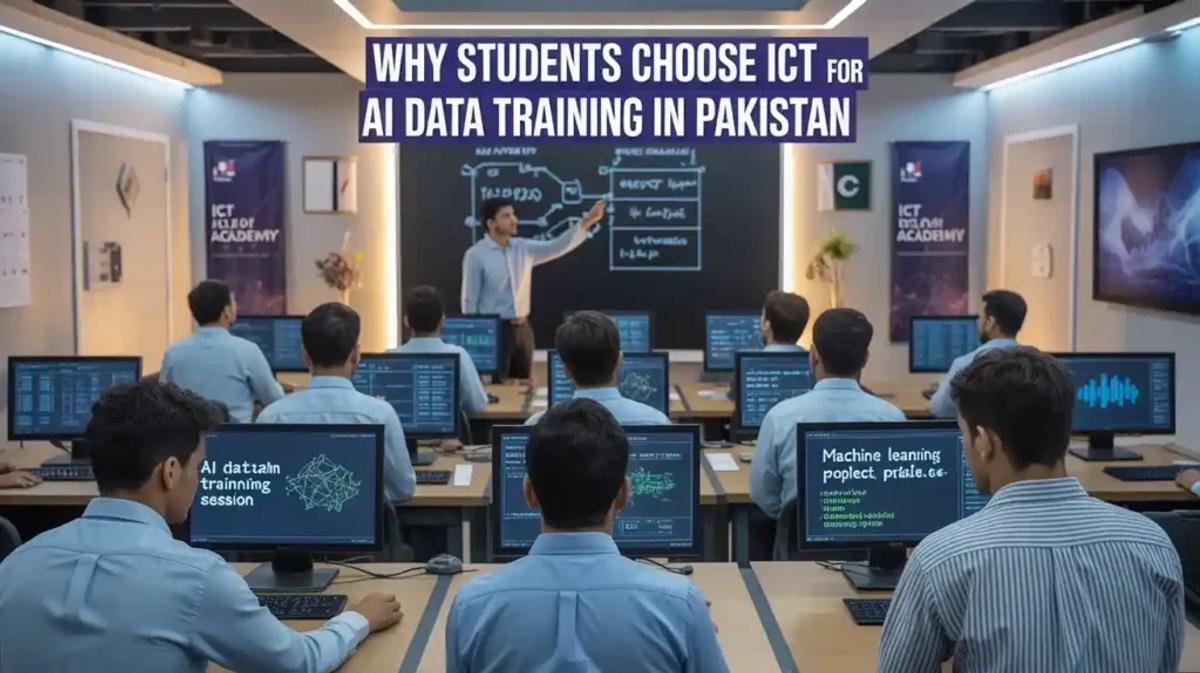
Introduction
Pakistan is standing at a digital crossroads. With over 60% of its population under the age of 30, the country holds massive potential to become a global player in the artificial intelligence economy. And right now, one of the smartest moves any student can make is learning AI data training through a trusted ICT institute.
But why are students across Karachi, Lahore, Islamabad, Rawalpindi, Peshawar, and even smaller cities like Multan and Faisalabad rushing toward ICT programs for AI skills? The answer is simple — opportunity, income, and future-proof careers. Let's break it all down.
What Is AI Data Training and Why Does It Matter in Pakistan?
AI data training is the process of preparing, labeling, annotating, and organizing raw datasets so that artificial intelligence models can learn from them. Think of it like teaching a child — before an AI model can recognize a face, understand speech, or translate a language, it needs thousands of labeled examples to learn from.
This process includes tasks like image labeling, text annotation, data classification, computer vision dataset preparation, and natural language processing (NLP) data tagging. These are not highly technical jobs that require a computer science degree. In fact, many students in Pakistan are doing this work successfully after just a few weeks of structured training.
Pakistan's IT export sector crossed $2.6 billion in 2023, and AI-related freelancing is one of the fastest-growing segments within that. According to the Pakistan Software Export Board (PSEB), Pakistan ranks among the top five freelancing countries in the world. AI data training is now one of the most in-demand skills on platforms like Upwork, Scale AI, Appen, and Remotasks — and Pakistani students are tapping into this global demand.
What Is ICT and How Does It Prepare Students for AI?
ICT — the Institute of Corporate and Taxation — is one of Pakistan's most recognized professional training institutes. While ICT is widely known for its taxation, corporate law, and business finance programs, it has also evolved as a hub for digital skills training that bridges the gap between traditional education and modern technology careers.
ICT's approach to education is practical, affordable, and market-driven. Students don't just study theory — they work on real-world tasks, use actual AI tools, and come out of the program ready to work in the global digital economy. This is exactly what the modern AI data training market demands.
You can explore the full range of programs on the ICT courses page and even reach out directly through the ICT contact page to get personalized guidance on which program fits your goals.
Top Reasons Why Students Choose ICT for AI Data Training in Pakistan
1. Practical, Job-Ready Curriculum
ICT's curriculum is designed in alignment with what global AI companies actually need. Students learn data annotation, image labeling, text classification, supervised learning concepts, and how to work with AI platforms. Unlike university courses that take four years to teach outdated theory, ICT programs are short, focused, and immediately applicable.
2. No Degree Required — Anyone Can Start
One of the biggest barriers for Pakistani youth is the requirement for formal degrees. ICT breaks that barrier entirely. Whether you are a matriculation student in Quetta, an intermediate pass in Hyderabad, or a fresh graduate in Islamabad — you can enroll and start learning AI data training without a computer science background.
3. Affordable Fee Structure With High Return on Investment
Many students cannot afford expensive private university courses. ICT offers professional-grade training at a fraction of the cost. When you consider that AI data training freelancers in Pakistan earn anywhere between PKR 50,000 to PKR 200,000 per month depending on skill level and project volume, the return on a short ICT course investment is extraordinary.
4. Government-Backed Ecosystem Supporting Digital Skills
Pakistan's government has been actively investing in digital skills development through programs like DigiSkills, PITB (Punjab Information Technology Board), IGNITE, NAVTTC, and the Presidential Initiative for AI. ICT aligns with this national vision by equipping students with the same skills these programs promote — making ICT graduates highly compatible with government-sponsored freelancing and AI projects.
5. Freelancing Income From Day One
Students who complete AI data training at ICT can immediately start earning on platforms like Appen, Lionbridge, Scale AI, and Remotasks. These platforms hire data annotators globally, and Pakistani students with verified skills are actively getting hired. ICT helps students build a portfolio and understand how to position themselves on these platforms.
6. Growing Demand Across Every Industry
AI is no longer limited to tech companies. Healthcare, agriculture, retail, logistics, and even Pakistan's textile industry are exploring AI-driven tools. This means the demand for AI data training professionals is spreading across every sector, creating employment opportunities in cities like Lahore, Karachi, Islamabad, Sialkot, Gujranwala, and beyond.
Key Skills Students Learn in ICT's AI Data Training Programs
When students enroll in AI-related ICT programs, they come out equipped with a solid blend of technical and practical skills that the market values right now:
- Data annotation and labeling — tagging images, videos, and text for machine learning models
- Natural language processing (NLP) basics — preparing text datasets for AI language models
- Computer vision dataset preparation — labeling objects in images for visual AI systems
- Python fundamentals for AI — basic scripting to automate data tasks
- AI tool usage — working with platforms like Label Studio, Scale AI, and Appen
- Quality assurance in AI datasets — ensuring accuracy and consistency in training data
- Remote work skills — communication, time management, and freelance project handling
These are not abstract skills. Every single one of them has a direct application in the real-world AI data market.
AI Data Training Career Scope in Pakistan: What Does the Future Look Like?
The global AI market is projected to reach $1.8 trillion by 2030 according to leading research by Goldman Sachs and McKinsey. Behind every AI system — every chatbot, image recognizer, voice assistant, or recommendation engine — there is a human-trained dataset. And humans are still needed to create, verify, and improve that data.
For Pakistan specifically, the opportunity is massive. Here's why:
Pakistan already has a proven freelancing infrastructure. Students in Lahore, Karachi, and Islamabad have been successfully delivering digital services globally for years. AI data training is simply the next evolution of that same system — but with significantly higher pay rates and longer project durations.
The DigiSkills program by the Pakistani government has already trained over 2 million Pakistanis in digital skills. AI data training fits naturally into this ecosystem, and students trained at ICT are well-positioned to tap into both local corporate demand and international freelance markets.
For students thinking about income — entry-level AI data annotators in Pakistan typically earn $5 to $15 per hour on global platforms. Senior annotators and project reviewers can earn $20 to $40 per hour. When you do that math for a month of part-time work, the income becomes life-changing for a Pakistani family.
How ICT Stands Apart From Other AI Training Options in Pakistan
There are many online AI courses available — Coursera, Google AI certifications, and various e-learning platforms offer AI content. But most of these platforms are built for international audiences and assume prior technical knowledge. They also don't provide the local mentorship, Urdu-language support, career guidance, and Pakistan-specific job market knowledge that ICT offers.
ICT bridges this gap by offering:
- In-person and hybrid training options
- Mentorship from experienced Pakistani professionals
- Career placement support after course completion
- A community of alumni working in Pakistan's tech and corporate sector
- Affordable, locally relevant fee structures
You can learn more about ICT's philosophy and track record on the ICT About page. The institute has a strong reputation not just in AI training but also in fields like corporate law, taxation, and business management — which means students trained here carry a credible, recognized certification.
Real Student Stories: How AI Data Training Changed Lives in Pakistan
Fatima from Rawalpindi was a commerce student with no IT background. She enrolled in an ICT digital skills program, learned data annotation basics, and within three months was earning PKR 80,000 per month on an international platform — all while completing her degree.
Ahmed from Peshawar was unable to afford university due to financial constraints. He joined an ICT short course, built a profile on Appen, and is now managing a small team of data annotators in his city — earning a full-time income and training others.
These are not isolated stories. Across KPK, Punjab, Sindh, and Balochistan, ICT-trained students are quietly building digital careers that were unimaginable just five years ago.
How to Apply for AI Data Training at ICT — Step by Step
Getting started is easier than most students think. Here is exactly how you can begin your AI data training journey through ICT:
- Visit the ICT website and browse the available programs
- Review the course details on the ICT courses page
- Contact the admissions team through the ICT contact page for guidance
- Confirm your enrollment, complete the fee process, and attend orientation
- Complete your training, build your portfolio, and start applying to AI platforms
For students who are also interested in expanding their financial and business knowledge alongside AI skills, ICT offers excellent programs like the Master Import and Export Course, the Master Sales Tax Course, and the Company Secretary Course. These programs help students understand Pakistan's business and tax ecosystem — a huge advantage if you plan to run a freelance business or register a tech startup.
Also, once you start earning, you will want to understand your tax obligations as a freelancer. Use this free Pakistan Freelance Tax Calculator to estimate your taxes. If you plan to start a business, the Pakistan Business Tax Calculator is extremely useful. And for general income tax planning, check out the Pakistan Income Tax Calculator — all free tools that help you stay compliant and manage your earnings professionally.
Frequently Asked Questions (FAQs)
What is AI data training in Pakistan? AI data training in Pakistan refers to the process of preparing and labeling datasets used to train artificial intelligence models. Students learn skills like image annotation, text labeling, and data classification, which are in high demand globally and can be done remotely as a freelancer.
Why do students choose ICT for AI data training in Pakistan? Students choose ICT because it offers practical, affordable, and job-ready AI training programs without requiring a university degree. ICT provides mentorship, career support, and Pakistan-specific guidance that international online platforms cannot offer.
How much can students earn from AI data training in Pakistan? Entry-level AI data annotators typically earn between PKR 50,000 to PKR 120,000 per month on international platforms like Appen and Scale AI. With experience and specialization, earnings can go significantly higher.
Is AI data training good for students in Pakistan without a degree? Yes, absolutely. AI data training is one of the few high-income digital skills that do not require a formal degree. ICT's short courses make it accessible to students at all academic levels, including matric and intermediate passouts.
Which cities in Pakistan have the most AI training opportunities? Major AI training activity is concentrated in Lahore, Karachi, and Islamabad, but ICT and similar institutions are making quality training accessible in Rawalpindi, Peshawar, Multan, Faisalabad, Quetta, Hyderabad, Sialkot, and Gujranwala through hybrid and online learning options.
Can students do AI data training part time while studying? Yes. AI data training is flexible and can be done part time. Many students complete ICT programs while pursuing their regular degrees and start freelancing on international platforms within weeks of finishing their training.
Conclusion — Your AI Career Starts Today
Pakistan's youth has always been resourceful, ambitious, and capable. What has been missing for many students is the right bridge between their potential and a real career opportunity. ICT for AI data training is that bridge.
Whether you are a student in Karachi looking for income, a graduate in Lahore seeking a career edge, or a young professional in Islamabad wanting to future-proof your skills — AI data training through ICT is one of the most practical investments you can make right now.
The AI economy is not coming — it is already here. And Pakistan's students are not late to the party. With the right training, the right tools, and the right guidance from ICT, you can build a career that earns in dollars, works on your own schedule, and grows with every passing year.
Book your seat today at ICT. Visit ict.net.pk and take the first step toward a smarter, more financially rewarding future.
Explore ICT's complete course catalog at ict.net.pk/courses — from AI skills to corporate law, taxation, and business management. Your career transformation starts with one decision.
Comments (0)
No comments yet. Start the conversation!
Leave a Reply
Your email address will not be published. Required fields are marked *