
FBR Audit Notice Explained: What It Is, Why You Got It & How to Respond
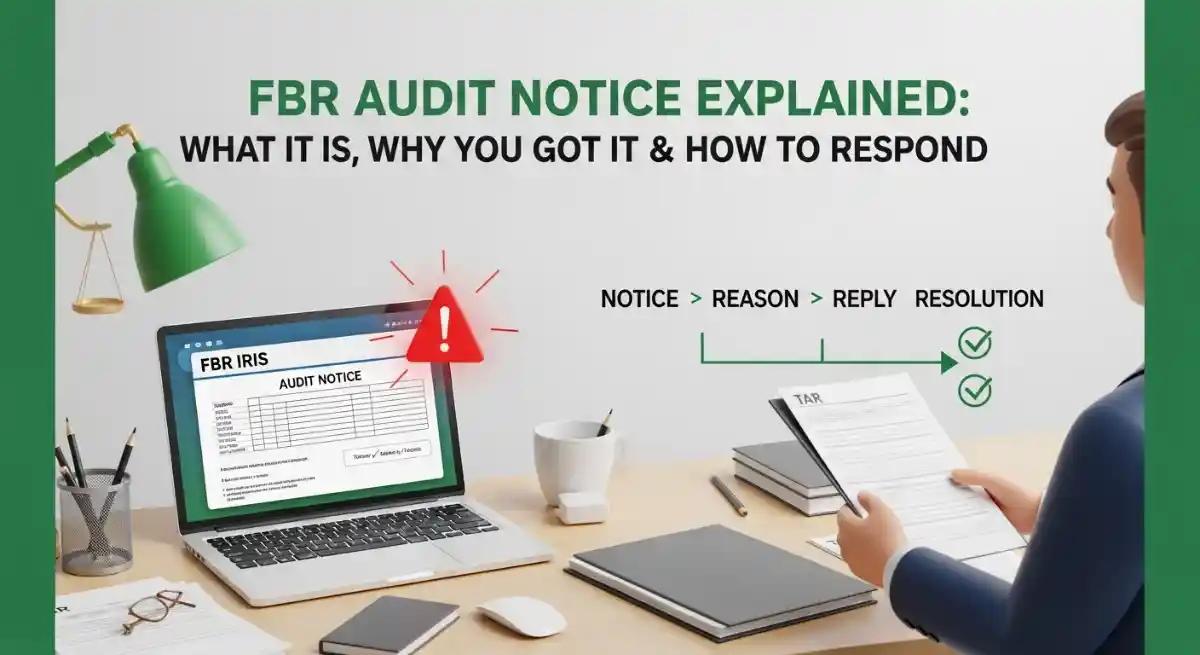
Receiving an FBR audit notice can feel overwhelming — especially if it's your first time. Your hands go cold, your mind races, and you wonder: Did I do something wrong? The truth is, thousands of taxpayers across Pakistan receive FBR audit notices every year, and most of them are resolved smoothly with the right knowledge and preparation. This complete guide explains everything you need to know about the FBR audit notice — what it means, why you received it, how to respond, and what happens if you don't.
What Is an FBR Audit Notice?
An FBR audit notice is an official communication issued by the Federal Board of Revenue (FBR) Pakistan, asking a taxpayer to provide supporting documentation, explanations, or clarifications about their filed income tax return, wealth statement, or business records.
It is not automatically a sign of wrongdoing. It simply means FBR wants to verify that your declared income, expenses, assets, and tax payments are accurate and consistent with the data they hold from third-party sources.
FBR issues these notices under different legal provisions of the Income Tax Ordinance 2001 — most commonly under Section 177 (audit of income tax return) and Section 214C (random ballot selection for audit). You may also receive notices under Section 122 (amendment of assessment) or Section 176 (information notice).
Understanding which section your notice falls under is the first step toward responding correctly.
Why Did You Receive an FBR Audit Notice?
This is the question every taxpayer asks. FBR selects taxpayers for audit through multiple methods, and it's important to understand that being selected does not mean you've committed tax evasion.
Common reasons for receiving an FBR audit notice include:
- Random ballot selection under Section 214C — FBR runs a computerized draw every year and randomly selects tax filers for audit. You may simply be unlucky.
- Third-party data matching — FBR collects information from banks, SECP, NADRA, property registrars, motor vehicle authorities, and utility companies. If your declared income doesn't match your high-value transactions, FBR's system flags your return for review.
- FBR audit based on bank statement — If large deposits appear in your accounts that don't match your declared income, expect scrutiny.
- Wealth statement discrepancies — If your lifestyle, properties, or assets don't reconcile with your declared wealth statement, this is a major audit trigger.
- Unexplained income or concealment of income — If you received significant cash income that wasn't reported, FBR's data matching system can detect patterns.
- Non-filers receiving income — FBR is increasingly sending audit notices to non-filers who have active bank accounts, registered property, or SIM cards.
- Mismatch in withholding tax statement — If the taxes withheld by your employer or clients don't align with what you declared in your return, FBR may want to investigate.
- Specific risk sectors — Real estate dealers, traders, importers, exporters, manufacturers, and freelancers are currently under heightened FBR scrutiny in 2025–2026.
If you're in Lahore, Karachi, Islamabad, Rawalpindi, Faisalabad, or any other major city, the process and deadlines are the same — FBR operates nationally through its IRIS portal.
What Is Section 177 of the Income Tax Ordinance 2001?
Section 177 of the Income Tax Ordinance 2001 gives the Commissioner Inland Revenue the authority to audit any taxpayer's return of income. Under this provision, the Commissioner can call for records, books of accounts, documents, and any other information necessary to verify the correctness of the return.
An FBR notice under Section 177 means a tax officer has specifically identified your return for scrutiny — often due to data discrepancies or specific risk profiling. This is different from the random ballot under Section 214C, which is a computerized selection process.
Both types of notices require you to respond formally, professionally, and within the given deadline.
What Is the IRIS FBR Portal and How Does It Work?
The IRIS FBR portal (iris.fbr.gov.pk) is FBR's official online tax management system. All e-notices issued by FBR — including audit notices — are delivered through this platform. If you are a registered taxpayer with an NTN number, you can log in to your IRIS account to view notices, submit replies, upload documents, and track the status of your audit proceedings.
This is why maintaining an active IRIS login is essential for every filer in Pakistan. Many taxpayers miss FBR notices simply because they don't check their IRIS portal regularly — and missed notices can lead to severe penalties.
How to Respond to an FBR Audit Notice — Step by Step
Responding to an FBR audit notice correctly is critical. Here's a practical, step-by-step approach:
Step 1 — Read the Notice Carefully Identify which section the notice is issued under, what specific documents are being requested, and what the deadline is for your reply.
Step 2 — Log Into Your IRIS Portal Access your FBR IRIS login at iris.fbr.gov.pk and view the full notice in your inbox. Download and save a copy for your records.
Step 3 — Gather Your Documents Collect all relevant documents that FBR may require, including your income tax return for the relevant year, bank statements, wealth statement, salary slips or business invoices, withholding tax certificates, property documents, and vehicle registration papers.
Step 4 — Prepare a Written Reply Your reply must be professional, factual, and directly address each query raised in the notice. Avoid leaving any point unanswered. If you have supporting documents, attach them clearly labeled.
Step 5 — Submit Your Reply Through IRIS Upload your response and all supporting documents through the IRIS portal. Keep the submission reference number for follow-up.
Step 6 — Hire a Tax Consultant if Needed If the notice is complex, involves large amounts, or is under a challenging section, hire a qualified tax consultant or chartered accountant who specializes in FBR audit representation services.
What Documents Are Required for an FBR Audit?
The documents required depend on your specific situation, but generally include:
- Filed income tax returns for the audit year and preceding years
- Bank statements for all accounts (personal and business)
- Wealth reconciliation statement with supporting evidence
- Books of accounts (for business owners)
- Sales tax returns (if registered for sales tax)
- Withholding tax statements and certificates
- Property purchase/sale agreements and valuation documents
- Investment proofs (shares, mutual funds, foreign remittances)
- Business invoices, purchase orders, and financial statements
- Salary slips or employment contracts (for salaried persons)
For freelancers in Pakistan, you may also need to produce foreign remittance certificates from your bank, Payoneer or Wise transaction history, and platform payment records from Upwork, Fiverr, or similar platforms.
What Is the Deadline to Reply to an FBR Audit Notice?
The reply deadline is specified within the notice itself. Typically, FBR gives taxpayers between 15 to 30 days to respond after receiving the notice. However, this can vary. If you need more time, you can request an extension from the Commissioner Inland Revenue — but this must be done before the deadline passes.
Ignoring the deadline is one of the biggest mistakes a taxpayer can make. It gives FBR the legal authority to proceed with an ex-parte assessment, which means they can determine your tax liability based solely on available information without your input — usually resulting in a much higher tax demand.
What Happens If You Ignore an FBR Audit Notice?
Ignoring an FBR audit notice is never a safe option. If you fail to respond within the given timeframe, the following consequences can follow:
- FBR can issue an ex-parte assessment order, significantly increasing your tax liability
- Penalty notices and surcharge can be issued under the Income Tax Ordinance 2001
- FBR may freeze your bank accounts or attach your assets
- Your name may be added to the non-compliant taxpayers list
- Legal proceedings can be initiated against you
- Your NTN may be deactivated, removing you from the Active Taxpayer List (ATL)
The penalties for non-compliance can far exceed the original tax amount in question. This is why timely and professional response is essential.
Can FBR Audit a Salaried Person?
Yes, absolutely. FBR audit notices for salaried persons are increasingly common in Pakistan. If your employer withheld taxes correctly but your wealth statement shows assets inconsistent with your declared salary, FBR may select you for audit. Similarly, if you received rental income, freelancing income, or capital gains from property or shares that weren't declared, your return is at risk.
Salaried individuals in cities like Islamabad, Rawalpindi, Lahore, and Karachi often receive notices when their CNIC-linked data — such as property, vehicle registrations, or investment accounts — doesn't align with their income tax return.
Can FBR Audit Freelancers in Pakistan?
Yes, and this is becoming more common as FBR tightens its data matching capabilities. Freelancers who receive foreign remittances are required to declare their income and file tax returns. FBR receives data from the State Bank of Pakistan on inward remittances, which allows it to cross-check whether freelancers have properly reported their earnings.
If you're a freelancer based in Lahore, Karachi, Islamabad, or working remotely from any city in Pakistan, and you have not filed returns or declared your full income, you are at increasing risk of receiving an FBR audit notice.
To understand more about your obligations as a freelancer, read this detailed guide on freelancers' tax rules in Pakistan 2026 published by ICT.

FBR Audit Notice Explained What It Is, Why You Got It & How to Respond
Is an FBR Audit Notice the Same as a Tax Demand Notice?
No, these are two different things. An FBR audit notice initiates the process of reviewing your tax return and supporting records. It is an investigative step. A tax demand notice, on the other hand, is issued after the audit or assessment process is complete, informing you of a specific tax amount you owe.
Think of an audit notice as the investigation and a tax demand notice as the verdict. You can challenge both at different stages through the formal appeal process.
Can FBR Audit Previous Years' Returns?
Yes. Under the Income Tax Ordinance 2001, FBR can audit returns filed within the past five years. In cases involving fraud, concealment of income, or wilful misrepresentation, this period can be extended. This is why maintaining proper records and books of accounts for at least five years is not just good practice — it's a legal requirement.
How to Challenge an FBR Audit Order
If you disagree with the outcome of an FBR audit, you have the right to file an appeal. The process works as follows:
First, you file an appeal before the Commissioner Inland Revenue (Appeals) within 30 days of receiving the assessment or amendment order. If unsatisfied with that decision, you can escalate to the Appellate Tribunal Inland Revenue. Further legal challenges can be taken to the High Court and Supreme Court of Pakistan.
Having a qualified tax consultant or tax lawyer to represent you at each stage significantly improves your outcome.
Does FBR Check Bank Accounts During an Audit?
Yes. FBR has legal authority to access your banking information through third-party data requests from the State Bank of Pakistan and commercial banks. If your bank deposits, withdrawals, or transfers are inconsistent with your declared income, FBR will question these transactions during the audit process.
This is why FBR's audit based on bank statements is one of the most common triggers for a full audit. If you receive large amounts of cash deposits that you can't explain, you need to be prepared with documentation.
For a broader understanding of how FBR's digital transformation affects taxpayers, see this insightful read on FBR's digital transformation in Pakistan 2025.
Your Rights During an FBR Audit
Many taxpayers don't realize they have rights during the audit process. These include:
- The right to be informed about the specific reason and legal authority for the audit
- The right to present your case and submit evidence in your favour
- The right to professional representation — you can authorize a tax consultant or chartered accountant to appear before FBR on your behalf
- The right to appeal against any unfavourable order at multiple levels
- The right to request adjournments and extensions under reasonable circumstances
Understanding these rights ensures you are not pressured into accepting incorrect assessments.
How Long Does the FBR Audit Process Take?
The duration varies depending on complexity. A straightforward audit where documents are submitted promptly and there are no major discrepancies can be resolved in two to four months. More complex cases — especially those involving large businesses, multiple years, significant wealth statement gaps, or contested assessments — can take one to three years, including appeal proceedings.
Cooperating promptly and professionally at every stage is the most effective way to minimize the duration of the process.
Who Can Help You With an FBR Audit Notice?
You should consider professional help if your notice involves a large amount, multiple years, business income, international transactions, or if you simply don't know how to navigate the IRIS portal and legal framework.
Options include:
- Chartered accountants registered with ICAP
- Tax consultants and tax advisors specializing in FBR audit representation
- Tax lawyers for appeal proceedings
- Certified Tax Advisors trained in income tax ordinance compliance
If you're looking to build your own knowledge so you're never caught off-guard again, you can explore the Advanced Taxation and Litigation Course offered by the Institute of Corporate and Taxation (ICT) — a practical, professional-level program that covers FBR audit procedures, response strategies, and litigation in detail.
You can also read ICT's related guide on how to respond to an FBR notice under Section 114 for practical step-by-step guidance.
Where to Get Professional FBR Audit Help Across Pakistan
Whether you're in Lahore, Karachi, Islamabad, Rawalpindi, Faisalabad, Multan, Peshawar, Quetta, Sialkot, or Gujranwala — professional help is available. Many certified tax advisors and consultancy firms offer FBR audit notice response services across the country. Choosing someone with practical FBR experience and knowledge of the IRIS portal is essential.
ICT (Institute of Corporate and Taxation), based in Islamabad and serving students and professionals across Pakistan, offers some of the most comprehensive tax education available — from FBR compliance basics to advanced audit and litigation. Learn more at ict.net.pk.
Frequently Asked Questions About FBR Audit Notices
What is an FBR audit notice? An FBR audit notice is an official communication from the Federal Board of Revenue asking a taxpayer to verify their income tax return, wealth statement, or business records by submitting supporting documents and explanations within a specified deadline.
Why did I receive an FBR audit notice? You may have been selected through random ballot under Section 214C, or FBR's data matching system identified discrepancies between your declared income and third-party information from banks, NADRA, or property records.
How do I respond to an FBR audit notice? Log into your IRIS FBR portal, carefully read the notice, gather all requested documents, prepare a factual written reply addressing each query, and submit it before the deadline. Hiring a tax consultant is advisable for complex cases.
What documents are required for FBR audit? You will typically need your income tax return, bank statements, wealth reconciliation statement, withholding tax certificates, books of accounts (for businesses), and property or investment documents as relevant to the specific queries raised.
What is the penalty for not responding to FBR audit notice? Failure to respond can lead to ex-parte assessment, significantly higher tax demand, bank account freezing, asset attachment, and removal from the Active Taxpayer List.
Can a tax consultant represent me in an FBR audit? Yes. You can formally authorize a certified tax advisor, chartered accountant, or tax lawyer to represent you before the Commissioner Inland Revenue and in all subsequent appeal proceedings.
Conclusion — Don't Panic, But Don't Ignore It Either
An FBR audit notice is serious, but it is manageable. The worst thing you can do is ignore it. The second worst thing is to respond without proper knowledge or documentation. Whether you are a salaried employee in Islamabad, a business owner in Karachi, a property dealer in Lahore, or a freelancer working remotely from Rawalpindi — the rules are the same, and your right to a fair process is protected under Pakistani tax law.
The best protection against future audit notices — and the best way to handle a current one — is knowledge. Understanding the Income Tax Ordinance 2001, the IRIS FBR portal, wealth statement requirements, and audit procedures puts you firmly in control.
Ready to build that knowledge professionally?
Enroll in the Advanced Taxation and Litigation Course at the Institute of Corporate and Taxation (ICT) — Pakistan's leading taxation training institute. Learn from industry experts, gain practical FBR filing and audit response skills, and build a career that's audit-proof.
👉 Book your seat today at ICT's Advance Taxation Course and take the first step toward complete tax confidence.
For more resources, explore ICT's blog on income tax ordinance 2001 compliance in 2026 and the guide on FBR Active Taxpayer List 2026 to stay updated and compliant.
Comments (0)
No comments yet. Start the conversation!
Leave a Reply
Your email address will not be published. Required fields are marked *