
Salary Scope After Becoming a Certified Tax Advisor in Pakistan (2026 Guide)
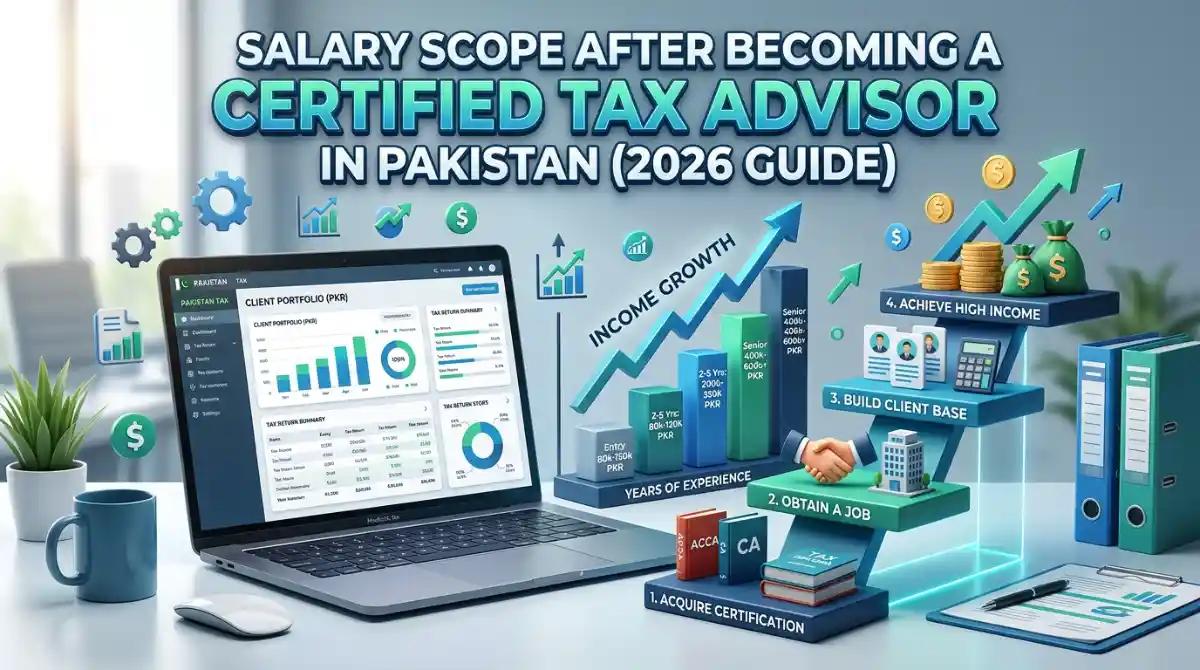
If you've recently completed — or are planning to enroll in — a certified tax advisor course, the first question on your mind is probably the same one everyone asks: "What will I actually earn?"
That's a fair question. And the honest answer is: quite a lot — if you play your cards right.
Pakistan's taxation landscape is changing fast. The Federal Board of Revenue (FBR) is digitalizing its systems, compliance requirements are tightening, and businesses from Karachi to Islamabad are actively hunting for qualified tax professionals. In this environment, a certified tax advisor isn't just a title — it's a career asset that opens doors most accountants never even get to knock on.
This guide breaks down the complete salary scope, career trajectory, job roles, and earning potential after becoming a certified tax advisor in Pakistan. Whether you're a fresh graduate or a working professional looking to pivot, this is everything you need to know.
What Is a Certified Tax Advisor?
A certified tax advisor is a trained professional who helps individuals, businesses, and organizations manage their tax obligations legally, efficiently, and strategically. This goes well beyond simply filing income tax returns.
A certified tax advisor in Pakistan typically handles:
- Filing income tax and sales tax returns with FBR
- Advising clients on tax planning and long-term tax strategy
- Ensuring FBR tax compliance for individuals and business entities
- Representing clients before tax authorities
- Preparing and reviewing financial statements in line with GAAP accounting principles
- Managing tax liabilities for multinational companies and SMEs
- Advising on withholding tax regulations and laws and regulations compliance
In short, they are the bridge between complex tax legislation and real-world financial decisions. And that bridge is in very high demand right now.
Why the Salary Scope Is Growing in 2026
Before diving into numbers, it's worth understanding why this career pays well — and why it will keep paying better.
Pakistan's Income Tax Ordinance and Sales Tax Act are not simple documents. They run into hundreds of sections, and they change every budget cycle. Most business owners, freelancers, and even salaried professionals don't have the time or expertise to navigate this on their own. They need someone who does.
Add to that the fact that the FBR has been aggressively pushing for digital compliance — the IRIS 2.0 portal, real-time invoicing systems, e-filing mandates — and you have a situation where demand for qualified tax professionals is outpacing supply.
According to the Bureau of Labor Statistics, tax accountants and auditors are among the more stable professional categories globally, with consistent demand even during economic downturns. Pakistan mirrors this trend. Businesses don't stop having tax obligations when the economy slows down — they actually need more help navigating them.
The Securities and Exchange Commission of Pakistan (SECP) has also tightened corporate compliance requirements, meaning companies registered with SECP must maintain cleaner, more audit-ready books — another win for tax advisors.
Certified Tax Advisor Salary in Pakistan — The Real Numbers
Here is a realistic salary breakdown based on experience level and role type. These figures reflect current market conditions in 2026.
Certified Tax Advisor Salary Table — Pakistan 2026
| Experience Level | Monthly Salary (PKR) | Annual Salary (PKR) | Typical Employer |
| Entry Level (0–1 year) | 40,000 – 70,000 | 480,000 – 840,000 | SMEs, boutique tax firms |
| Junior Tax Advisor (1–3 years) | 70,000 – 120,000 | 840,000 – 1,440,000 | Mid-size accounting firms |
| Mid-Level Tax Consultant (3–5 years) | 120,000 – 200,000 | 1,440,000 – 2,400,000 | Corporates, Big 4 firms |
| Senior Tax Accountant (5–8 years) | 200,000 – 350,000 | 2,400,000 – 4,200,000 | MNCs, public accounting firms |
| Tax Partner / Director (8+ years) | 350,000 – 700,000+ | 4,200,000 – 8,400,000+ | Big 4, own consultancy |
These figures can vary significantly by city, industry sector, and whether you're employed or running your own tax consultancy. Freelance tax consultants in Pakistan who serve international clients through platforms like Upwork or Fiverr often earn in USD — which changes the equation entirely.
Tax Advisor Salary in Karachi vs Islamabad vs Lahore
Location plays a real role in your earning potential. Here's a city-by-city reality check.
Certified Tax Advisor Salary in Karachi
Karachi is Pakistan's commercial hub. It hosts the highest concentration of multinational companies, large trading businesses, and public accounting firms. A certified tax advisor in Karachi with 3–5 years of experience can realistically command PKR 150,000–250,000 per month. The best tax consultants in Karachi working with corporate clients or Big 4 firms like PWC, KPMG, Deloitte, and EY Pakistan earn significantly more. Corporate tax advisor roles in Karachi are among the highest-paying positions in the country.
Tax Compliance Officer Salary in Islamabad
Islamabad has a growing demand for tax professionals, largely driven by government contractors, NGOs, tech startups, and the expanding corporate sector. Tax advisory firms in Islamabad are increasingly looking for FBR-compliant professionals. A mid-level certified tax advisor in Islamabad typically earns PKR 100,000–180,000 per month, with senior roles crossing PKR 250,000.
Tax Advisor Career in Lahore
Lahore's industrial base — textile, manufacturing, retail — creates strong demand for tax compliance specialists and corporate tax advisors. Accounting firms in Lahore are hiring, especially for sales tax and income tax compliance roles. Entry to mid-level advisors earn PKR 60,000–150,000, with experienced professionals going well beyond that.
Career Opportunities After Tax Advisor Certification
Becoming a certified tax advisor doesn't lock you into one role. The certification opens multiple career pathways.
1. Tax Compliance Officer Work in-house at a corporate or multinational firm managing all FBR filings, withholding tax deductions, and regulatory submissions. This is one of the most stable and well-paying staff accountant roles in Pakistan today.
2. Independent Tax Consultant Set up your own practice. Once you build a client base — individuals, small businesses, freelancers — you can earn significantly more than any salaried position. Many consultants in Pakistan charge PKR 5,000–30,000 per client per filing season, and ongoing retainer arrangements are common.
3. Tax Preparation Professional at Accounting Firms Public accounting firms and boutique tax consultancies in Karachi, Lahore, and Islamabad are constantly looking for certified professionals to handle client portfolios. This is a strong entry point for new advisors.
4. Corporate Tax Advisor Large organizations — especially those listed with SECP or dealing in international trade — need in-house tax advisors who understand multinational company taxation, transfer pricing, and cross-border compliance. These roles pay at the senior end of the salary table above.
5. FBR Consultant / Tax Representative Some certified advisors focus entirely on representing clients before FBR during audits, responding to notices under Section 114, and handling tax litigation. This is a niche but highly lucrative path, especially for those who also pursue legal knowledge alongside their tax qualification.
6. International Tax Advisory Pakistan-based professionals with knowledge of UAE taxation, UK tax law, or US taxation are increasingly working with global clients remotely. The demand for Pakistani tax professionals in the UAE is particularly strong. You can explore this path through ICT's UAE Taxation Course or UK Taxation Course.
Role of a Tax Accountant — What You'll Actually Be Doing
People sometimes confuse the terms "tax advisor" and "tax accountant." There is overlap, but here's the practical distinction.
A tax accountant focuses on the preparation side — bookkeeping and accountancy, preparing financial statements, filing returns, calculating tax liabilities, and ensuring records align with GAAP accounting principles.
A certified tax advisor does all of that plus strategic advisory — advising clients on how to structure transactions, minimize tax exposure legally, and plan their financial affairs for the long term.
In terms of salary, a tax advisor with certified qualifications consistently earns 20–40% more than a general accountant at the same experience level. That premium reflects the depth of knowledge required — understanding not just what the rules are, but how to use them in your client's favor.
For a deeper dive into what this role involves day to day, read ICT's detailed guide on how to become a tax accountant.
How to Become a Certified Tax Advisor in Pakistan — Step by Step
This is the path most successful tax advisors follow:
Step 1 — Build your academic foundation. A degree in accounting and taxation or accounting and finance is the most direct route. Commerce graduates from B.Com, BBA, or MBA backgrounds also qualify.
Step 2 — Enroll in a certified tax advisor course. This is where practical knowledge kicks in. Academic degrees teach theory; a good certification course teaches you how to actually file returns on IRIS, handle FBR notices, calculate withholding tax, and advise clients. ICT's Certified Tax Advisor Course is one of the most comprehensive options available in Pakistan.
Step 3 — Get your NTN. Every tax professional needs a National Tax Number. You can learn the exact steps at ICT's guide on how to obtain NTN in Pakistan.
Step 4 — Register on FBR's IRIS portal. This is the primary platform for all tax compliance work in Pakistan. Familiarity with IRIS is non-negotiable.
Step 5 — Gain practical experience. Work with a tax consultancy, accounting firm, or under a senior advisor. Build your first 5–10 client cases. This is where your salary potential begins climbing.
Step 6 — Consider advanced specializations. Sales tax, corporate tax litigation, international tax — each specialization adds to your marketability and your rate. ICT's Advanced Taxation and Litigation Course is designed exactly for this stage.

Certified Tax Advisor Salary Pakistan 2026 Certification Scope Guide
Does FBR Certification Increase Salary Scope?
Yes — significantly.
Here's the reality of Pakistan's job market for tax professionals. Employers and clients are not just looking for someone who knows tax law in theory. They want someone who has proven, certified expertise. An FBR-registered tax professional with a recognized certification from an institute like ICT carries immediate credibility.
In practical terms, certified professionals report earning 30–50% more than uncertified peers at similar experience levels. And when it comes to independent consulting, certification is often the deciding factor for clients choosing between two advisors.
You can read more about why certification matters in ICT's article on why businesses prefer certified tax advisors and why banks and MNCs prefer certified tax professionals.
Is Tax Advisor a Good Career in Pakistan?
Absolutely — and here's why the answer is not just "yes" but "yes, especially now."
Job security is high. Tax obligations never disappear. Whether the economy is growing or contracting, individuals and businesses must file returns, maintain compliance, and pay taxes. That makes this profession far more recession-resistant than most.
Income scales with expertise. Unlike many fields where salary hits a ceiling, tax advisory is one where expertise genuinely compounds. The more you know — income tax, sales tax, corporate tax, international tax — the more clients you can serve and the higher you can charge.
Demand for tax professionals is rising. FBR's digital transformation, SECP compliance requirements, and Pakistan's expanding formal economy are all creating more work for tax professionals. The Pakistan Tax Bar Association has noted a growing shortfall of qualified tax advisors relative to demand.
You can go independent. Many successful advisors eventually start their own tax consultancy. The startup costs are low, the demand is steady, and a good reputation compounds quickly. ICT's guide on how tax knowledge helps you start your own consultancy walks you through exactly this path.
Global opportunities are real. Pakistani tax professionals are working with UAE, UK, US, and Canadian clients from their laptops. This is no longer unusual — it's a growing trend. For perspective on what's possible, read why UAE companies prefer Pakistani tax professionals.
What Software Do Tax Accountants Use in Pakistan?
Technical skills matter. Clients and employers expect certified advisors to be fluent in the tools of the trade.
The most commonly used platforms and software include:
- FBR IRIS Portal — mandatory for all income tax and sales tax filings in Pakistan
- QuickBooks / MYOB — widely used for bookkeeping and accountancy
- MS Excel (Advanced) — still the backbone of most tax workings and financial models
- Accounting software like Tally, Xero — used by firms serving international clients
- E-invoicing systems — increasingly required under FBR's digital invoicing mandates
A strong command of advanced accounting software is now a baseline expectation, not a bonus. ICT's Advanced Excel Course is a smart complement to any taxation qualification for exactly this reason.
What Is the Difference Between a Tax Advisor and a Tax Consultant?
These terms are often used interchangeably, but there is a subtle distinction worth knowing.
A tax consultant typically works reactively — helping clients file returns, respond to notices, and fix compliance issues after they arise.
A certified tax advisor works proactively — structuring financial decisions before they happen to minimize tax liability legally. They advise clients on business strategies, help businesses make decisions that are tax-efficient, and provide ongoing financial planning and tax guidance.
In terms of scope and salary, tax advisors generally occupy a more senior position. The certification signals that you can do both — handle the compliance work and provide the strategic advisory layer.
Certified Tax Professional Income After 5 Years
This is a question worth answering directly because many people underestimate the long-term trajectory.
At the five-year mark, a certified tax advisor in Pakistan who has built a solid client base and developed expertise in at least one specialization — whether corporate tax, sales tax, or international tax — is typically earning PKR 200,000–350,000 per month in employment. Independent consultants at this stage often earn considerably more, depending on their client portfolio.
Advisors who expand into international tax services — particularly UAE, UK, or US taxation — often cross PKR 500,000 monthly by year five, especially when they serve clients in foreign currencies.
The key variable is whether you keep learning. Tax law changes every year. Advisors who stay current, maintain their certifications, and add specializations consistently outperform those who rest on their initial qualification.
Why Choose ICT for Your Tax Advisor Certification?
The Institute of Corporate and Taxation (ICT) is Pakistan's leading institute for professional tax education. It's not just a course provider — it's a career launchpad.
Here's what makes ICT different from other options:
- Practical, IRIS-focused training — you learn to actually file returns, not just read about them
- Expert faculty with real-world tax advisory experience
- FBR-aligned curriculum that stays current with Pakistan's tax legislation
- Career support including internship guidance and job placement assistance
- Comprehensive course range — from the core Certified Tax Advisor Course to advanced specializations in UK, UAE, US, Canadian, and Saudi taxation
Students consistently credit ICT's hands-on approach as the reason they were able to step into professional roles immediately after completing their courses. You can read real student experiences at ICT's blog on how students transformed their careers with tax education.
For a complete picture of why ICT stands out, visit why ICT is better than other institutes and explore why ICT is the No. 1 institute for taxation in Islamabad.
Frequently Asked Questions
What is the starting salary of a tax advisor in Pakistan?
A fresh certified tax advisor in Pakistan typically earns between PKR 40,000 and PKR 70,000 per month at entry level. With 1–2 years of experience, this rises quickly to PKR 70,000–120,000 depending on the employer and city.
How long does it take to become a certified tax advisor?
The ICT Certified Tax Advisor Course can be completed in 2–3 months with regular attendance. Combined with your academic background, you can be job-ready within one semester of focused learning and practical application.
Can a tax advisor work independently in Pakistan?
Yes — and many do. After building initial experience with a firm or employer, most advisors establish their own practice. The overhead is low, the client demand is steady, and an established reputation compounds quickly through referrals.
What qualifications are needed to become a tax advisor?
A bachelor's degree in commerce, accounting, finance, or a related field is the standard academic foundation. Practical certification from a recognized institute like ICT, combined with FBR registration and NTN, completes your professional qualification.
Which accounting firms pay the highest salary to tax advisors in Pakistan?
The Big 4 firms — PWC Pakistan, KPMG Pakistan, Deloitte Pakistan, and EY Pakistan — consistently offer the highest salaries for tax professionals. Mid-size local firms and in-house corporate roles at multinationals also offer strong compensation, particularly for senior and specialized advisors.
What is the scope of taxation in Pakistan in 2026?
The scope is expanding rapidly. FBR's digital transformation, increased enforcement, SECP compliance mandates, and Pakistan's growing formal economy are all driving demand for qualified tax professionals. Career opportunities in tax compliance, advisory, audit, litigation, and international taxation are all growing year on year.
Conclusion — Is Becoming a Certified Tax Advisor Worth It?
The short answer: yes, unquestionably.
The salary scope after becoming a certified tax advisor in Pakistan is not just competitive — it's one of the stronger career investments you can make right now. You're entering a profession with guaranteed demand, a clear path to independence, international earning potential, and real salary growth tied to expertise.
The key is starting with the right foundation. A quality certification from a trusted institute, real-world practice on Pakistan's actual tax systems, and a commitment to staying current with FBR updates and tax legislation will put you on the fastest possible path to financial independence in this field.
Ready to take the next step?
Book your seat in ICT's Advanced Taxation Course — Pakistan's most comprehensive, practically focused certification for aspiring and working tax professionals.
👉 Explore the Certified Tax Advisor Course at ICT 👉 View all ICT Courses 👉 Contact ICT to enroll today
Your career as a certified tax advisor starts with one decision. Make it today.
Comments (0)
No comments yet. Start the conversation!
Leave a Reply
Your email address will not be published. Required fields are marked *