
Cross-Border Tax Compliance for Freelancers & Consultants
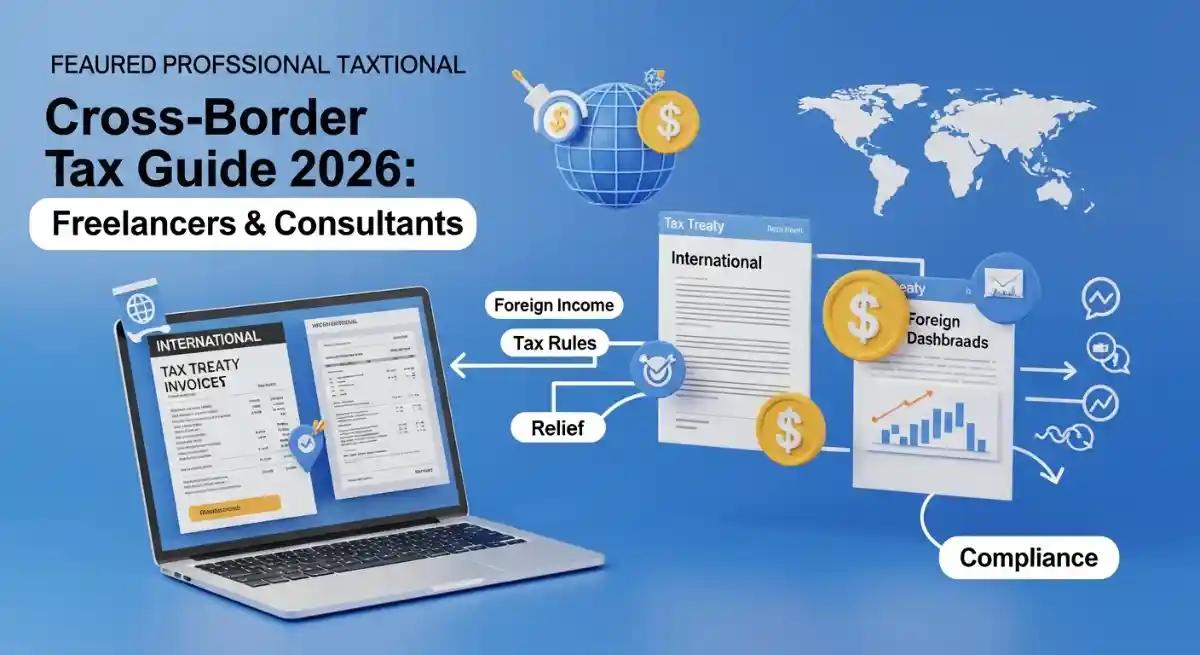
If you are a freelancer or consultant earning income from foreign clients, congratulations — you are part of one of the fastest-growing professional communities in Pakistan. But here is the uncomfortable truth that most people skip: earning dollars, euros, or pounds does not automatically mean you are tax-compliant. Cross-border tax compliance is one of the most misunderstood and overlooked responsibilities for remote workers, digital consultants, and independent professionals today.
Whether you are working with a US-based startup, filing invoices for a UK agency, or consulting for a Canadian firm from your home office in Islamabad or Lahore — the moment money crosses a border, tax obligations follow. And ignoring them can cost you far more than just penalties.
This guide breaks everything down clearly, practically, and in plain language so you can protect your income, stay compliant with FBR, and build a professional freelance career without the tax headaches.
What Is Cross-Border Tax Compliance for Freelancers?
Cross-border tax compliance for freelancers means fulfilling all legal tax obligations that arise when you earn income from clients, companies, or platforms located in a different country than your own.
For a Pakistani freelancer or consultant, this involves three key layers:
First, you must comply with domestic tax laws — meaning you report your foreign income to the Federal Board of Revenue (FBR) and file your income tax return through the IRIS portal. Second, you must understand the international tax rules of the country where your client is based, particularly rules around withholding tax, VAT, and GST for digital services. Third, you need to understand any Double Taxation Avoidance Agreements (DTAA) that Pakistan has with that country so you are not taxed twice on the same income.
Simple in concept. Complex in practice. This is exactly why thousands of Pakistani freelancers either overpay, underpay, or unknowingly become non-compliant.
Why Cross-Border Tax Compliance Matters More Than Ever in 2026
The global freelance economy has exploded. According to the World Bank's data on digital trade and remittances, Pakistan consistently ranks among the top remittance-receiving and digital export nations in Asia. The number of Pakistani freelancers working internationally has grown dramatically in recent years, particularly in IT services, digital marketing, accounting, and consulting.
But with growth comes scrutiny. FBR has been aggressively expanding its digital infrastructure through IRIS 2.0, automated audit triggers, and new monitoring frameworks for foreign currency income. The Active Taxpayer List (ATL) is now a real-world credential that affects your bank rates, property transactions, and even vehicle registration.
If you earn from Upwork, Fiverr, Toptal, or direct international clients, you are not invisible to the tax system anymore. Staying compliant is no longer optional — it is a professional necessity.
You can also read how FBR's digital transformation is reshaping tax compliance in Pakistan at FBR's Digital Transformation Pakistan 2025.
Do Pakistani Freelancers Pay Tax on Foreign Income?
Yes. Under the Income Tax Ordinance 2001, Pakistani tax residents are taxed on their worldwide income. This means all income — regardless of whether it is received in USD, GBP, EUR, or any other foreign currency — is taxable in Pakistan.
Here is what that looks like in practice:
If you are a resident of Pakistan (meaning you spend more than 183 days per year in Pakistan), all your foreign freelance income must be declared in your annual income tax return filed with FBR. The income is converted into Pakistani Rupees at the applicable exchange rate on the date of receipt or the average annual rate, depending on how you account for it.
The good news? Pakistan offers a significant exemption for IT and IT-enabled services exporters. Under a special SRO notification, freelancers and software exporters who bring in income through proper banking channels may claim a 100% tax exemption on foreign-source income — but this exemption applies only if you meet the qualifying conditions, and only when income is remitted through a recognized financial channel.
This is not automatic. You need an NTN (National Tax Number), you need to be an active filer, and your income must be properly documented.
For a complete breakdown of freelancer-specific tax rules in Pakistan, visit Freelancers Tax Rules in Pakistan 2026.
Understanding Double Taxation: A Real Risk for Consultants
Double taxation happens when the same income is taxed in both the country where it is earned (source country) and the country where you live (residence country). For a Pakistani consultant billing a UK law firm, for example, the UK might apply withholding tax on your payment — and then Pakistan could also want its share.
This is where Double Taxation Avoidance Agreements (DTAAs) become critical.
Pakistan has signed DTAAs with over 65 countries including the USA, UK, UAE, Saudi Arabia, Canada, Germany, and China. These treaties define:
- Which country has the right to tax specific types of income
- How much withholding tax can be applied at source
- How tax paid in one country can be credited against your liability in another
For example, the DTAA between Pakistan and the UK generally allows Pakistan-resident consultants to claim relief on taxes withheld in the UK, so the same income is not fully taxed twice.
However — and this is crucial — claiming DTAA benefits is not automatic. You usually need to provide a Tax Residency Certificate from FBR, a certificate that requires you to be an active filer with a clean compliance history.
For a detailed explanation of double taxation relief for Pakistani freelancers, check out Double Taxation Relief Pakistan Freelancers.
How to File Tax Returns as a Freelancer with Foreign Income in Pakistan
Here is a practical step-by-step process for cross-border income tax filing in Pakistan:
Step 1: Get Your NTN
Visit the IRIS portal at iris.fbr.gov.pk and register to get your National Tax Number. You will need your CNIC, a valid email, phone number, and banking details. This is your legal identity in Pakistan's tax system.
For the full guide on obtaining your NTN, read Steps to Obtain NTN Pakistan 2026.
Step 2: Open a Proper Bank Account for Foreign Income
Always receive your freelance income through a legitimate Pakistani bank account — a freelancer account or a regular savings account. Payments received through platforms like Payoneer, Wise, or direct bank transfer should be routed into your Pakistani account to create a proper paper trail.
Step 3: Maintain Bookkeeping Records
Document every invoice, every payment receipt, every platform payout, and every bank transaction. Proper bookkeeping for cross-border consultants is not optional — it is the foundation of your tax compliance. Tools like QuickBooks, Xero, and well-structured Google Sheets can serve this purpose effectively. For software recommendations, see Software Tax Professionals Use.
Step 4: Declare All Income in Your Annual Return
Log into the IRIS portal, go to income tax returns, and declare your total annual income including all foreign-source income. Convert it to Pakistani Rupees using the applicable exchange rate. Claim applicable exemptions under the IT export facilitation SRO if eligible.
Step 5: Claim DTAA Relief Where Applicable
If your client's country withheld tax on your payment, you can claim a foreign tax credit in your Pakistani return. Attach documentary evidence including the foreign tax certificate or deduction slip.
Step 6: File Before the Deadline
The standard deadline for individual income tax returns in Pakistan is September 30 each year. File on time to stay on the Active Taxpayer List (ATL).
For the complete step-by-step filing guide, visit Steps to Filing Income Tax Return Pakistan 2026.
Withholding Tax: What Happens When Your Foreign Client Deducts Tax?
When you work with a client in the US, UK, Canada, or other high-income countries, they may be legally required to withhold a portion of your payment as tax before sending it to you. This is called withholding tax.
For example:
- US-based clients may issue a Form 1042-S if they withhold US federal tax from payments made to non-US persons
- UK clients may apply withholding tax under UK tax law on certain professional fees
- Canadian clients working under the CRA framework may have similar obligations
The key point for Pakistani freelancers is this: You need to provide your foreign clients with a W-8BEN form (for US clients) or equivalent documentation to establish your non-resident status and potentially reduce or eliminate withholding tax under the applicable tax treaty.
Without this form, US clients may apply a flat 30% withholding rate. With a properly completed W-8BEN claiming Pakistan-US DTAA benefits, that rate may be significantly reduced.
This is exactly the kind of practical knowledge that separates well-advised freelancers from those who lose thousands of rupees in preventable tax deductions every year. Learn more about how US-based tax filing works for Pakistani freelancers at US LLC Tax Filing Pakistan 2026.
Permanent Establishment Risk: The Hidden Danger for Consultants
Here is something most freelance consultants have never heard of — permanent establishment (PE) risk.
If you are working as a consultant for a foreign company and your role involves certain activities like negotiating contracts, maintaining an inventory, or acting as an agent with authority to bind the company — tax authorities in the client's country might argue you have created a permanent establishment of that foreign company in Pakistan.
This matters because a permanent establishment can trigger corporate tax obligations for your client and create complex compliance issues for you as the consultant.
Avoiding PE risk requires careful structuring of your consulting agreements. Your contracts should clearly define you as an independent contractor, not an agent or employee. They should limit your authority to commit the client to contracts. This is an area where an experienced international tax consultant becomes genuinely valuable.

Cross-Border Tax Compliance for Freelancers & Consultants
VAT, GST, and Digital Service Taxes: What Consultants Need to Know
Cross-border tax compliance is not just about income tax. If you are supplying digital services to clients in the European Union, UK, Australia, or Canada, you may face indirect tax obligations in those jurisdictions too.
- The EU requires non-EU digital service providers to register for VAT if they supply services to EU consumers
- The UK has similar rules under HMRC for offshore digital service providers
- Australia applies GST to digital services supplied by offshore providers under the widely known digital services tax framework
However, for B2B services — which is the case for most Pakistani freelancers and consultants working with companies rather than individual consumers — the reverse charge mechanism typically shifts the VAT obligation to the client. This means the client accounts for the VAT, and you do not need to register in their country.
Understanding whether your services are B2B or B2C is therefore a critical distinction for indirect tax compliance. Read more about digital invoicing and tax compliance at Digital Invoicing and Tax Compliance Guide.
Common Tax Mistakes Freelancers Make with Cross-Border Income
Let us be honest about the mistakes that are happening every day among Pakistani freelancers:
Not becoming a filer at all is the most costly mistake. If you are earning foreign income and are not on the FBR Active Taxpayer List, you are paying double withholding tax on every bank transaction, higher tax rates on property and vehicles, and building zero compliance history.
Mixing personal and business accounts is another common problem. When you receive client payments in the same account you use for personal expenses, you make it nearly impossible to produce clean financial records if FBR sends an audit notice.
Failing to document foreign currency income is equally problematic. Currency exchange rates matter for tax calculations. Keeping records of when income was received and at what exchange rate protects you in any audit scenario.
Ignoring DTAA benefits means paying tax that you legally do not owe. Thousands of Pakistani freelancers overpay because they are unaware of treaty reliefs available to them.
Not maintaining proper bookkeeping means scrambling every September when the filing deadline approaches, often making costly errors.
For a complete rundown of these mistakes and how to avoid them, see Common Tax Mistakes Freelancers Pakistan.
The Role of a Tax Consultant in Cross-Border Compliance
A qualified tax consultant for freelancers in Pakistan does far more than just file your return once a year. A good international tax advisor helps you:
- Structure your freelance business correctly from the start
- Decide whether to operate as an individual, sole proprietor, or registered company
- Understand which income qualifies for exemptions and reliefs
- Prepare and submit documentation for DTAA claims
- Respond to FBR audit notices or queries
- Advise on tax-efficient invoicing and payment structures
The difference between a generic accountant and a specialist cross-border tax consultant can literally be worth lakhs of rupees in tax savings and penalties avoided.
If you want to build this expertise yourself — or offer cross-border tax advisory as a professional service — the Institute of Corporate and Taxation (ICT) in Islamabad offers some of the most practical, career-ready taxation training programs available in Pakistan today.
Explore the Advanced Taxation and Litigation course at ICT Advanced Taxation and Litigation Course — a program designed for professionals who want to handle real-world tax compliance at the highest level.
Tools and Accounting Software for Cross-Border Freelancers
The right tools make compliance far less painful. Here are the most effective options for international freelancers and consultants:
For bookkeeping: QuickBooks Online and Xero are the industry standard for tracking income, expenses, and preparing for tax season. Both support multi-currency transactions and integrate smoothly with Pakistani banking systems.
For invoicing: Tools like FreshBooks, Wave (free), and Zoho Invoice allow you to create professional invoices in USD, GBP, EUR, or any currency — while automatically converting to PKR for your records.
For FBR filing: The IRIS portal is the official government platform, and FBR's Tax Asaan app provides simplified mobile access for basic compliance tasks.
For exchange rate documentation: Always use the State Bank of Pakistan's official exchange rate tables to record conversion rates — this protects you in any audit scenario.
For a full comparison of tools that tax professionals use in Pakistan, visit Software Tax Professionals Use.
Is There a Tax Exemption for IT Freelancers in Pakistan?
Yes — and it is significant.
Under Pakistan's IT export facilitation framework, income from the export of IT and IT-enabled services is currently exempt from income tax, provided the income is brought into Pakistan through proper banking channels within a specified timeframe.
This applies to:
- Software development and app development
- Web design and development
- Digital marketing services
- Content writing and creative services
- Graphic design and multimedia
- IT consulting and advisory services
However, this exemption requires active filer status, proper documentation of the nature of services, remittance through authorized banks, and timely filing of returns.
Without these conditions being met, you cannot claim the exemption — and FBR is increasingly strict about documentation requirements.
For a complete breakdown of tax exemptions for IT exporters in Pakistan, read Freelancer Tax Compliance in Pakistan 2025.
How to Build a Career in Cross-Border Tax Compliance
Here is something the freelance community does not talk about enough: cross-border tax compliance is itself a lucrative professional service.
Pakistani tax consultants who understand international tax law, DTAA rules, FBR filing, and foreign client structures are in serious demand — not just locally but globally. Platforms like Upwork and Fiverr have entire categories for international tax advisory, and Pakistani professionals with verified expertise are actively winning those clients.
For a full guide on earning from tax consultancy as a freelancer, see 10 Tax Services You Can Offer as a Freelancer.
If you are looking to build or upgrade these skills, the ICT Certified Tax Advisor course is one of the most comprehensive programs available in Pakistan, covering both domestic and international taxation with practical, hands-on training.
Visit ICT Certified Tax Advisor Course to explore the full curriculum and enrollment details.
ICT also offers specialized courses directly relevant to the countries Pakistani freelancers most commonly work with:
- USA Taxation Course — master IRS rules, W-8BEN, and US tax structures
- UK Taxation Course — understand HMRC, self-assessment, and UK income tax
- Canadian Taxation Course — CRA filing, GST/HST, and Canadian tax law
- UAE Taxation Course — VAT, corporate tax, and ZATCA compliance
Also read How to Get Your First International Tax Client for practical strategies on building your global tax consulting clientele.
FAQs: Cross-Border Tax Compliance for Freelancers
What is cross-border tax compliance for freelancers?
It is the process of meeting all legal tax obligations — both in Pakistan and in the client's country — when earning income from foreign clients or platforms. This includes income declaration, FBR filing, DTAA claims, and managing withholding tax.
Is Upwork or Fiverr income taxable in Pakistan?
Yes. Income from Upwork, Fiverr, or any other foreign platform is taxable in Pakistan. However, if your services qualify as IT exports and income is properly remitted, you may qualify for the IT income tax exemption under Pakistan's current policy framework.
What documents do I need for cross-border tax filing?
You will need your NTN, bank statements showing foreign currency receipts, invoices issued to foreign clients, exchange rate documentation, proof of services rendered, and any foreign tax deduction certificates if withholding was applied.
How does DTAA help Pakistani freelancers?
DTAA allows you to avoid paying full tax in both countries on the same income. Under most treaty provisions, if tax was withheld in the client's country, you can claim a credit for that amount against your Pakistani tax liability — reducing your total tax burden significantly.
What happens if I don't comply with cross-border tax rules?
Penalties include monetary fines for late filing, higher withholding tax rates on all banking transactions, being removed from the Active Taxpayer List, potential FBR audit notices, and in serious cases, prosecution under the Income Tax Ordinance 2001.
Do I need a tax consultant for international freelance income?
While not legally mandatory, having a qualified tax advisor significantly reduces your risk of errors, helps you claim all available exemptions, and ensures your compliance documentation is audit-ready. For complex international income situations, professional advice pays for itself many times over.
Conclusion: Take Control of Your Tax Compliance Today
Cross-border tax compliance for freelancers and consultants is not as intimidating as it sounds — but it does require knowledge, consistency, and the right professional support. The rules are clear, the tools are available, and the benefits of staying compliant far outweigh the short-term effort it takes to get there.
Whether you are just starting out as a freelancer or already earning consistently from international clients, the time to get your tax affairs in order is now — before FBR comes looking, before a client asks for your compliance certificate, and before avoidable penalties start stacking up.
The smartest investment you can make as a freelance professional in 2026 is not just in your technical skills — it is in your understanding of the financial and legal framework that governs your income.
Ready to take the next step?
Book your seat in the Advanced Taxation Course offered by the Institute of Corporate and Taxation (ICT) — Pakistan's leading institute for practical, career-focused tax education. Whether you want to manage your own cross-border taxes or build a professional tax consulting practice serving international clients, ICT has the program for you.
Enroll today at ICT Courses — Institute of Corporate and Taxation and start building the expertise that global clients are actively paying for.
For more expert guidance on taxation, compliance, and professional development, explore the full resource library at ICT Blog.
Comments (0)
No comments yet. Start the conversation!
Leave a Reply
Your email address will not be published. Required fields are marked *