
Human vs AI Tax Advisory: Who Wins in 2026?
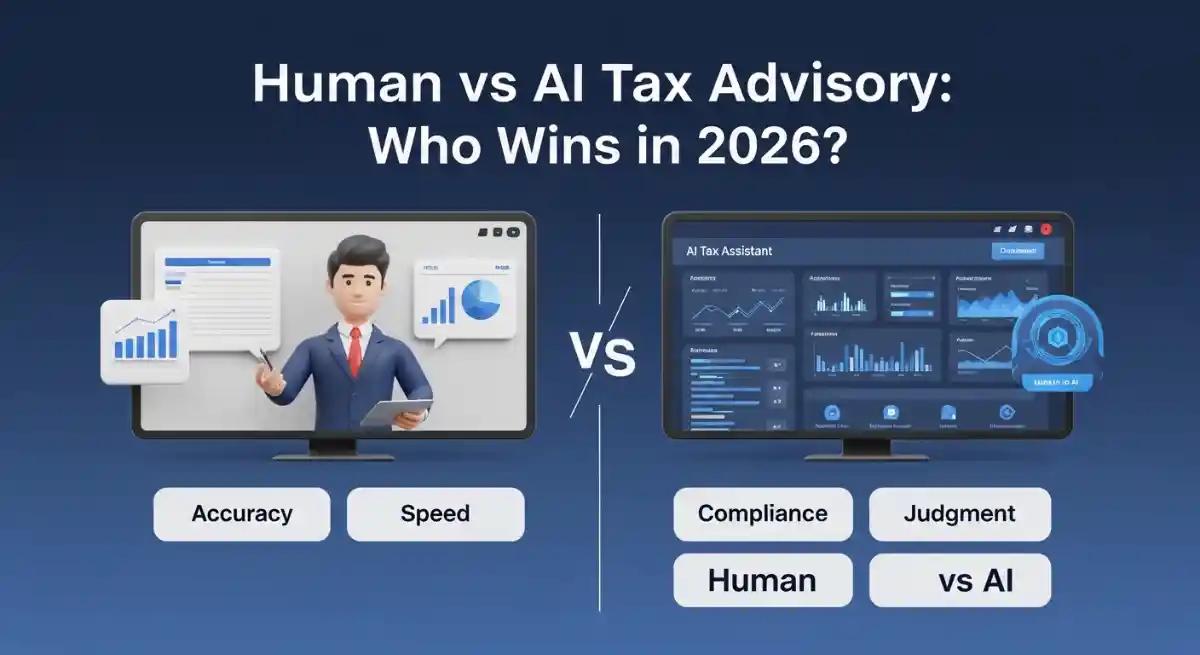
If you've ever sat across from a tax consultant and thought, "Could an app do this better?" — you're not alone. Millions of individuals and businesses worldwide are asking the same question in 2026. Artificial intelligence is no longer a buzzword. It's filing tax returns, flagging compliance risks, and advising on tax planning strategies in real time. But does that mean the human tax accountant is finished? Not quite. The real answer is more nuanced — and understanding it could save your business thousands of rupees, or dollars, depending on where you operate.
Let's break it down honestly.
What Is AI Tax Advisory — and How Does It Actually Work?
AI tax advisory refers to the use of machine learning, natural language processing, and intelligent automation to handle tasks traditionally done by a certified public accountant or tax consultant. Tools like TurboTax, H&R Block's AI assistant, and emerging platforms in Pakistan are now capable of reading financial data, applying current tax legislation, calculating tax liabilities, and even suggesting tax strategies — all without a human in the room.
These AI tax preparation tools work by processing large volumes of structured financial data against a ruleset derived from tax law. They're fast, consistent, and increasingly accurate for standard scenarios.
But here's where it gets interesting.
Tax law is not always standard. And in markets like Pakistan, where FBR regulations shift frequently and compliance requirements vary by business type, standard scenarios are actually the minority.
The Case for AI: Speed, Cost, and Consistency
There's no denying that AI has earned its place in the tax advisory landscape. Here's what it genuinely does well.
Speed and Scalability
An AI-powered tax tool can process hundreds of returns simultaneously. For a mid-sized accounting firm handling hundreds of salaried clients, automating routine income tax return filing through tools integrated with FBR's IRIS portal saves enormous time. What takes a human tax professional two to three hours can take AI under two minutes.
Cost Efficiency
Hiring a senior tax accountant in Pakistan costs anywhere from PKR 60,000 to PKR 250,000+ per month depending on experience and the firm. AI tax software subscriptions, even for business-grade packages, can run a fraction of that. For small businesses and startups in Karachi, Lahore, and Islamabad looking to stay FBR-compliant without overextending their budget, this matters.
Consistency and Error Reduction
Humans make mistakes under pressure. AI doesn't get tired. When applying generally accepted accounting principles (GAAP) to standard transactions, AI-powered accounting software produces consistent results. It doesn't misapply a tax slab because it had a long day.
Data-Driven Tax Decisions
Modern AI tools pull real-time data, cross-reference it with tax legislation, and flag potential liabilities or deductions automatically. This kind of data-driven tax decision-making is genuinely useful for businesses trying to stay ahead of compliance with tax laws.
The Case for Humans: Judgment, Relationships, and Complex Strategy
Here's what AI cannot do — at least not yet.
Interpreting Ambiguous Tax Legislation
Tax legislation is written by humans, interpreted by regulators, and applied to unique situations. When the FBR issues a new notification or when a business has an unusual corporate structure, a human tax consultant draws on years of experience, professional judgment, and knowledge of how auditors think. AI reads the rule. A human understands the intent behind it — and that distinction can be worth millions in a tax audit.
Client-Specific Tax Planning
True tax planning goes beyond calculations. It requires understanding a client's business goals, risk appetite, family circumstances, investment horizon, and future plans. A certified tax advisor sitting across from a client asks questions that no AI prompt has yet been designed to ask. Personalized tax planning for multinational companies, for instance, requires diplomatic sensitivity, multi-jurisdictional knowledge, and strategic foresight that machine learning simply cannot replicate today.
Representing Clients Before the FBR
This is one of the clearest dividing lines. If you receive an audit notice under Section 114 or face an FBR compliance investigation, you need a qualified human professional — a licensed tax consultant or enrolled agent — to represent you. AI cannot appear before tax authorities. It cannot argue your case, negotiate a resolution, or read the room in a hearing. For guidance on how FBR audit notices work in Pakistan, the ICT blog on how FBR audit notices work is an excellent resource.
Emotional Intelligence in Advisory
Tax stress is real. When a business owner is facing a massive unexpected liability, they don't just need calculations — they need reassurance, context, and a plan they can understand emotionally as well as financially. Human tax professionals provide that. AI gives you a number and a risk score.
Human vs AI Tax Advisory: A Direct Comparison
| Factor | Human Tax Consultant | AI Tax Advisory Tool |
| Speed | Moderate | Very Fast |
| Cost | Higher | Lower |
| Complex Tax Strategy | Excellent | Limited |
| FBR Representation | Yes | No |
| Emotional Support | Yes | No |
| Real-Time Updates | Depends on Professional | Often Automated |
| Accuracy (Standard Cases) | High | Very High |
| Accuracy (Complex Cases) | Very High | Moderate |
| Personalized Planning | Yes | Limited |
| Error Rate | Low (with experience) | Very Low (for routine tasks) |
The verdict from this table is not a winner — it's a partnership. And that's exactly how leading accounting firms are approaching 2026.
What Human Tax Professionals Actually Do That AI Can't Replace
The Bureau of Labor Statistics projects continued demand for tax accountants and auditors, even as automation rises. Why? Because the role of a tax accountant has evolved. Senior tax accountant responsibilities have shifted from data entry and basic calculations — which AI now handles — toward advisory, litigation support, business strategy, and client relationship management.
A qualified human tax professional in 2026:
- Advises businesses on restructuring to minimize corporate tax exposure
- Guides individuals on deductions, credits, and legitimate tax strategies
- Manages tax compliance for business entities operating under complex ownership structures
- Represents clients before tax authorities including the FBR
- Identifies opportunities in tax legislation that AI tools might overlook due to ambiguous language
- Builds long-term financial planning strategies that align tax efficiency with business growth
If you're considering a career as a tax accountant, the age of AI hasn't made you redundant — it's made you more valuable, as long as you upgrade your skill set. A good starting point is reading about how to become a tax accountant and what the modern career path looks like.
The Pakistan Angle: AI Tax Advisory and FBR Compliance in 2026
Pakistan's tax landscape is uniquely complex. The Federal Board of Revenue has been aggressively modernizing its systems — the IRIS 2.0 portal, digital invoicing mandates, and expanding the active taxpayer list (ATL) are all part of a broader digital transformation. You can read more about this on ICT's guide to FBR's digital transformation in Pakistan.
AI tools can help with:
- Automated FBR income tax return filing for salaried persons
- Sales tax return calculations and submissions
- NTN registration support
- Monitoring ATL status and filer verification
- Generating FBR-compliant digital invoices
However, Pakistan-specific challenges make human consultants indispensable:
- Frequent changes to FBR policy and notifications require real-time human interpretation
- Non-filer penalty escalation in 2026 has made compliance more critical — and more confusing — than ever (see ICT's blog on FBR non-filer penalties 2026)
- SMEs in Karachi, Lahore, and Islamabad often operate with mixed income streams that require nuanced categorization
- Business owners frequently need guidance that blends tax compliance with corporate law — something AI tools are not designed to provide holistically
The best tax advisory services in Pakistan in 2026 are those combining AI-powered tools with certified human consultants who understand the local regulatory environment deeply.

Very Low (for routine tasks)
AI Tools Tax Professionals Are Using in 2026
Rather than replacing human tax professionals, AI is becoming their most powerful tool. The smartest tax consultants and accounting firms are using platforms that automate the repetitive and using their brainpower for the complex. Here are the types of tools dominating the space:
- IRIS-integrated filing software for automated FBR tax return submission
- AI-powered bookkeeping platforms like QuickBooks AI and Xero that sync bank data and auto-categorize transactions
- Tax liability calculators with machine learning that update dynamically with new slabs
- Audit risk assessment tools that scan returns for red flags before submission
- Natural language AI assistants that answer routine client queries, freeing up consultant time
For a comprehensive list of tools that tax professionals are using, ICT has published a useful breakdown at software tax professionals use.
Career as a Tax Accountant in the Age of AI: Is It Still Worth It?
Absolutely — but the path has changed.
In 2026, a tax accountant career is not about manually crunching numbers. It's about interpreting, advising, representing, and strategizing. The professionals thriving today are those who understand both tax law and how AI tools work — making them capable of using technology efficiently while delivering the human judgment clients genuinely need.
According to the Bureau of Labor Statistics, employment of accountants and auditors is expected to remain steady through the late 2020s, with growing demand in areas like tax compliance, advisory services, and forensic accounting. The tax accountant salary for qualified professionals with advisory skills is rising, not falling, in response to AI adoption.
If you're looking to future-proof your career, consider specializing in areas where AI is weakest — complex corporate tax strategy, international tax advisory, litigation support, or tax planning for multinational companies.
Pakistan-based professionals are increasingly finding opportunities in UAE, UK, Canada, and US markets by combining local tax knowledge with international certifications. ICT's blog on why UAE companies prefer Pakistani tax professionals explores this growing trend in detail.
How Accounting Firms Are Blending Human and AI Advisory
The most forward-thinking public accounting firms are not choosing between human and AI — they're integrating both into a hybrid advisory model. Here's how it works in practice:
Tier 1 — AI handles: Routine data entry, standard return filing, document verification, deadline tracking, basic tax liability calculations.
Tier 2 — AI assists human: Generating draft tax plans, flagging anomalies, running scenario models, preparing first-draft responses to FBR notices.
Tier 3 — Human leads: Client consultation, complex strategy, litigation, audit representation, relationship management, compliance decisions involving judgment.
This model is producing better outcomes than either AI alone or traditional human-only advisory. Clients get speed and accuracy from automation combined with trust and intelligence from their human advisors.
For businesses wondering whether they still need a human tax advisor in the AI era, ICT has addressed this directly in their piece on why your business needs a tax advisor in the AI era.
Should You Trust AI for Tax Planning? The Honest Answer
For basic, routine tax filing — yes, AI is reliable and efficient. For strategic tax planning, audit defense, and complex compliance decisions — no, AI is not sufficient on its own.
The key risk of over-relying on AI for tax advice is that tax law is contextual. A tool that correctly applies the rule to 95% of cases will still get 5% wrong — and in taxation, that 5% can be the most consequential. Penalties, back taxes, audit notices, and legal liability don't care that your AI tool had a good track record.
The safest and most effective approach in 2026: use AI to make your tax processes faster and cheaper, and invest in a qualified human tax consultant for strategy, audit support, and anything involving judgment calls.
Frequently Asked Questions
Is AI better than a human tax consultant in 2026? AI is faster and cheaper for routine tax filing and compliance tasks. But for complex tax strategy, FBR audit representation, and personalized financial planning, a qualified human tax consultant is significantly more effective. Most businesses benefit from using both together.
Can AI file my tax returns accurately in Pakistan? Yes, for standard salaried income and straightforward business returns, AI-integrated tools can file FBR income tax returns accurately. However, complex business structures, mixed income types, and non-standard situations still require human review to ensure full compliance.
What can a human tax consultant do that AI cannot? A human tax consultant can represent you before the FBR, interpret ambiguous tax legislation, build personalized long-term tax strategies, provide emotional reassurance during audits, and adapt to unique financial circumstances — all areas where AI tools fall short.
Will AI replace tax professionals by 2026? No. AI is automating routine tasks, but the demand for qualified tax professionals who can advise, represent, and strategize is growing. The Bureau of Labor Statistics data supports sustained demand for tax accountants and auditors throughout the decade.
What are the best AI tools for tax compliance in Pakistan? IRIS-integrated filing platforms, QuickBooks AI, Xero, and FBR's own Tax Asaan app are among the most used tools for Pakistan-based tax compliance. They work best when combined with human oversight for complex returns.
How to become a tax accountant in the age of AI? Focus on developing advisory, litigation, and strategic skills alongside technical tax knowledge. Earning a certification from a recognized institution, gaining practical FBR filing experience, and learning how to use AI tax tools effectively will set you apart in the 2026 job market.
Conclusion: The Real Winner Is the Hybrid Model
So who wins — human or AI in tax advisory 2026? Neither, in isolation. The winner is the professional or business smart enough to combine both.
AI brings speed, consistency, and cost efficiency to tax compliance. Human tax consultants bring judgment, empathy, strategic thinking, and legal representation that no algorithm can replicate. In a market as dynamic and regulation-heavy as Pakistan's, that combination is not just smart — it's necessary.
The future of tax advisory is not human versus AI. It's human plus AI, with each doing what it does best.
If you want to build a career that thrives in this new landscape, start by investing in the right education. The Advanced Taxation Course offered by the Institute of Corporate and Taxation (ICT) is designed specifically to equip students and professionals with practical FBR filing skills, strategic tax advisory knowledge, and hands-on experience with the tools that define modern accountancy.
👉 Book your seat in the Advanced Taxation Course at ICT — and position yourself on the right side of the AI revolution in taxation.
For further reading, explore ICT's complete resource library including guides on AI tools every freelance tax consultant will use in 2026, the future of tax advisory in Pakistan 2026–2030, and will AI replace tax consultants.
Comments (0)
No comments yet. Start the conversation!
Leave a Reply
Your email address will not be published. Required fields are marked *