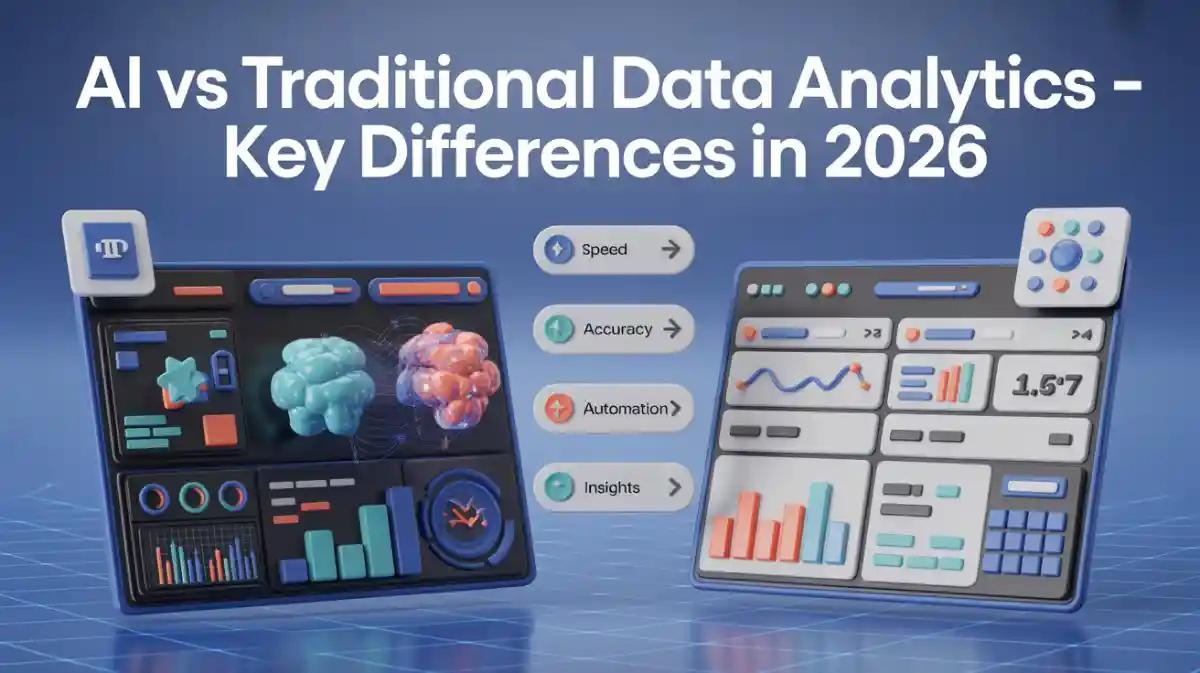
AI vs Traditional Data Analytics – Key Differences in 2026
Data is the new oil — but only if you know how to refine it.
Every business today generates massive amounts of data. The real question is: how do you turn that raw data into meaningful decisions? For decades, traditional data analytics was the gold standard. Spreadsheets, SQL queries, dashboards — it worked well enough. But today, artificial intelligence data analytics has changed the game completely.
Whether you're a business owner in Islamabad, a data professional in London, or a startup founder in Dubai, understanding the difference between AI vs traditional data analytics isn't just useful — it's essential. In 2025, companies that fail to adapt risk falling behind competitors who use AI-driven insights vs manual reporting.
In this article, we break down everything you need to know — clearly, practically, and honestly.
What Is Traditional Data Analytics?
Traditional data analytics refers to the process of collecting, organizing, and analyzing structured data using manual methods, statistical models, and rule-based tools. Think Excel spreadsheets, SQL databases, Power BI dashboards, and Tableau reports.
At its core, traditional analytics follows a simple cycle:
- Collect data from known sources
- Clean and organize it manually
- Apply statistical analysis methods
- Create reports and dashboards
- Let a human analyst interpret the results
This approach relies heavily on business intelligence reporting, ETL (Extract, Transform, Load) processes, and data warehouse analytics. It answers questions like: "What happened last quarter?" or "How much did we sell in March?"
Traditional analytics tools are great for descriptive analytics — telling you what happened in the past. They are less effective when you need to predict the future or process unstructured data like social media posts, voice recordings, or customer reviews.
Some of the most commonly used traditional analytics tools include Microsoft Power BI, Tableau, Google Looker Studio, and Excel-based dashboards. These tools have served businesses well for over two decades — but they have clear limitations when scaled against the demands of modern, data-heavy environments.
What Is AI-Powered Analytics?
AI analytics, or artificial intelligence data analytics, goes several steps further. Instead of just showing you what happened, it tells you why it happened, what is likely to happen next, and even suggests what you should do about it.
AI-powered analytics uses machine learning models, neural networks, natural language processing analytics, and deep learning data processing to analyze both structured and unstructured data — at scale and in real time.
Key capabilities of AI analytics include:
- Predictive analytics AI: Forecasting future trends based on historical patterns
- Anomaly detection: Automatically identifying irregular activity or outliers
- Pattern recognition in data: Finding hidden connections humans would miss
- Real-time data analytics: Processing live data streams as they flow in
- Natural language processing: Analyzing text, speech, and customer sentiment
AI analytics tools include platforms like Google Cloud BigQuery ML, IBM Watson Analytics, Microsoft Azure Machine Learning, and modern augmented analytics platforms that combine human intuition with machine intelligence.
Unlike traditional analytics, AI doesn't wait for a human analyst to ask the right question. It proactively surfaces insights — including ones nobody thought to look for.
AI vs Traditional Data Analytics – Key Differences Explained
Let's get specific. Here is a side-by-side comparison of how AI analytics differs from traditional analytics across the most important dimensions.
1. Speed of Data Processing
Traditional analytics: Analysts manually pull data, clean it, and build reports. This can take hours or days. A weekly sales report often takes a full day to prepare.
AI analytics: Machine learning models process millions of data points in seconds. Real-time analytics using artificial intelligence means decisions are made on live data, not data from three days ago.
Winner: AI — by a wide margin.
2. Type of Data Handled
Traditional analytics works best with structured data — neatly organized rows and columns. If your data lives in a spreadsheet or SQL table, traditional tools handle it well.
AI analytics handles both structured vs unstructured data. It can analyze social media comments, emails, customer call transcripts, images, sensor readings, and more — all simultaneously.
Winner: AI — especially in the age of big data.
3. Human Involvement
Traditional analytics requires significant human involvement at every step. A data analyst course in Pakistan or anywhere else teaches you how to manually build models, interpret results, and create reports. Human judgment is central.
AI analytics automates many of these steps. That said, human oversight is still needed — especially in model validation, ethical decision-making, and interpreting nuanced results. AI doesn't fully replace human analysts; it empowers them.
Winner: Depends on the use case — but AI reduces workload significantly.
4. Scalability of Analytics
Traditional analytics struggles to scale. As data volumes grow, human analysts become a bottleneck. Adding more data means adding more people, which means more cost and time.
AI analytics scales effortlessly. A machine learning model trained on a million records can just as easily handle a billion. Scalability of AI analytics is one of its greatest competitive advantages.
Winner: AI — it's not even close.
5. Accuracy
Human vs AI data analysis is a much-discussed topic. Traditional analytics is only as accurate as the analyst running it. Cognitive biases, fatigue, and incomplete models introduce errors.
AI analytics, when trained on quality data, achieves significantly higher accuracy. According to IBM, AI-powered systems can reduce forecasting errors by up to 50% compared to traditional methods. However, poor training data can make AI models just as flawed — sometimes more so, because the errors are less visible.
Winner: AI — with proper data governance.
6. Cost
Cost of AI analytics vs traditional is a fair concern. Traditional tools like Excel and Power BI are relatively cheap. A basic business intelligence setup costs far less upfront than building an AI analytics pipeline.
However, the long-term ROI of AI analytics is usually superior. You reduce analyst headcount needs, catch errors earlier, and make faster decisions that compound over time.
Winner: Traditional wins on upfront cost; AI wins on long-term value.
7. Insight Type
Traditional analytics delivers descriptive and diagnostic insights — what happened and why. This is valuable but backward-looking.
AI analytics delivers predictive and prescriptive insights — what will happen and what you should do. This is the difference between reading a map of where you've been versus getting GPS directions to where you're going.
Winner: AI — for forward-looking strategy.
How Machine Learning Improves Data Analytics Accuracy
When people ask how machine learning improves data analytics accuracy, the answer comes down to three things: volume, speed, and continuous learning.
Machine learning models don't just analyze data once and stop. They learn from every new data point. Over time, a well-built model becomes more accurate, not less. This is called model training — and it's something no human analyst can truly replicate at scale.
For example, a retail company using AI for demand forecasting doesn't just look at last year's sales. It simultaneously processes weather data, social media trends, competitor pricing, local events, and economic indicators — adjusting its predictions in real time. A human analyst using traditional analytics tools would need weeks to manually correlate even a fraction of those variables.
This is why companies like Amazon, Netflix, and Google have invested billions in AI analytics infrastructure. It's not a trend — it's a competitive necessity.
Limitations of Traditional Business Intelligence Tools
To be fair, traditional analytics isn't dead. But it does have real limitations that are becoming more painful as data volumes grow in 2025.
The biggest limitations of traditional analytics include:
Manual bottlenecks: Every report requires a human to build and validate it. As business complexity grows, this becomes unsustainable.
Static reporting: Most traditional BI tools show you data from the past. They don't adapt or update automatically when circumstances change.
Structured data only: If your data isn't in a clean table format, most traditional tools can't process it without significant manual effort.
Reactive, not proactive: Traditional analytics tells you what went wrong after it went wrong. AI catches problems before they escalate.
Power BI limitations: While Power BI is excellent for visualization, it lacks native predictive modeling capabilities. You can connect it to AI services, but that's a different conversation.
Scalability ceiling: Beyond a certain data volume, traditional tools simply can't keep up without expensive hardware upgrades or significant manual intervention.
These limitations of traditional analytics are the primary reason why companies are rapidly adopting AI-powered alternatives.
When to Use AI Analytics vs Traditional Analytics
This is one of the most practical questions in the field: when to use AI analytics vs traditional analytics.
Use traditional analytics when:
- Your data is well-structured and limited in volume
- You need simple historical reports and dashboards
- Budget is a major constraint
- Your team lacks technical AI expertise
- Regulatory requirements demand fully explainable, auditable decision-making
Use AI analytics when:
- You're working with large, complex, or unstructured datasets
- You need real-time insights or predictive forecasting
- You want to automate repetitive analysis tasks
- Your business decisions require pattern recognition across multiple variables
- You want to identify anomalies or opportunities at scale
For most mid-to-large organizations in 2025, the answer is a hybrid approach — using traditional BI tools for routine reporting while layering AI analytics for strategic decision-making.
Which Industries Benefit Most from AI Analytics
AI analytics is transforming virtually every sector. But some industries have seen the most dramatic impact.
Healthcare: AI analytics platforms analyze patient data, predict disease progression, and optimize hospital resource allocation. Real-time analytics using artificial intelligence has directly improved patient outcomes.
Finance and Banking: AI-driven anomaly detection catches fraudulent transactions in milliseconds — something no human analyst could achieve manually. Predictive analytics AI also powers credit scoring, risk modeling, and algorithmic trading.
Retail and E-Commerce: AI analyzes purchase history, browsing behavior, and social sentiment to personalize recommendations and forecast demand. Amazon's recommendation engine alone reportedly drives 35% of its revenue.
Manufacturing: AI monitors equipment sensors in real time, predicting failures before they happen. This is a field where the cost of AI analytics vs traditional methods pays off quickly.
Marketing and Advertising: AI analytics identifies audience segments, optimizes ad spend in real time, and measures campaign attribution across dozens of channels simultaneously.
HR and Talent Analytics: AI in HR analytics helps identify top candidates, predict employee turnover, and measure team performance patterns.
In Pakistan specifically, AI analytics adoption is growing rapidly across telecom, banking, and retail sectors. Professionals who invest in data analytics courses in Islamabad or across Pakistan are positioning themselves at the forefront of this shift.

AI vs Traditional Data Analytics – Key Differences in 2026
Why Companies Are Switching from Traditional to AI Analytics
The shift from traditional to AI analytics isn't driven by hype — it's driven by measurable results. Here's why companies switch to AI analytics:
Faster decision cycles: Businesses operating on weekly reports lose to competitors operating on real-time AI insights.
Competitive intelligence: AI can monitor competitor pricing, product launches, and customer sentiment at scale — impossible with traditional tools.
Cost efficiency at scale: AI automates data analysis jobs that previously required entire teams of analysts.
Customer experience: AI enables hyper-personalization, which drives loyalty and revenue.
Risk management: Predictive analytics flags risks before they become crises — from supply chain disruptions to customer churn.
According to McKinsey's 2024 Global AI Survey, organizations that fully adopt AI analytics report 20–30% reductions in operational costs and revenue gains of 5–10% within the first two years.
AI vs Traditional Analytics in 2025 – What's New
The landscape of AI vs traditional analytics 2025 looks significantly different from even three years ago. Several emerging developments are worth noting.
Generative AI in data analytics: Tools like ChatGPT for data analytics allow non-technical users to query databases in plain English. You don't need to write SQL anymore — you just ask your question.
LLM for data analysis: Large language models are being integrated into analytics platforms, enabling natural language reporting, automated insight generation, and conversational data exploration.
AI agents in analytics: Autonomous analytics platforms now deploy AI agents that independently gather data, run analyses, and deliver reports — requiring minimal human input.
AI decision intelligence: This emerging field combines data science, behavioral science, and AI to not just recommend decisions, but model their likely outcomes across multiple scenarios.
Next-gen analytics AI: Platforms like Databricks, Snowflake, and Google Vertex AI are converging data engineering and AI modeling into unified, cloud-native environments.
These AI analytics trends 2025 signal one thing clearly: the gap between AI-powered and traditional analytics will only widen.
AI Data Analyst Course in Pakistan – Why ICT Is Leading the Way
Understanding these concepts is one thing. Actually building the skills to work with AI analytics is another — and this is where ICT (Institute of Corporate and Taxation) stands out as one of Pakistan's most respected training institutions.
ICT offers a Certified Data Analyst course specifically designed for professionals and students who want to enter the data analytics field with real, job-ready skills. The course covers data analysis fundamentals, machine learning models, Python for data analytics, visualization tools, and AI-powered analytics workflows.
For those interested in broader data and AI training, ICT also provides resources on AI data analyst certification course skills and a comprehensive guide on becoming an AI data analyst in Pakistan.
Whether you're in Islamabad, Lahore, or Karachi — ICT's courses are structured to get you from beginner to industry-ready professional. If you're searching for data analytics courses in Islamabad or a data analyst course in Pakistan with practical, hands-on training, ICT is the clear first choice.
Their AI Data Analyst Career 2025 guide is an excellent free resource to start with, covering job scope, salary expectations, and the skills employers actually look for.
You can also explore why students choose ICT for AI and data training in Pakistan and what differentiates ICT from other institutes.
For the most up-to-date course offerings, visit the full ICT courses page.
Future of Data Analytics – Where Is This Heading?
The future of data analytics is clear: AI will handle the heavy lifting, and humans will focus on strategy, ethics, and interpretation.
This doesn't mean data analysts will disappear. It means the role of a data analyst is evolving. Tomorrow's top analysts will be those who understand both the technical side of machine learning and the business context of the decisions they're informing.
Autonomous analytics platforms will become standard. Business intelligence vs AI analytics will no longer be a debate — they'll be integrated into the same platform. AI decision intelligence will make scenario modeling accessible to every department, not just data science teams.
For professionals in Pakistan, the Middle East, UK, Canada, and beyond — the window to upskill in AI and machine learning analytics is right now. AI analytics adoption Asia Pacific and across the Middle East is accelerating faster than many expect.
The professionals and businesses that invest in learning AI analytics today will be the ones leading industries tomorrow.
Frequently Asked Questions
What is the difference between AI analytics and traditional analytics?
Traditional analytics uses rule-based, manual methods to analyze structured, historical data. AI analytics uses machine learning, deep learning, and natural language processing to analyze both structured and unstructured data — delivering real-time, predictive, and prescriptive insights automatically.
Is AI better than traditional data analysis?
For most modern business needs in 2025, yes. AI analytics is faster, more scalable, handles more data types, and delivers forward-looking insights. However, traditional analytics still has value for simple reporting, regulated environments, and budget-constrained teams.
Can AI replace data analysts?
AI automates many routine analysis tasks, but it cannot replace human analysts entirely. Strategic thinking, ethical judgment, business context interpretation, and stakeholder communication still require human expertise. AI empowers analysts — it doesn't eliminate them.
What are the limitations of traditional data analytics?
Traditional analytics is limited by manual bottlenecks, an inability to process unstructured data at scale, static and backward-looking reporting, and a scalability ceiling that becomes a serious problem as data volumes grow.
What tools are used in AI analytics vs traditional analytics?
Traditional analytics tools include Excel, Tableau, Power BI, SQL, and Google Looker Studio. AI analytics tools include Python (with Scikit-learn, TensorFlow, PyTorch), Google BigQuery ML, IBM Watson, Microsoft Azure ML, and cloud-native AI platforms like Databricks and Snowflake.
Which industries benefit most from AI analytics?
Healthcare, finance, retail, manufacturing, marketing, and human resources are among the top beneficiaries of AI analytics — with measurable gains in efficiency, accuracy, and cost reduction.
What is augmented analytics?
Augmented analytics is the combination of AI and machine learning with traditional business intelligence tools to automate data preparation, insight generation, and explanation. It bridges the gap between traditional BI and full AI analytics — making advanced insights accessible to non-technical business users.
Conclusion
The debate of AI vs traditional data analytics is not about which one is "right." It's about knowing which tool fits which job — and having the skills to use both intelligently.
Traditional analytics gave us the foundation. AI analytics is building the future on top of it. In 2025, the most competitive professionals and businesses will be those who understand both worlds and know how to navigate the shift.
If you're serious about building a career in data analytics or AI — or if you want to bring these capabilities to your business — there's no better time to start than right now.
ICT's Certified Data Analyst course is designed to give you practical, employer-ready skills in data analysis, machine learning tools, and AI-powered workflows. Whether you're a fresh graduate, a working professional, or a business owner looking to upskill your team — ICT has a program built for you.
Book your seat today at ICT — Pakistan's No. 1 institute for data analytics and AI training. Visit ict.net.pk to explore courses, read student success stories, and take the first step toward a smarter, higher-earning career in data.
The future belongs to those who understand data. Make sure you're one of them.
Comments (0)
No comments yet. Start the conversation!
Leave a Reply
Your email address will not be published. Required fields are marked *