How to Become a Tax Preparer in Pakistan: Qualifications, Courses, and Career Path (2026)
If you have ever wondered how to become a tax preparer in Pakistan, you are not alone. With the Federal Board of Revenue (FBR) pushing hard for digital compliance and tax broadening in 2026, the demand for qualified tax filing professionals in Pakistan has never been higher. Whether you are a fresh graduate, an accountant looking to specialize, or someone completely new to finance — this guide gives you a complete, step-by-step roadmap to become a certified tax preparer in Pakistan, land clients, and build a rewarding career.
Let us get straight into it.
What Is a Tax Preparer in Pakistan?
A tax preparer in Pakistan is a professional who helps individuals, freelancers, salaried employees, and businesses file their income tax returns, sales tax returns, and wealth statements with the Federal Board of Revenue. They work on the FBR IRIS portal, register taxpayers for NTN (National Tax Number), handle withholding tax statements, manage advance tax under Section 147, and advise clients on minimizing tax liability legally.
Think of them as the bridge between everyday Pakistanis and the complex tax system governed by the Income Tax Ordinance 2001 and the Sales Tax Act 1990.
A tax preparer is different from a Chartered Accountant or ACCA-qualified professional — they do not need to audit accounts or sign off on financial statements. Their core job is tax compliance, tax filing, and tax advisory — which makes it a far more accessible career path for beginners.
Why Tax Preparation Is One of the Smartest Careers in Pakistan Right Now
Here is a fact most people overlook: Pakistan has over 9 million registered taxpayers on the Active Taxpayer List (ATL), and that number is growing every year. FBR's aggressive drive against non-filers in 2026 — including blocked SIMs, restrictions on property purchases, and higher withholding tax rates for non-filers — has pushed millions of Pakistanis to seek professional help with tax filing.
This creates real, recurring demand for tax preparers across Karachi, Lahore, Islamabad, Rawalpindi, Faisalabad, Multan, Peshawar, and Quetta.
The career scope of taxation in Pakistan in 2026 is massive. Businesses need tax practitioners. Salaried individuals need help filing returns. Freelancers earning from platforms like Upwork and Fiverr need specialized compliance support. And every single one of them needs a professional tax preparer.
If you want to calculate what your own tax liability looks like before diving into this career, use this Pakistan Income Tax Calculator — it gives you instant results based on FBR's 2025-26 tax slabs.
Who Can Become a Tax Preparer in Pakistan?
This is the most asked question — and the answer is more flexible than most people think.
You do NOT necessarily need a degree to start as a tax preparer in Pakistan. However, having a relevant background certainly helps you grow faster. Here is a breakdown:
Fresh Graduates — B.Com, BBA, BS Accounting, or BA Economics graduates can begin right away with a practical taxation course. Many successful tax preparers in Pakistan started with nothing more than a short certification and hands-on training.
Accountants and Finance Professionals — If you already hold qualifications like ACCA, ICMA, PIPFA, or are a CA student, adding a practical taxation certification accelerates your career significantly.
Non-Finance Backgrounds — Lawyers, IT professionals, and even business owners with no formal finance education have successfully become tax practitioners in Pakistan by taking focused short courses.
Freelancers — If you already handle overseas clients, understanding Pakistan's freelancer tax rules under the Fixed Final Tax regime is both a legal necessity and a powerful service you can offer your network. Try the Pakistan Freelance Tax Calculator to understand your current obligations.
The bottom line: the door is open to almost everyone. What matters is getting the right training.
What Qualifications Do You Need to Become a Tax Preparer in Pakistan?
There is no single mandatory government licence to operate as a tax preparer in Pakistan the way there is in the USA (where a PTIN is required). However, the following qualifications and certifications dramatically improve your credibility, client trust, and earning potential:
1. Certified Tax Advisor (CTA) Certification This is one of the most practical and recognized certifications for tax preparers in Pakistan. It covers FBR IRIS portal operations, income tax return filing, sales tax compliance, NTN registration, withholding tax management, and tax audit handling. ICT (Institute of Corporate and Taxation) offers the most sought-after Certified Tax Advisor Course in Pakistan — with practical, hands-on training designed specifically for the real-world Pakistan tax environment.
2. Diploma in Taxation (Income Tax + Sales Tax) Offered by institutions like PIM (Pakistan Institute of Management) in Karachi, Lahore, and Islamabad, and IBA's Centre for Executive Education in Karachi, this 4-month diploma covers both direct and indirect taxes comprehensively.
3. Certificate in Practical Taxation (ICMA Pakistan) The ICMA International (Institute of Cost and Management Accountants of Pakistan) offers a Certification in Practical Taxation that covers income tax filing, sales tax returns, provincial sales tax, and withholding tax compliance — ideal for finance professionals looking to add tax expertise.
4. Advanced Certificate in Taxation (CITP) The Chartered Institute of Taxation Pakistan offers structured programs covering direct taxes, indirect taxes, and international taxation — a strong choice for those targeting corporate or cross-border tax roles.
5. NSU Tax Certification — Islamabad National Skills University in Islamabad offers an accessible tax certification course that teaches FBR IRIS portal usage and return filing — ideal for beginners in the capital region.
6. Advanced Taxation and Litigation Course For those who want to go further — representing clients before FBR, handling audit notices, and filing appeals — ICT's Advanced Taxation and Litigation Course is the most comprehensive practical programme in Pakistan right now.
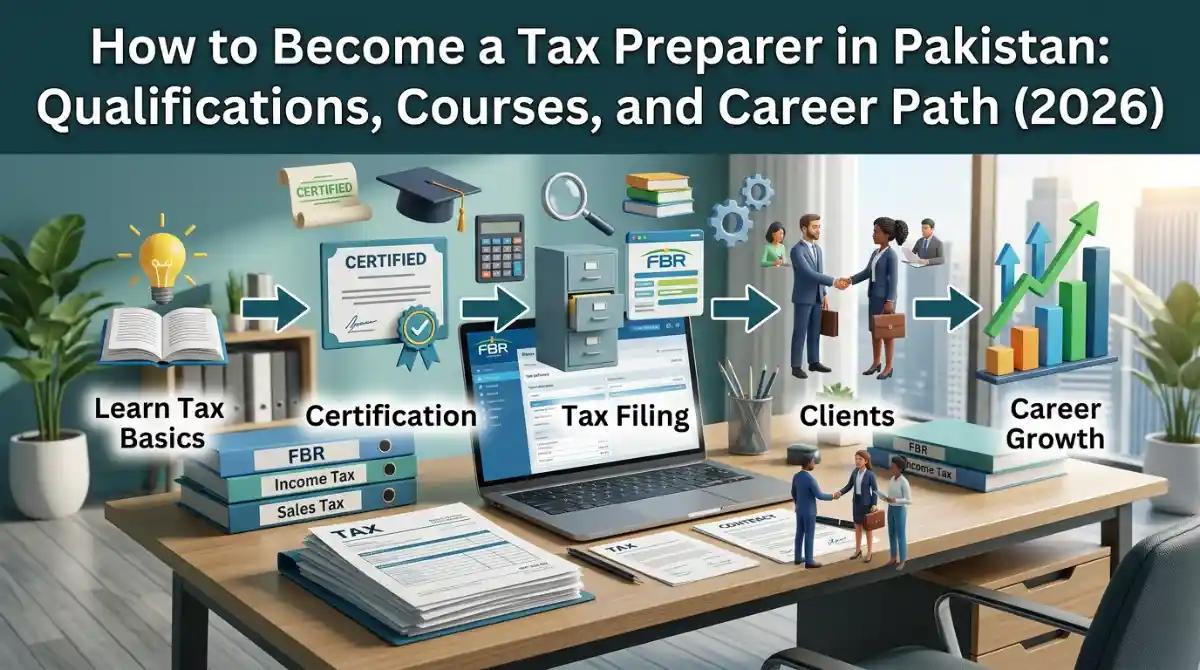
Step-by-Step: How to Become a Tax Preparer in Pakistan (2026)
Here is the exact career path laid out clearly:
Step 1: Build foundational knowledge Understand the basics of Pakistan's tax system — income tax, sales tax, provincial taxes (PRA, SRB, KPRA, BRA), and the FBR's IRIS portal. You can read ICT's foundational blogs on how to file an income tax return in Pakistan and what is the FBR IRIS portal to get started.
Step 2: Enroll in a practical taxation course Choose a course that emphasizes hands-on training — not just theory. Look for programmes that teach you to actually file returns on the FBR portal, handle NTN registrations, prepare withholding tax statements, and respond to FBR notices. ICT's Certified Tax Advisor course is the best starting point for this reason — it covers all of this with real-case practice.
Step 3: Get your own NTN registered To offer tax services professionally, you need to register yourself as a filer with FBR and obtain your NTN number. This is done through the FBR IRIS portal at iris.fbr.gov.pk. The process is straightforward — you register with your CNIC, verify your email and mobile, and submit your profile. Read ICT's detailed guide on steps to obtain NTN in Pakistan 2026.
Step 4: Build practical experience Start by filing tax returns for family members, friends, or small business owners in your area — for free or at a low cost. This gives you real portfolio experience and helps you understand the nuances of different client types (salaried, business, freelancer, corporate).
Step 5: Get certified and start marketing your services Once you have a certification and some practical experience, start promoting your services. LinkedIn, local Facebook groups, and WhatsApp networks are powerful tools for getting your first paid clients in Islamabad, Karachi, Lahore, or any other city. ICT's blog on how to get recurring income tax clients in Pakistan has excellent strategies.
Step 6: Consider specialization Once you have the basics covered, you can specialize in areas like US taxation (working remotely with American clients via platforms like Upwork), UAE VAT compliance, Canadian taxation (CRA), UK taxation (HMRC), or corporate tax planning for Pakistani businesses. ICT offers dedicated courses in US Taxation, UAE Taxation, UK Taxation, Canadian Taxation, and Saudi Taxation.
Best Taxation Institutes in Pakistan (2026)
Here is an honest overview of where to learn:
ICT — Institute of Corporate and Taxation, Islamabad Widely regarded as the No. 1 taxation institute in Pakistan for practical training. ICT's courses are designed around real FBR scenarios, not just textbook content. They offer courses in Pakistan taxation, international taxation (US, UAE, UK, Canada, Saudi Arabia), advanced excel, company law, and corporate advisory. Visit ict.net.pk/courses for the full range.
PIM — Pakistan Institute of Management Government-backed institute with taxation diplomas in Karachi, Lahore, and Islamabad. The 4-month diploma in income tax and sales tax is a solid choice for professionals already in the workforce.
IBA Centre for Executive Education — Karachi The IBA Karachi taxation diploma is a highly respected 3-month programme for finance professionals and business owners. Classes run on weekends, making it practical for working individuals.
CITP — Chartered Institute of Taxation Pakistan Offers Certificate in Taxation Management (CTM) and Advanced Certificate in Taxation (ACT) — rigorous examinations-based qualifications for those targeting senior tax roles.
Pakistan Institute of Taxation (PIT) — Karachi An online-focused institute delivering tax training virtually across Pakistan — a great option for students outside major cities.
NSU — National Skills University, Islamabad Affordable certificate course focused on FBR IRIS portal usage and return filing — ideal for beginners in Islamabad and Rawalpindi.
For business owners wondering about their own tax obligations, the Pakistan Business Tax Calculator can be a helpful starting point before you seek a tax preparer.

How to Become a Tax Preparer in Pakistan 2026 Career Guide
Tax Preparer Salary in Pakistan 2026 — Real Numbers
Let us talk about earning potential because this is what most people want to know.
According to ICT's published salary research for tax professionals in Pakistan, the earning ranges in 2026 are:
- Fresh / Entry Level Tax Preparer: PKR 35,000 – 60,000 per month
- 1–3 Years Experience Tax Consultant: PKR 60,000 – 100,000 per month
- Mid-Level Tax Advisor (3–6 Years): PKR 80,000 – 150,000 per month
- Senior Tax Professional (6–10 Years): PKR 180,000 – 350,000+ per month
- Tax Litigation Specialist / FBR Appeals Expert: PKR 150,000 – 500,000+ per month
For freelancers offering tax services to international clients in the US, UK, UAE, or Canada, monthly earnings can reach USD 1,000–3,000+ depending on client volume and specialization — a figure that surpasses most corporate jobs in Pakistan.
Karachi generally offers the highest salaries among Pakistani cities, followed by Islamabad and Lahore.
Tax Preparer vs CA vs ACCA: Which Path Is Right for You?
This is a common dilemma. Here is a direct comparison:
A Chartered Accountant (CA) qualification from ICAP takes 4–6 years minimum, involves multiple rigorous examinations, and opens doors to audit, financial reporting, and CFO-level roles. It includes taxation but is not focused exclusively on it.
An ACCA qualification typically takes 3–5 years and is internationally recognized — again, broad-based finance qualification that includes tax modules.
A Certified Tax Advisor or Practical Taxation Certification from ICT or CITP can be completed in 3–6 months, is practice-focused, costs a fraction of CA or ACCA, and allows you to start earning as a tax preparer almost immediately.
The choice depends on your goals. If you want to become a CFO or auditor at a Big Four firm, pursue CA or ACCA. If you want to build a tax practice, earn quickly, and serve clients independently, a focused taxation certification is the smarter first move — and you can always pursue CA or ACCA alongside or after.
Read ICT's honest comparison guide on whether the Certified Tax Advisor course is worth it in 2026 for a detailed breakdown.
Can You Work From Home as a Tax Preparer in Pakistan?
Yes — absolutely, and this is one of the most exciting aspects of this career in 2026. The FBR IRIS portal and all provincial tax portals (SRB for Sindh, PRA for Punjab, KPRA for Khyber Pakhtunkhwa, BRA for Balochistan) are fully online. You can file returns, register clients for NTN or STRN, make tax payments, and respond to FBR notices entirely from your laptop — from anywhere in Pakistan.
Many tax preparers in Pakistan operate home-based consultancies serving clients across multiple cities. With tools like Zoom, WhatsApp, and email, geography is no longer a limitation.
You can also offer international tax services to US, UK, UAE, or Canadian clients remotely. ICT's blog on how Pakistanis are building global tax careers explains exactly how this works in practice.
Key Tax Laws Every Tax Preparer in Pakistan Must Know
To serve clients competently, you need working knowledge of:
- Income Tax Ordinance 2001 (and all amendments through Finance Act 2025)
- Sales Tax Act 1990
- Provincial Sales Tax on Services laws (SRB, PRA, KPRA, BRA)
- Withholding Tax provisions under the Income Tax Ordinance
- Advance Tax under Section 147
- Super Tax provisions for high-income individuals and companies
- Minimum Tax and Final Tax regimes
- Wealth Statement filing requirements
- E-invoicing requirements under FBR's digital invoicing system (2026)
If you are working with freelancers, understanding the Fixed Final Tax regime and how to calculate freelancer taxes is critical. Use the Pakistan Freelance Tax Calculator to understand how freelancer income is taxed before advising clients.
For Zakat deduction eligibility — which affects tax credits — the Zakat Calculator is a helpful resource to share with clients.
Frequently Asked Questions (FAQs)
What is a tax preparer in Pakistan? A tax preparer in Pakistan is a professional who files income tax returns, sales tax returns, and wealth statements on behalf of individuals and businesses through the FBR IRIS portal. They also handle NTN registration, withholding tax compliance, and FBR audit notices.
Is a degree required to become a tax preparer in Pakistan? No, a formal degree is not legally required to operate as a tax preparer in Pakistan. However, completing a recognized practical taxation course — such as ICT's Certified Tax Advisor programme — is strongly recommended for credibility and competence.
How do I register as a tax practitioner with FBR? You register on the FBR IRIS portal at iris.fbr.gov.pk using your CNIC. Once your NTN is issued and your return filing history is established, you can begin offering tax services. Some institutional certifications also provide professional recognition.
How much does a tax preparer earn in Pakistan? Entry-level tax preparers earn PKR 35,000–60,000 per month. With 3–5 years of experience and a client base, earnings rise to PKR 100,000–350,000+ per month. Freelancers serving international clients can earn USD 1,000–3,000+ monthly.
Which course is best for taxation in Pakistan in 2026? ICT's Certified Tax Advisor Course and Advanced Taxation and Litigation Course are widely regarded as the best practical taxation programmes in Pakistan. For international taxation, ICT also offers dedicated courses in US, UAE, UK, Canadian, and Saudi taxation.
How long does it take to become a tax consultant in Pakistan? With a focused short course (3–6 months), you can begin offering tax preparation services. Building a full client base and senior-level expertise typically takes 2–3 years of practical experience.
Can I become a tax preparer without any accounting background? Yes. Many successful tax preparers in Pakistan come from non-finance backgrounds. A well-structured practical course that teaches FBR IRIS operations, return filing, and tax law fundamentals is sufficient to start.
Conclusion: Your Next Step Starts Today
The taxation career path in Pakistan in 2026 is wide open — and the demand is only growing. With millions of filers, expanding FBR digitization, and aggressive enforcement against non-compliance, qualified tax preparers are needed everywhere from Islamabad to Karachi, Lahore to Quetta.
The most important step is not waiting for the perfect moment. Enroll in a practical course, get hands-on training with real FBR cases, and start building your client base.
Whether you want to run a local tax consultancy, work with corporate clients, or build a remote practice serving US or UAE clients — it all starts with the right education.
Book a seat in ICT's Advanced Taxation Course today and take the first step toward a career that pays well, grows consistently, and keeps you ahead of the curve — visit ict.net.pk/courses/advance-taxation-and-litigation to enroll now.
Also explore ICT's full course catalogue at ict.net.pk/courses — from Pakistan taxation to US taxation, UAE VAT, UK HMRC compliance, Canadian CRA training, and more.
Want to check your own tax liability before your next filing? Use the free Pakistan Income Tax Calculator, Business Tax Calculator, or Freelance Tax Calculator — quick, accurate, and FBR-aligned.
Comments (0)
No comments yet. Start the conversation!
Leave a Reply
Your email address will not be published. Required fields are marked *