
Import Export Laws Every Entrepreneur Must Know in Pakistan
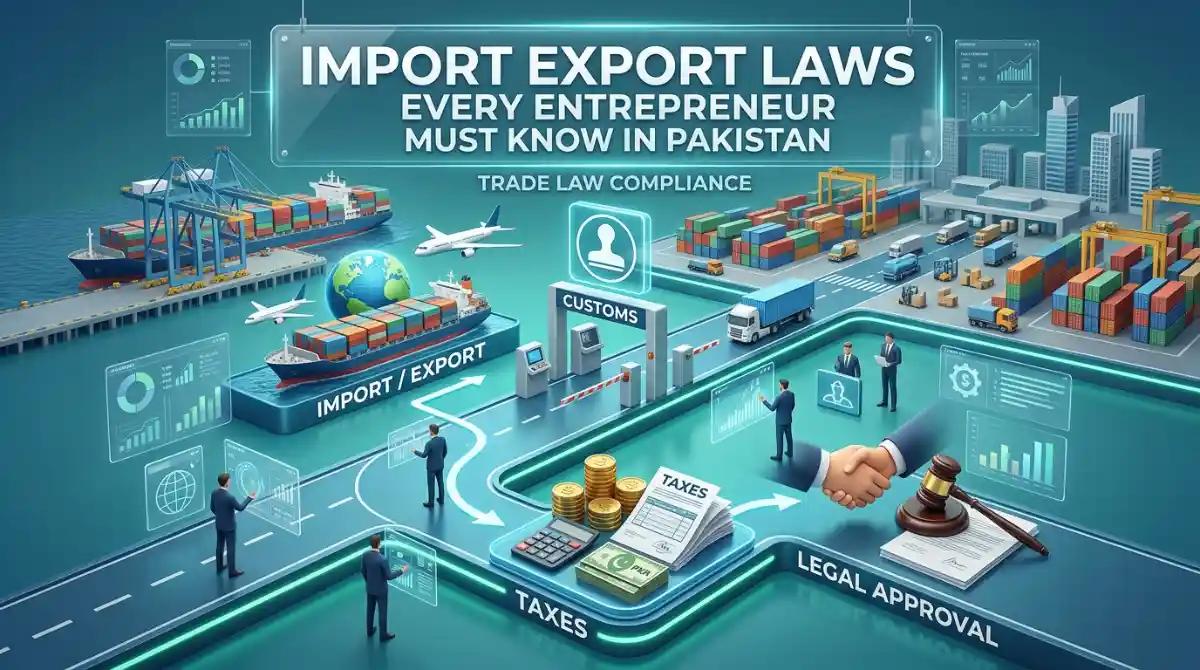
If you are thinking about starting an import export business in Pakistan, the first thing you need to understand is this — the law comes before the profit.
Many entrepreneurs in Karachi, Lahore, and Islamabad jump into international trade with great enthusiasm but zero knowledge of Pakistan's customs laws, FBR regulations, and TDAP requirements. The result? Penalties, shipment delays, and sometimes complete business shutdown.
This guide breaks down every import export law every entrepreneur must know — written in plain language, with real steps and zero legal jargon. Whether you are a complete beginner or already running a small trading business, this article will save you from costly mistakes and set you up for long-term compliance.
What Are Import Export Laws and Why Do They Matter in Pakistan?
Import export laws are the legal framework that governs how goods move in and out of a country. In Pakistan, these laws are enforced by multiple government bodies — primarily the Federal Board of Revenue (FBR), the Trade Development Authority of Pakistan (TDAP), and the State Bank of Pakistan (SBP).
These laws cover everything from business registration to customs duties, documentation, prohibited goods, and foreign exchange rules.
Why does this matter to you as an entrepreneur?
Pakistan exported goods worth over $27 billion in FY2023, while imports stood at over $55 billion. That is a massive economic engine — and every rupee moving through it is subject to trade regulations. If you do not understand these rules, you are not just risking fines. You are risking your entire business.
1. Registration and Legal Setup — The Foundation of Your Import Export Business
Before you import or export a single product, you need to be legally registered. This is where most beginners in Pakistan skip steps and pay for it later.
SECP Company Registration
Your first step is registering your business with the Securities and Exchange Commission of Pakistan (SECP). You can register as a sole proprietor, partnership firm, or private limited company. For import export businesses, a private limited company adds credibility with international buyers and banks.
You can complete SECP registration online through their e-services portal. The process takes 1–3 working days if your documents are in order. For a complete walkthrough of company registration requirements, read our detailed guide on SECP Annual Return Filing and Company Compliance in Pakistan.
NTN Registration with FBR
Once your company is registered, you need a National Tax Number (NTN) from the Federal Board of Revenue. Without an NTN, you cannot open a commercial bank account, and without a bank account, you cannot receive or send international payments.
Apply for NTN online through the FBR IRIS portal. You will also need a Sales Tax Registration Number (STRN) if your business crosses the taxable threshold or if you deal in taxable goods. Follow the complete steps in our guide on how to get your NTN and register your business in Pakistan.
Understanding the difference between ATL, NTN, STRN, and SECP registration is also critical — read our explainer on ATL vs NTN vs STRN vs SECP in Pakistan.
TDAP Registration
TDAP — the Trade Development Authority of Pakistan — is the body that supports Pakistani exporters with market access, trade fairs, and export certification. Registering with TDAP is mandatory for exporters, particularly those exporting to the European Union under the GSP Plus scheme.
TDAP also issues the REX (Registered Exporter) status, which allows Pakistani exporters to self-certify the origin of goods for preferential tariff access in EU markets.
Chamber of Commerce Membership
For export-related documentation like certificates of origin, you need to be a member of your local Chamber of Commerce. In Islamabad, that is the Islamabad Chamber of Commerce and Industry (ICCI). In Karachi, it is the Karachi Chamber. In Lahore, it is the Lahore Chamber of Commerce and Industry (LCCI).
This membership is not optional for active exporters — banks and buyers will ask for chamber-certified documents.
2. Customs and Documentation Laws — What Papers You Must Have
Pakistan's customs system has gone fully digital. The two main platforms you need to know are WeBOC and the Pakistan Single Window (PSW).
What Is WeBOC?
WeBOC (Web-Based One Customs) is Pakistan's online customs clearance system developed by Pakistan Revenue Automation Limited (PRAL) for FBR. All import and export declarations are filed through WeBOC. It eliminates physical paperwork and allows real-time tracking of shipments.
If you are importing goods through Karachi Port, Port Qasim, or Dry Ports in Lahore and Islamabad, your customs broker will file the Goods Declaration (GD) through WeBOC on your behalf.
What Is the Pakistan Single Window (PSW)?
The Pakistan Single Window is a government initiative that connects all regulatory agencies — FBR, TDAP, SBP, and others — into one digital platform. It allows traders to submit all import/export documentation through a single entry point, dramatically reducing clearance time and human error.
As a new entrepreneur, you will work with your customs broker to use PSW, but understanding how it works gives you a real edge over competitors.
Essential Export Documents You Must Prepare
Every export shipment from Pakistan requires the following documents:
- Commercial Invoice — Shows the value, quantity, and description of goods
- Packing List — Details the weight, dimensions, and packaging of each item
- Bill of Lading or Airway Bill — Issued by the shipping carrier as proof of shipment
- Certificate of Origin — Issued by the Chamber of Commerce, confirms goods are of Pakistani origin
- Letter of Credit (LC) — A bank-issued payment guarantee from the buyer's bank
- HS Code Declaration — Harmonized System code identifying your product category
Want to master all of these documents with hands-on practice? Explore the top skills you will learn in an import export course at ICT.
What Is an HS Code and How Do You Find It?
An HS code is a universal product classification system used in international trade. In Pakistan, HS codes determine your customs duty rate. You can find HS codes on the Pakistan Trade Information Portal or through FBR's customs tariff schedule.
Getting your HS code wrong can result in incorrect duty calculations and shipment delays — so always verify with a licensed customs broker before filing.
3. Tax and Duty Regulations — FBR Rules Every Entrepreneur Must Know
Pakistan customs duty regulations apply on all imported goods based on their HS code and declared value. Understanding this structure will directly impact your profit margins.
Types of Import Taxes in Pakistan
When you import goods into Pakistan, you pay:
- Customs Duty — Varies by product, ranges from 0% to 35%
- Sales Tax — Typically 18% on most goods
- Additional Customs Duty (ACD) — Applied on certain categories
- Regulatory Duty (RD) — Applied to protect local industries
- Withholding Tax — Advance income tax collected at the import stage
For exporters, exports from Pakistan are generally zero-rated for sales tax. This means you do not pay sales tax on exported goods, and you can claim refunds on input tax paid. Get a complete breakdown of how sales tax works in our Pakistan Sales Tax Guide 2025.
To estimate your import tax exposure instantly, use this free tool: Pakistan Business Tax Calculator.
What Is the Duty Drawback Scheme?
The Duty Drawback Scheme allows Pakistani exporters to claim refunds on customs duties paid on imported raw materials that were used to produce exported goods. This is one of the biggest financial incentives for manufacturers who export.
To apply, you submit a claim through FBR after export. The scheme can significantly improve your profit margins — especially in textile, leather, and surgical instruments exports.
Understanding Withholding Tax on Import Transactions
Withholding tax is collected at the import stage as advance income tax. The rate varies depending on whether you are a filer or non-filer on the FBR Active Taxpayer List. Filers get significantly lower withholding tax rates — another strong reason to maintain your tax filer status. Read our full guide on withholding tax on bank and trade transactions in Pakistan.
You can also calculate your personal income tax liability using this free tool: Pakistan Income Tax Calculator.
4. Import and Export Tax Rules — A Practical Breakdown
Many entrepreneurs confuse customs duty with income tax and sales tax. Here is how they all connect in the import export context. Read our dedicated breakdown of import and export tax rules explained for Pakistani entrepreneurs.
For exporters, the key tax advantages are:
- Zero-rated sales tax on all exports
- Duty drawback on imported raw materials used in exported goods
- Export financing schemes through SBP-linked commercial banks
- Tax exemptions for IT and ITS exporters registered with PSEB (until June 2026)
For importers, the tax burden is heavier, so understanding your landed cost — the total cost of goods after all duties and taxes — is essential before finalizing any import deal.
Want to start your import export business after completing proper training? Read our guide on how to start an import export business after completing a course in Pakistan.

Essential Import Export Laws for Pakistan Entrepreneurs
5. Foreign Exchange Rules — SBP Regulations for Exporters and Importers
One area that catches many entrepreneurs off guard is Pakistan's foreign exchange regulations. All cross-border financial transactions are governed by the State Bank of Pakistan (SBP) under the Foreign Exchange Manual.
Key SBP Rules You Must Know
For Exporters:
- Export proceeds must be repatriated to Pakistan within 180 days of shipment
- All export payments must pass through an authorized dealer (a licensed commercial bank)
- For e-commerce exports under $5,000 per consignment, the E-Form requirement has been waived — making B2C exports much easier for small entrepreneurs and home-based sellers
For Importers:
- You must open a Letter of Credit or arrange payment through an authorized dealer bank
- Advance payments for imports are allowed up to certain limits defined by SBP
- All foreign exchange transactions must be documented and reported to your bank
Violating SBP rules is not just a business problem — it can result in criminal prosecution under the Foreign Exchange Regulation Act. For a deeper understanding of cross-border financial compliance, read our cross-border tax compliance guide for 2026.
6. Prohibited and Restricted Items — What You Cannot Import or Export
Not every product can freely cross Pakistan's borders. Understanding the prohibited and restricted goods list is critical — violations can result in criminal charges, not just fines.
Items Banned from Import into Pakistan
Pakistan's customs laws prohibit the import of:
- Goods that harm public morality or national security
- Counterfeit currency and fake branded goods
- Certain chemicals and precursors without special licenses
- Agricultural products without phytosanitary certificates
- Goods from internationally sanctioned entities
Items Restricted from Export
Pakistan restricts the export of:
- Antiquities and cultural heritage items
- Certain wildlife and animal products regulated under CITES
- Strategic goods requiring an export license from the Ministry of Commerce
- Goods subject to international trade agreements or quantity quotas
Always consult the Pakistan Customs Tariff and the Ministry of Commerce's restricted goods list before selecting your product. If you are unsure whether your product falls under any restriction, consult a licensed customs broker before investing in your first shipment.
7. Trade Agreements and Incentives — How to Use Them to Your Advantage
Pakistan has multiple free trade agreements (FTAs) and preferential trade arrangements that can dramatically reduce your cost of doing business internationally.
GSP Plus — Pakistan's Biggest Export Advantage
The Generalized System of Preferences Plus (GSP Plus) allows Pakistan to export thousands of products to the European Union at zero or significantly reduced tariffs. This is one of the most powerful tools available to Pakistani exporters across all sectors — from textiles to surgical instruments.
To benefit from GSP Plus, you must register with TDAP's REX system and ensure your products meet EU rules of origin requirements. Missing this registration means leaving money on the table with every shipment.
CPEC Trade Opportunities
The China-Pakistan Economic Corridor has opened new trade routes, logistics infrastructure, and industrial zones — particularly benefiting entrepreneurs in Lahore, Islamabad, and KPK who can now access Central Asian markets more efficiently than ever before.
FTA with China, Malaysia, and Sri Lanka
Pakistan has active FTAs with China, Malaysia, and Sri Lanka, offering reduced import duties on goods from these countries. If you are importing raw materials from China for manufacturing, the FTA preferential rates can significantly cut your input costs and improve your competitiveness.
For a complete picture of how corporate law and trade policy interact, read our guide on corporate law and taxation in Pakistan 2025.
8. Penalties and Compliance — What Happens If You Break the Rules
Pakistan's customs laws carry serious penalties for non-compliance. As an entrepreneur, ignorance of the law is never accepted as a defense.
Common Violations and Their Penalties
- Misdeclaration of goods value or HS code — Fine up to 3x the customs duty evaded, plus seizure of goods
- Import of prohibited goods — Outright confiscation plus criminal prosecution
- Failure to repatriate export proceeds — SBP penalties and banking restrictions
- Non-registration with TDAP — Denial of export incentives, drawback claims, and trade benefits
- Filing false customs declarations — FIR registration and prosecution under the Customs Act 1969
The lesson is simple: compliance is not optional. It is the price of doing business legally in Pakistan's international trade sector.
You can also check your tax filer status to ensure you are compliant with FBR before starting trade operations: FBR Active Taxpayer List Guide 2026.
Use this calculator to estimate your overall tax position before starting: Pakistan Business Tax Calculator.
9. City-Specific Guide — Import Export Business in Karachi, Lahore, and Islamabad
Pakistan's three major cities offer different strengths and infrastructure for import export entrepreneurs.
Import Export Business in Karachi
Karachi is the undisputed hub of Pakistan's international trade. Home to Karachi Port and Port Qasim, it handles over 95% of Pakistan's seaborne trade. Entrepreneurs in Karachi have direct access to shipping agents, customs brokers, freight forwarders, and bonded warehouses. If you are dealing in high-volume goods — textiles, chemicals, petroleum products, or machinery — Karachi gives you the strongest trade infrastructure in the country.
Start your journey with the best import export course for beginners in Karachi — offered by ICT with practical, job-ready training.
Import Export Business in Lahore
Lahore is Pakistan's manufacturing powerhouse. The city's strength lies in textiles, leather goods, surgical instruments from nearby Sialkot, and agricultural products. Export business from Lahore typically uses the Lahore Dry Port (Mughalpura) for customs clearance and cargo consolidation. Entrepreneurs here have excellent access to manufacturers, suppliers, and the Punjab-based industrial base.
Import Export Business in Islamabad
Islamabad is growing as a hub for service-oriented import export businesses, IT exports, consultancy-based trade, and government-linked procurement. The Islamabad Dry Port in Rawat handles cargo for the capital region. Many TDAP-registered agents, trade consultants, and customs advisors operate from Islamabad, making it a strong base for entrepreneurs who want to manage trade operations at a strategic level.
Explore ICT's import export training programs available for entrepreneurs across all three cities: Import Export Careers in Pakistan 2025.
10. How to Learn Import Export Business in Pakistan — Best Courses and Training
Understanding the laws is one thing. Mastering the practical skills of import export — documentation, buyer communication, customs filing, trade finance, and compliance — requires dedicated professional training.
The Master Import and Export Course at the Institute of Corporate and Taxation (ICT) in Islamabad is Pakistan's most comprehensive import export training program. It covers:
- WeBOC customs declaration filing
- TDAP registration and export incentive claims
- Letter of credit and trade finance management
- International buyer communication strategies
- Import export compliance under FBR and SBP rules
- Documentation mastery — invoices, packing lists, certificates of origin
Whether you are a fresh graduate, a business owner looking to expand internationally, or a professional seeking career growth, ICT's import export certification course in Pakistan prepares you for real-world trade from day one.
Also explore these related reads before you enroll:
- What is the scope of the import export course in Pakistan?
- Job scope after import export certification
- Is the import export course a smart investment in 2025?
- Import export business ideas in Pakistan 2025
- How to start an import export business in Pakistan
Frequently Asked Questions (FAQs)
What are the import export laws in Pakistan? Pakistan's import export laws are governed by the Customs Act 1969, the Import Policy Order, the Export Policy Order, FBR regulations, and the SBP Foreign Exchange Manual. These laws cover business registration, documentation, customs duties, prohibited goods, and foreign exchange compliance for all traders.
Do I need an NTN to start an import export business in Pakistan? Yes. A National Tax Number (NTN) from FBR is mandatory for any import export business in Pakistan. Without it, you cannot open a commercial bank account or clear goods through customs at any port or dry port.
What is TDAP and why do exporters need it? TDAP (Trade Development Authority of Pakistan) is the government body that supports Pakistani exporters with market access, certification, trade fair participation, and EU REX registration. Exporters must register with TDAP to access export incentives, duty drawback claims, and GSP Plus benefits for the European market.
What is WeBOC used for in Pakistan trade? WeBOC is Pakistan's online customs declaration and clearance system. All import and export goods declarations are filed through WeBOC by licensed customs brokers. It enables paperless, real-time customs processing at all major seaports, airports, and dry ports across Pakistan.
What are the penalties for violating import export laws in Pakistan? Penalties include fines up to three times the evaded customs duty, seizure and forfeiture of goods, cancellation of import/export privileges, banking restrictions imposed by SBP, and criminal prosecution under the Customs Act 1969 and the Foreign Exchange Regulation Act.
Can I export without registering with TDAP? You may export certain goods without TDAP registration, but you will forfeit critical benefits including duty drawback refunds, GSP Plus preferential access to EU markets, participation in international trade fairs, and official export promotion support. For any serious export business in Pakistan, TDAP registration is non-negotiable.
Conclusion — Start Right, Start Legal, Start Strong
Pakistan's import export sector is one of the most exciting and accessible business opportunities in 2025. With CPEC opening new trade corridors, GSP Plus giving duty-free access to EU markets, and digital systems like WeBOC and PSW making customs clearance faster than ever — the conditions for trade entrepreneurs have never been more favorable.
But none of this works without legal compliance. Registration, documentation, customs duties, SBP rules, and TDAP certification are not bureaucratic hurdles. They are the foundation of a sustainable, scalable, and profitable trade business.
The entrepreneurs who win in Pakistan's import export sector are those who invest in knowledge before they invest in goods.
Ready to build that knowledge with Pakistan's leading trade training institute?
👉 Enroll in the Master Import and Export Course at ICT — practical, certified, and designed for real-world results.
👉 Also explore: Advanced Taxation and Litigation Course at ICT — because every serious trade entrepreneur needs to understand taxation too.
👉 Already a filer? Check your current tax position: Pakistan Income Tax Calculator
👉 Estimate your import duties before your first shipment: Pakistan Business Tax Calculator
Comments (0)
No comments yet. Start the conversation!
Leave a Reply
Your email address will not be published. Required fields are marked *