
HMRC Self Assessment for Pakistanis in the UK — Complete Guide 2025–26
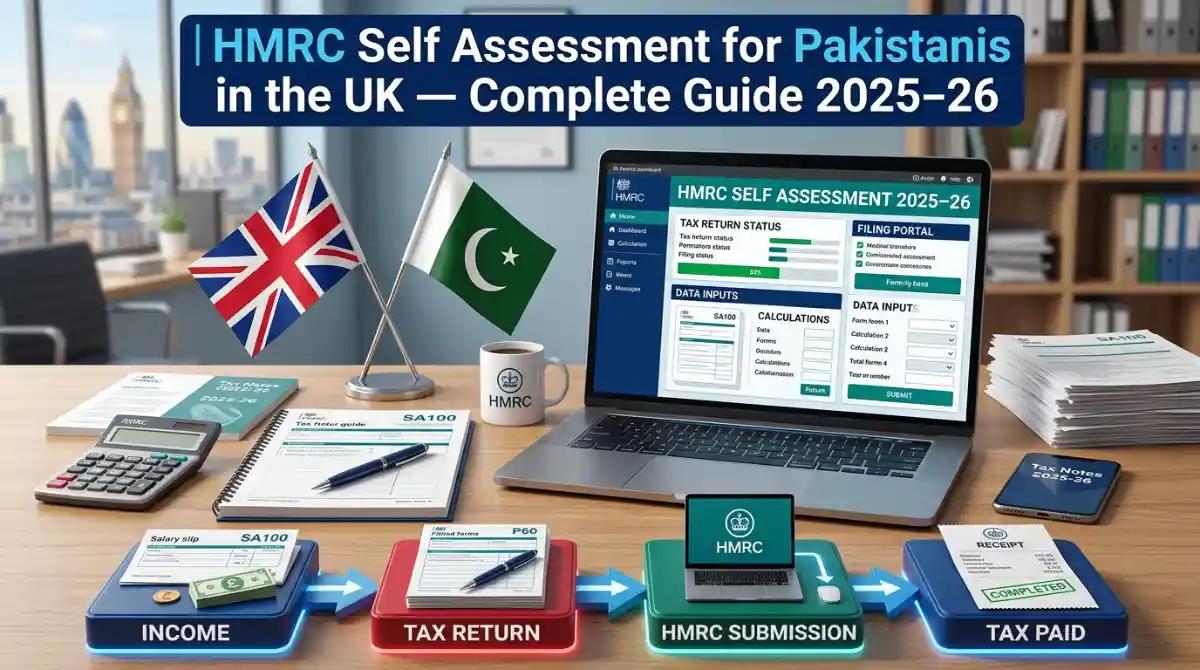
If you are a Pakistani living in the UK — whether you run a takeaway in Bradford, drive for Uber in Birmingham, work as an NHS nurse, or own rental properties in Manchester — you have a legal obligation to file a Self Assessment tax return with HMRC if your income situation requires it. This is not optional. And yet, thousands of British Pakistanis miss deadlines, pay unnecessary penalties, or simply do not know where to begin.
Whether you are newly arrived in the UK or have been here for decades, this complete HMRC Self Assessment guide for Pakistanis will walk you through every step — from registration to filing to payment.
What Is HMRC Self Assessment and Why Does It Matter for Pakistanis in the UK?
HMRC stands for His Majesty's Revenue and Customs. It is the UK's tax authority, equivalent to FBR (Federal Board of Revenue) in Pakistan. Self Assessment is the system HMRC uses to collect income tax from people whose tax is not automatically taken through PAYE (Pay As You Earn).
Most employees in the UK have their income tax automatically deducted from their salary by their employer through PAYE. However, if you are self-employed, a landlord, a business owner, or earn income from multiple sources, HMRC requires you to file a Self Assessment tax return (SA100 form) every year.
For the Pakistani community in the UK, this is especially important because a large proportion are self-employed — running takeaways, taxi businesses, retail shops, construction firms, Amazon stores, or working as freelancers and delivery drivers. If you fall into any of these categories, filing your Self Assessment tax return is not just a legal obligation — it is how you formally declare your income, claim expenses, avoid fines, and stay on the right side of UK law.
Who Needs to File a Self Assessment Tax Return in the UK?
You must file a Self Assessment return for the 2024–25 tax year if any of the following apply to you:
- You were self-employed and your gross income exceeded £1,000
- You are a partner in a business partnership
- You earned rental income from UK property (landlord)
- Your total taxable income exceeded £100,000
- You received untaxed income such as dividends, savings interest, or foreign income
- You are liable for the High Income Child Benefit Charge (income over £60,000)
- You received income from abroad (including from Pakistan)
- You are a company director with untaxed income
- You are a CIS (Construction Industry Scheme) subcontractor who wants to reclaim overpaid tax
This covers a massive portion of the Pakistani community in cities like Bradford, Birmingham, Manchester, London, Luton, and Leicester — where self-employment rates in the South Asian community are significantly higher than the national average.
Not sure if you need to file? Use the official HMRC checker at gov.uk to confirm your situation.
The UK Tax Year — Key Dates Every Pakistani Must Know
The UK tax year runs from 6 April to 5 April the following year. This is different from Pakistan's tax year, which runs from 1 July to 30 June, so do not confuse the two.
For the 2024–25 tax year (6 April 2024 to 5 April 2025):
- Register for Self Assessment: by 5 October 2025
- Paper tax return deadline: 31 October 2025
- Online tax return deadline: 31 January 2026
- Pay your tax bill: by 31 January 2026
- Second payment on account (if applicable): 31 July 2026
For the 2025–26 tax year (6 April 2025 to 5 April 2026):
- Register for Self Assessment: by 5 October 2026
- Online filing deadline: 31 January 2027
- First payment due: 31 January 2027
Miss these dates and HMRC will issue an automatic £100 penalty — even if you owe no tax at all.
How to Register for Self Assessment as a Pakistani in the UK — Step by Step
Many Pakistanis find this first step the most confusing. Here is exactly what you need to do:
Step 1 — Check if you need to register Use HMRC's online tool to verify if your income situation requires Self Assessment. This is free at gov.uk.
Step 2 — Create a Government Gateway account Go to the HMRC website and create a Government Gateway account using your email address. You will receive a 12-digit User ID. Keep this safe — you will need it every year.
Step 3 — Register as self-employed or for Self Assessment If you are self-employed, register using the "Register as self-employed" option. If you are not self-employed but need to file for another reason (landlord, foreign income, etc.), register directly for Self Assessment. You will need your National Insurance (NI) number.
Step 4 — Receive your UTR number After registering, HMRC will send your Unique Taxpayer Reference (UTR) number by post within 10 working days. This is your permanent tax ID in the UK — think of it like your NTN in Pakistan. Never lose it.
Step 5 — File your return online Log in to your Government Gateway account, complete the SA100 tax return form online, and submit before the 31 January deadline.
If you want to learn how to handle UK taxation professionally, consider the UK Taxation Course at ICT — one of the most practical tax training programmes for Pakistani professionals.
UK Personal Tax Allowance and Income Tax Rates 2024–25
Before you worry about how much tax you owe, you need to understand the UK's personal allowance. For the 2024–25 tax year:
- Personal Allowance: £12,570 (income below this is tax-free)
- Basic Rate (20%): £12,571 to £50,270
- Higher Rate (40%): £50,271 to £125,140
- Additional Rate (45%): above £125,140
This is very different from Pakistan's tax slabs, and many newly arrived Pakistanis are pleasantly surprised to find that the first £12,570 of their earnings is completely free of income tax. However, once you earn above this threshold, HMRC expects accurate and timely reporting through Self Assessment.
Use this free Pakistan Income Tax Calculator from Toolify to understand your tax position if you have income in both countries.
What Documents Do You Need for UK Self Assessment?
Whether you file yourself or use an accountant, you will need the following:
- Your UTR (Unique Taxpayer Reference) number
- Your National Insurance number
- P60 or P45 (if you also have employment income)
- Self-employment income records — invoices, bank statements, sales records
- Business expense receipts
- Rental income records (if you are a landlord)
- Bank interest certificates from UK and overseas accounts
- Any foreign income details, including income from Pakistan
- Capital gains details (if you sold property or investments)
The UK tax system works on honesty and self-declaration. HMRC can cross-check your bank accounts, property records, and business activity. Keeping accurate digital records is not just good practice — from April 2024, Making Tax Digital (MTD) requirements mean it is increasingly becoming mandatory for many businesses.
Pakistani-Specific Tax Situations You Need to Know
Self-Employed Pakistanis — Taxi Drivers, Takeaway Owners, Delivery Drivers
If you drive for Uber, Deliveroo, or run your own taxi service, you are self-employed. Your entire turnover — not just profit — must be reported on your SA100 form. The good news is that you can deduct allowable business expenses before tax is calculated. These include:
- Fuel costs
- Vehicle maintenance
- Business insurance
- Phone bills (business proportion)
- Accountant fees
- Restaurant/takeaway supplier costs
For takeaway owners, keep records of every till receipt, supplier invoice, and business-related cost. Your taxable profit is income minus allowable expenses — so good bookkeeping directly reduces your tax bill.
Pakistani Landlords in the UK
If you rent out property in the UK, rental income must be declared through Self Assessment. You can deduct mortgage interest (subject to restrictions for residential landlords), letting agent fees, repairs, and insurance. Many Pakistani landlords in cities like Bradford, Birmingham, and Leeds have multiple properties — making Self Assessment essential.
Pakistanis With Income From Pakistan
This is a key area of confusion for many. If you are a UK tax resident and receive income from Pakistan — whether from property, business, salary, dividends, or family money — HMRC may have a claim on it.
The good news is that the UK and Pakistan have a Double Taxation Agreement (DTA) in place since 1987. This means that income already taxed in Pakistan is not necessarily taxed again in full in the UK. You can usually claim Foreign Tax Credit Relief on your Self Assessment return to avoid being taxed twice. However, you must declare the income — not declaring overseas income is one of the most common mistakes that leads to HMRC investigations.
For Zakat calculations on your combined UK and Pakistan wealth, you can use this free Zakat Calculator.
CIS Construction Workers
Thousands of Pakistani workers in the UK construction sector work under the CIS scheme. Under CIS, your contractor deducts 20% tax before paying you. You may have overpaid tax and are entitled to a refund — but only if you file a Self Assessment return. Many Pakistani construction workers in Bradford, Dewsbury, and Oldham are owed money by HMRC that they never claim because they do not file. Do not leave this money on the table.
Is Income From Pakistan Taxable in the UK?
Yes — in most cases, if you are a UK tax resident, your worldwide income is taxable in the UK. This includes:
- Rental income from property in Pakistan
- Business profits from a company or partnership in Pakistan
- Salary or consultancy fees paid by a Pakistani employer
- Dividends from Pakistani companies
- Interest from Pakistani bank accounts
However, under the UK-Pakistan Double Taxation Agreement, you can claim relief for tax already paid in Pakistan. The key is to declare the income and then apply the correct relief. Hiding income from HMRC is a criminal offence and can lead to penalties, back-taxes, and even prosecution.
If you are unsure how to calculate your combined tax position, use the Pakistan Business Tax Calculator for a quick estimate.
What Are the Penalties for Missing the HMRC Self Assessment Deadline?
Missing the 31 January deadline is costly. Here is what happens:
- Day 1 (1 February): Automatic £100 penalty — even if no tax is owed
- 3 months late: Additional £10 per day (up to £900)
- 6 months late: A further 5% of the tax owed or £300 (whichever is greater)
- 12 months late: Another 5% or £300, plus potential HMRC investigation
Interest is also charged on unpaid tax from 1 February at the Bank of England base rate plus 2.5%.
For context — if you earn £30,000 as a self-employed taxi driver and owe £3,500 in tax but do not file until 8 months late, you could face penalties and interest pushing your total liability well above £5,000. Filing on time is always cheaper.

HMRC Self Assessment for Pakistanis in the UK
Can I File My Self Assessment in Urdu?
HMRC does not currently offer Self Assessment forms in Urdu. However, HMRC does provide a Needs Extra Support service for people who need help, and many private accountants across the UK — particularly in areas like Bradford, Birmingham, Luton, and Manchester — offer services in Urdu, Punjabi, and Mirpuri. Searching for a Pakistani accountant or Urdu-speaking tax advisor in your area is a practical solution if English is a barrier.
Many Pakistani community organisations and mosques also run free tax clinics around the Self Assessment deadline period — particularly in January. It is worth checking your local area.
How to Pay Your HMRC Self Assessment Tax Bill
Once you have filed your return, HMRC will calculate what you owe. You can pay:
- Online via bank transfer (BACS)
- Via your online bank using HMRC's bank details
- Through your PAYE tax code (if you also have employment income)
- By cheque (not recommended due to postal delays)
Your payment reference is your UTR number followed by K. Always use this reference when making payment so HMRC correctly allocates it to your account.
HMRC also offers a Time to Pay arrangement if you genuinely cannot afford to pay your bill in full. You can set up a payment plan online if you owe less than £30,000.
Making Tax Digital (MTD) — What Pakistanis Need to Know for 2026
Making Tax Digital is HMRC's long-term plan to move all tax reporting to digital platforms. From April 2026, self-employed people and landlords earning over £50,000 will be required to submit quarterly digital updates to HMRC instead of one annual return.
This is a significant change. It means if you are a Pakistani sole trader earning above this threshold — whether running a takeaway, taxi business, or contracting firm — you will need to use HMRC-approved accounting software such as QuickBooks, Xero, or FreeAgent from April 2026 to submit quarterly income and expense updates.
Start preparing now. The shift to MTD is not optional and the fines for non-compliance will be substantial.
HMRC Self Assessment Help for Pakistanis — Location-Specific Support
The Pakistani community is spread across the UK with high concentrations in certain cities. If you are looking for a Pakistani tax accountant or HMRC Self Assessment help, here are the key areas:
Bradford — Bradford has one of the largest Pakistani communities in the UK and is home to numerous Pakistani-run accountancy firms specialising in Self Assessment for sole traders, landlords, and small businesses. Firms like Amanah Accountants and Certax Bradford offer Urdu-friendly services.
Birmingham — Birmingham's Sparkhill, Alum Rock, and Small Heath areas have dozens of accountants familiar with the Pakistani business community. Gondal Accountancy in Birmingham specifically serves self-employed clients from the South Asian community.
Manchester — Rusholme and Longsight in Manchester have a strong Pakistani business presence. Local accountants in these areas regularly assist with HMRC Self Assessment filing.
Luton, Leicester, Slough, Oldham, Dewsbury, Huddersfield, Sheffield, Wolverhampton, Coventry, and Leeds — all have established Pakistani community networks where tax support is available either through local accountants or community organisations.
If you are in Pakistan and want to build a career helping British Pakistanis with UK tax affairs, the UK Taxation Course at ICT is exactly what you need. ICT has trained hundreds of Pakistani tax professionals who now serve UK clients remotely. You can also explore their broader career roadmap.
Can Pakistanis in the UK Do Their Own Self Assessment?
Yes. HMRC's online filing portal is relatively straightforward for simple cases — a single employment income, basic self-employment with no complex expenses, or straightforward rental income. If your situation is simple, filing yourself saves money and is perfectly legal.
However, if you have:
- Income from Pakistan or overseas
- Multiple income streams
- CIS deductions to reclaim
- Capital gains from property sales
- Company director income
- Complex expenses to claim
...then using a qualified UK accountant is strongly recommended. The fee they charge is almost always recoverable through legitimate tax savings and expense claims they identify that you might miss.
Do Pakistani Students in the UK Need to Pay Income Tax?
Pakistani students on a student visa can work up to 20 hours per week during term time. If your total income from part-time work stays below the personal allowance of £12,570 in 2024–25, you will owe no income tax and likely do not need to file a Self Assessment return.
However, if you earn above this through multiple jobs, tutoring, or freelancing, you may need to register for Self Assessment. Students with scholarships, grants, or income from Pakistan should seek individual advice as the rules vary by source.
The UK-Pakistan Double Tax Treaty — Your Protection Against Double Taxation
One of the most valuable but under-used tools available to Pakistanis in the UK is the UK-Pakistan Double Taxation Agreement, which has been in force since 1987. This treaty means:
- Income from Pakistan that has already been taxed there can receive Foreign Tax Credit Relief in the UK
- UK residents of Pakistani domicile may have significant Inheritance Tax advantages compared to nationals of most other countries
- Profits from Pakistani businesses do not automatically face full UK tax if structured correctly
The key is declaring income correctly and claiming the right reliefs. The treaty does not eliminate your UK tax obligation — it prevents double payment. For full details, you can access the official treaty text at GOV.UK's Pakistan tax treaties page.
Frequently Asked Questions (FAQs)
Do Pakistanis living in the UK need to file a Self Assessment? Yes, if you are self-employed, earn rental income, have overseas income, earn over £100,000, or meet any of HMRC's other filing criteria, you must file a Self Assessment tax return. Your nationality does not exempt you from UK tax law.
What is a UTR number and how do I get one? A UTR (Unique Taxpayer Reference) is your 10-digit personal tax ID with HMRC. You receive it after registering for Self Assessment. It is sent by post within 10 working days and is used for all UK tax correspondence.
When is the Self Assessment deadline in the UK? The online filing deadline for the 2024–25 tax year is 31 January 2026. The paper return deadline was 31 October 2025. You must also pay any tax owed by 31 January 2026.
What happens if I miss the HMRC tax return deadline? You automatically receive a £100 fine on the first day. Penalties increase to £10 per day after three months, and further charges apply at six and twelve months. Interest is also charged on unpaid tax.
Is income from Pakistan taxable in the UK? Generally yes, if you are a UK tax resident. However, the UK-Pakistan Double Taxation Agreement allows you to claim Foreign Tax Credit Relief for tax already paid in Pakistan, so you are not taxed twice on the same income.
Can I claim expenses on my UK Self Assessment? Yes. Self-employed individuals can deduct allowable business expenses — fuel, tools, professional fees, phone costs, marketing costs, and more — before calculating taxable profit. Keeping proper records is essential.
Do I need to declare Pakistani bank accounts to HMRC? Yes. As a UK tax resident, you are required to declare all overseas bank accounts and income sources to HMRC. Failure to do so can result in penalties under the Failure to Correct offshore tax rules.
What is Making Tax Digital and how does it affect me? Making Tax Digital (MTD) is HMRC's programme to move tax reporting online using approved software. From April 2026, self-employed people and landlords earning over £50,000 must submit quarterly digital updates rather than one annual return.
Why Learning UK Taxation Is a Career Opportunity for Pakistanis
If you are reading this from Pakistan — or if you are a British Pakistani who wants to turn this knowledge into income — understanding UK Self Assessment is not just a personal obligation. It is a career.
Thousands of Pakistani freelancers now offer UK tax filing services to British Pakistani clients remotely through platforms like Upwork and Fiverr. The demand is real, and it is growing. The Pakistani community in the UK is one of the largest diaspora communities in the world, and most of them need affordable, culturally familiar tax advice in Urdu or Punjabi.
ICT (Institute of Corporate and Taxation) offers a comprehensive UK Taxation Course that covers Self Assessment, HMRC filing, PAYE, VAT, corporation tax, and more — specifically designed for Pakistani professionals who want to build an international tax career or serve UK-based clients. You can read about the career paths this opens up.
ICT's courses are trusted by thousands of students across Pakistan. If you are serious about building a future in international taxation, start your journey today.
Also explore their guide on how Pakistani professionals are already building global tax careers and the full UK taxation course career roadmap.
For additional tax tools, use the free PTA Tax Calculator and the Pakistan Business Tax Calculator to estimate your obligations on both sides.
Conclusion — Take Control of Your UK Tax Obligations Today
HMRC Self Assessment for Pakistanis in the UK does not have to be complicated or scary. Once you understand the system, the deadlines, and your own income situation, it becomes a straightforward annual task — one that protects you legally, keeps your record clean with HMRC, and often puts money back in your pocket through legitimate expense claims and tax reliefs.
The key steps are simple: know if you need to file, register before 5 October, get your UTR, gather your income and expense records, file online before 31 January, and pay what you owe on time.
If you have income from Pakistan, use the UK-Pakistan Double Tax Treaty to your advantage. If you are self-employed, claim every expense you are entitled to. If you are in the construction industry under CIS, file your return and reclaim overpaid tax.
And if you want to turn this knowledge into a profession — helping the hundreds of thousands of Pakistanis in the UK who need affordable, honest, Urdu-friendly tax advice — enrol in the UK Taxation Course at ICT today.
Whether you are a taxi driver in Bradford, a restaurant owner in Birmingham, a landlord in Manchester, or a freelancer anywhere in the UK — your HMRC Self Assessment is your responsibility. Handle it correctly, and it works for you.
This article is for informational purposes only and does not constitute formal tax advice. For your specific situation, always consult a qualified UK tax accountant or visit gov.uk for official HMRC guidance.
Comments (0)
No comments yet. Start the conversation!
Leave a Reply
Your email address will not be published. Required fields are marked *