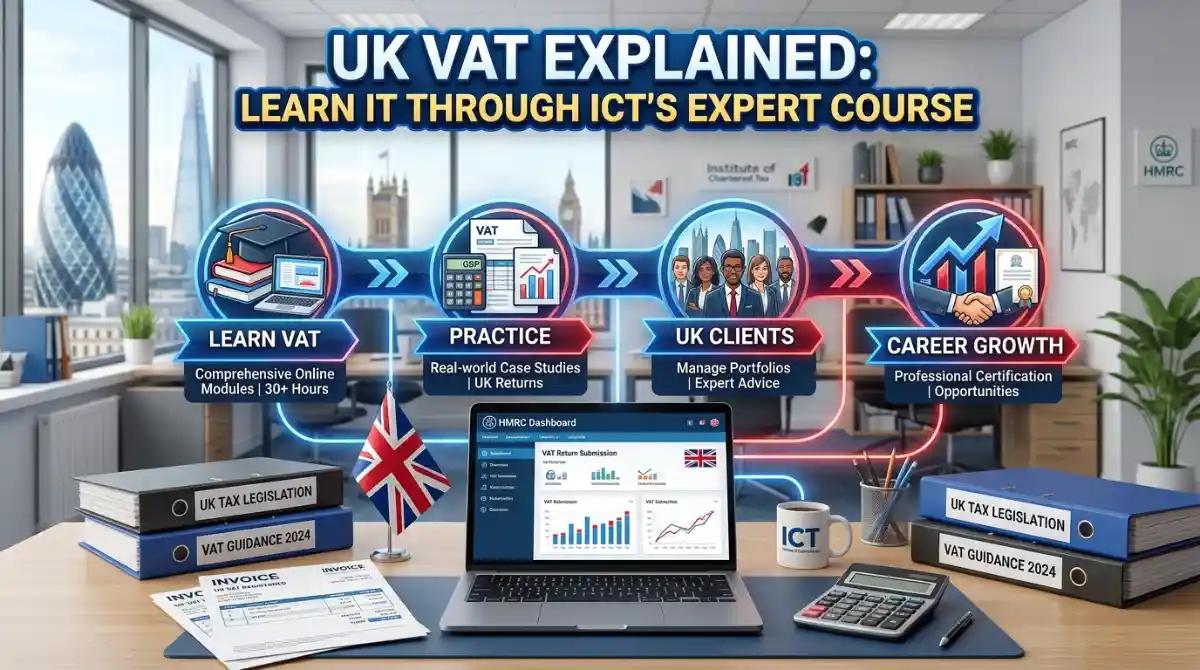
UK VAT Explained: Learn It Through ICT's Expert Course
If you've ever tried to get your head around UK VAT and ended up more confused than when you started, you're not alone. Value Added Tax is one of those topics that sounds straightforward until you're actually sitting in front of a VAT return, staring at boxes you don't understand, wondering whether your supplies are zero-rated or exempt — and whether those two things even mean the same thing (they don't).
The good news? VAT doesn't have to be confusing. With the right training, the right structure, and an expert guiding you through real examples, UK VAT becomes completely manageable — even second nature. That's exactly what ICT's UK VAT expert course is designed to do.
Whether you're a business owner trying to stay compliant, an accountant looking to fill gaps in your knowledge, or a freelancer wanting to offer tax services to UK clients, this article will walk you through everything you need to know — and show you why ICT is the right place to learn it.
What Is VAT in the UK?
VAT, or Value Added Tax, is an indirect consumption tax applied to most goods and services sold in the United Kingdom. It's charged at each stage of the supply chain — from manufacturer to wholesaler to retailer — with the end consumer ultimately bearing the cost.
The UK operates VAT under three main rates:
- Standard rate — 20%: Applied to most goods and services
- Reduced rate — 5%: Applied to things like home energy, children's car seats, and certain sanitary products
- Zero rate — 0%: Applied to most food, children's clothing, books, and public transport
There are also exempt supplies — items completely outside the VAT system, like insurance, financial services, and most healthcare — and outside the scope supplies that don't count as business activities at all.
Understanding the difference between zero-rated and exempt is one of the first things ICT's course covers, because confusing the two is one of the most common and costly mistakes businesses make.
How Does VAT Work in the UK?
Here's the core mechanic: when a VAT-registered business sells goods or services, it charges VAT on top of its price. This is called output tax. When that same business buys goods or services for its business, it pays VAT — this is called input tax. At the end of each VAT period, the business calculates the difference:
- If output tax is higher than input tax, the business pays the difference to HMRC
- If input tax is higher than output tax, the business can reclaim the difference from HMRC
This input/output tax mechanism is the heartbeat of the entire UK VAT system, and ICT's course walks you through it with real-world examples so it clicks on a practical level, not just a theoretical one.
When Do I Need to Register for VAT in the UK?
The VAT registration threshold for 2024/2025 is £90,000. If your taxable turnover exceeds this figure in any rolling 12-month period, you are legally required to register for VAT with HMRC.
You can also register voluntarily if your turnover is below the threshold — which many small businesses do to reclaim input tax and appear more credible to larger clients.
Key things to know about VAT registration:
- You must register within 30 days of exceeding the threshold
- HMRC will issue a VAT registration certificate with your VAT number
- Your VAT number must appear on all VAT invoices
- Once registered, you must charge the correct VAT rate on taxable supplies
The VAT deregistration threshold is £88,000. If your turnover drops below this, you may apply to deregister.
ICT's course covers VAT registration step by step — from checking whether you need to register, to completing the online form via the HMRC portal, to understanding your obligations once registered.
What Are the Different VAT Schemes in the UK?
One of the most useful parts of the UK VAT explained picture is understanding that HMRC offers several accounting schemes designed to simplify VAT for smaller businesses. The right scheme can save you time and sometimes money.
Standard VAT Accounting
You account for output tax when you issue a VAT invoice and reclaim input tax when you receive one — regardless of whether payment has actually been made. This is the default method.
Cash Accounting Scheme
You only account for VAT when cash actually changes hands. Useful for businesses with cash flow concerns or clients who pay late.
Flat Rate Scheme
Instead of calculating input and output tax separately, you pay a fixed percentage of your gross turnover to HMRC. The rate varies by industry — for example, accountants pay 14.5%, IT consultants pay 14.5%, and retailers pay different rates. The flat rate scheme can be simpler and occasionally more profitable for small businesses.
Annual Accounting Scheme
You submit one VAT return per year instead of four, making advance payments during the year based on an estimate. Good for businesses that prefer fewer deadlines.
ICT's UK VAT training course covers all four schemes in detail, helping you advise clients or manage your own business VAT with confidence.
Understanding VAT Returns: What Goes in Each Box?
Submitting a VAT return is a regular legal requirement for every VAT-registered business. Returns are usually submitted quarterly, though monthly returns are possible if you regularly reclaim VAT.
Here's what the nine boxes on a standard UK VAT return mean:
- Box 1: VAT due on your sales and other outputs (output tax)
- Box 2: VAT due on acquisitions from EU member states (post-Brexit, mostly applies to Northern Ireland)
- Box 3: Total VAT due (Box 1 + Box 2)
- Box 4: VAT reclaimed on purchases and inputs (input tax)
- Box 5: Net VAT payable to or reclaimable from HMRC (Box 3 minus Box 4)
- Box 6: Total value of all sales, excluding VAT
- Box 7: Total value of all purchases, excluding VAT
- Box 8: Total value of goods supplied to EU countries (Northern Ireland protocols)
- Box 9: Total value of goods acquired from EU countries (Northern Ireland protocols)
Getting these boxes right is critical. Errors can lead to penalties, interest charges, and HMRC compliance checks. ICT's course spends dedicated time on completing a VAT return box by box — using real case studies so you understand not just what to enter, but why.
What Is Making Tax Digital for VAT?
Making Tax Digital (MTD) for VAT is HMRC's digital tax initiative that requires all VAT-registered businesses to:
- Keep digital records of their VAT transactions
- Submit VAT returns directly from compatible software — not manually via the HMRC portal
MTD for VAT has been mandatory for all VAT-registered businesses since April 2022, regardless of turnover. Popular compatible software includes Xero, QuickBooks, Sage, and FreeAgent.
This shift to digital tax records has changed how accountants and bookkeepers work. If you're providing VAT services or managing business accounts, understanding MTD for VAT is no longer optional — it's a core professional requirement.
ICT's course includes dedicated training on Making Tax Digital for VAT, covering digital record-keeping requirements, compatible software options, and how to submit a compliant return through the HMRC digital gateway.
VAT Exemptions, Zero-Rating, and Partial Exemption
This is where many people get confused — and where getting things wrong has real financial consequences.
Zero-Rated vs. Exempt: What's the Difference?
Both zero-rated and exempt supplies attract no VAT from the customer's perspective. The critical difference lies in input tax recovery:
- Zero-rated: The supply is VATable at 0%. The business can still reclaim input tax on costs related to making zero-rated supplies
- Exempt: The supply is outside the VAT system. The business generally cannot reclaim input tax on costs related to making exempt supplies
This distinction matters enormously. A business that treats exempt supplies as zero-rated will over-reclaim input tax — and face penalties when HMRC catches the error.
What Is Partial Exemption?
If a business makes both taxable and exempt supplies, it's partially exempt. It can only reclaim the portion of input tax that relates to its taxable supplies. The calculation involves an apportionment method — either the standard method (based on turnover ratios) or a special method approved by HMRC.
Partial exemption is one of the more complex areas of UK VAT, and it's covered thoroughly in ICT's expert VAT course.
What Is Reverse Charge VAT?
The reverse charge VAT mechanism shifts the responsibility for accounting for VAT from the supplier to the customer. Instead of the supplier charging VAT on the invoice, the customer accounts for the VAT themselves — both as output tax and (usually) as reclaimable input tax.
Reverse charge applies in several key situations:
- Construction services (domestic reverse charge): Applies in the UK construction sector to tackle VAT fraud
- Business-to-business services received from overseas suppliers: If you're UK VAT-registered and receive services from outside the UK, you typically account for VAT under the reverse charge
- Import VAT: Post-Brexit, import VAT rules changed significantly for UK businesses trading with the EU
Understanding reverse charge VAT is essential for businesses operating internationally or working in sectors like construction. ICT's UK VAT course covers domestic and cross-border reverse charge scenarios with practical worked examples.
VAT Invoice Requirements in the UK
Every VAT-registered business must issue a valid VAT invoice when making standard or reduced-rate supplies to another VAT-registered customer. A full VAT invoice must include:
- A unique sequential invoice number
- The supplier's name, address, and VAT registration number
- The invoice date and the tax point date
- The customer's name and address
- A description of the goods or services supplied
- The quantity and unit price
- The VAT rate applied and the VAT amount charged
- The total amount payable including VAT
Simplified VAT invoices (for retail supplies under £250 including VAT) have fewer requirements but must still show the VAT rate and the amount including VAT.
Getting VAT invoices right isn't just good practice — it's a legal requirement. Incorrect or missing VAT invoices can result in rejected input tax claims during a VAT inspection.

UK VAT Explained Learn It Through ICT's Expert Course
VAT for Small Businesses in the UK
If you're running a small business, VAT raises specific questions that deserve direct answers.
Can I reclaim VAT as a small business? Yes — but only if you're VAT registered. Once registered, you can reclaim input tax on business purchases, which can be a genuine financial benefit even for businesses below the registration threshold.
What is the VAT flat rate scheme for small businesses? The flat rate scheme simplifies VAT accounting for businesses with taxable turnover below £150,000. Instead of calculating input and output tax separately, you apply a flat rate percentage to your gross turnover. It reduces admin but isn't always more financially advantageous — it depends on your industry and spending patterns.
Do I charge VAT on everything? No. You only charge VAT on taxable supplies at the appropriate rate (20%, 5%, or 0%). Exempt supplies and supplies outside the scope of VAT are not charged.
What are the VAT penalties? HMRC can charge penalties for late registration, late filing of VAT returns, late payment, and errors in returns. The penalty regime was updated in 2023 with a new points-based system for late returns. ICT's course covers VAT compliance and how to avoid common penalty triggers.
Post-Brexit VAT Changes for UK Businesses
The UK's departure from the European Union changed VAT in some significant ways. If you're working with clients who trade internationally, understanding these changes is essential.
Key post-Brexit VAT changes include:
- Import VAT: UK businesses importing goods from the EU now pay import VAT at the border (or use postponed VAT accounting)
- Postponed VAT accounting: UK VAT-registered businesses can account for import VAT on their VAT return rather than paying it upfront at import — a useful cash flow tool
- EU VAT rules: UK businesses selling goods to EU consumers may need to register for VAT in EU member states or use the EU's One Stop Shop (OSS) scheme
- Reverse charge on services: The place of supply rules for services changed post-Brexit, affecting how VAT is accounted for on cross-border service transactions
These changes affect thousands of UK businesses, and the rules are detailed. ICT's course addresses Brexit VAT changes within its broader UK VAT curriculum, helping students understand the current UK VAT landscape rather than the pre-2021 version.
Why Choose ICT for Your UK VAT Training?
The Institute of Corporate and Taxation (ICT) has built a reputation as one of Pakistan's leading professional training institutions for international tax and accounting courses. Their UK Taxation Course is taught by practicing tax professionals — people who work with HMRC rules every day, not just academics who teach from textbooks.
Here's what makes ICT's approach different:
Expert-led instruction: Every module is delivered by professionals with hands-on experience in UK tax compliance, VAT returns, and HMRC correspondence.
Practical case studies: You don't just learn theory. You work through real VAT return scenarios, registration cases, and compliance exercises that mirror actual professional practice.
Structured curriculum: ICT's UK VAT training follows a clear progression — from basic concepts through to advanced topics like partial exemption, reverse charge, and MTD compliance — so you build knowledge systematically.
Career-focused outcomes: Whether you want to offer UK VAT services as a freelancer, work with UK accounting firms, or manage VAT compliance for a business, ICT structures its course around practical career goals.
CPD value: For qualified accountants and bookkeepers, ICT's courses count toward continuing professional development — important for AAT members, ACCA students, and other professionals with CPD requirements.
ICT also offers a growing library of international tax courses. If you're interested in broadening your tax expertise beyond UK VAT, explore their offerings in US Taxation, UAE Taxation, Canadian Taxation, and Saudi Taxation — all delivered with the same practical, professional approach.
Who Should Take a UK VAT Course?
ICT's UK VAT expert course is designed for a broad range of learners:
- Accounting professionals looking to add UK VAT expertise to their skillset
- Freelancers and tax consultants who want to offer VAT compliance services to UK clients
- Small business owners who want to understand and manage their own VAT obligations
- Bookkeepers working with UK-based businesses who need VAT knowledge to do their job properly
- Students studying for AAT, ACCA, or ATT qualifications who want practical support alongside their academic study
- Anyone returning to finance who needs a structured refresher on current UK VAT rules
Whether you're based in London, Manchester, Birmingham, Leeds, Glasgow, Edinburgh, Bristol, Cardiff, Belfast, or anywhere else in the UK — or you're a Pakistani professional building an international client base — ICT's course is accessible online and built around your schedule.
For Pakistani professionals specifically, gaining UK VAT expertise opens doors to remote consultancy work with UK businesses — a high-value skill in a growing market. See how 5 ways a UK taxation course helps in freelancing explains the real earning potential.
Career Opportunities After Learning UK VAT
Understanding UK VAT isn't just an academic achievement — it translates directly into professional opportunities:
- VAT consultant: Advise businesses on VAT registration, compliance, and scheme selection
- Tax accountant: Prepare and submit VAT returns for multiple clients
- Bookkeeper with VAT specialisation: Manage day-to-day VAT accounting using Xero, QuickBooks, or Sage
- Compliance officer: Work in-house for a business managing VAT obligations
- Freelance tax professional: Offer VAT services remotely to UK clients via platforms like Upwork or directly
- International tax advisor: Combine UK VAT knowledge with expertise in US, UAE, or Canadian taxation for a broad service offering
The demand for qualified VAT professionals in the UK is consistent and growing — particularly as Making Tax Digital continues to embed digital compliance into every VAT-registered business. Read more about career paths after a UK taxation course to understand the full opportunity.
If you're also exploring income tax tools and calculators to complement your tax knowledge, Pakistan's income tax calculator and business tax calculator are useful free resources that work alongside formal training.
How to Get Started: Learn UK VAT the Right Way
Here's a practical roadmap for anyone wanting to build genuine UK VAT expertise:
- Start with the fundamentals — understand output tax, input tax, VAT rates, and what a VAT return is
- Learn registration rules — when to register, how to register, what your obligations are once registered
- Study the different VAT schemes — flat rate, cash accounting, annual accounting, and standard accounting
- Practise completing VAT returns — work through box-by-box examples using realistic figures
- Understand exemptions and zero-rating — know the difference and why it matters for input tax recovery
- Learn reverse charge and international VAT — essential for businesses with cross-border transactions
- Get familiar with MTD for VAT — understand the digital record-keeping and filing requirements
- Enrol in a structured course — self-study can only take you so far; expert guidance accelerates real understanding
ICT's UK Taxation Course takes you through every one of these steps with structured lessons, expert instruction, and practical exercises that prepare you for real professional work — not just passing a test.
You can also explore the broader ICT course catalogue at ict.net.pk/courses to see how UK VAT fits into a wider professional development plan.
Frequently Asked Questions About UK VAT
What is VAT in the UK? VAT (Value Added Tax) is an indirect tax applied to most goods and services in the UK. Businesses charge it on their sales (output tax) and reclaim it on their purchases (input tax), paying the difference to HMRC. The standard rate is 20%.
When do I need to register for VAT in the UK? You must register when your taxable turnover exceeds £90,000 in any rolling 12-month period. You can also register voluntarily if your turnover is below this threshold.
What is the difference between zero-rated and exempt VAT? Zero-rated supplies are taxed at 0% and allow input tax recovery. Exempt supplies fall outside the VAT system and do not allow input tax recovery on related costs. Confusing the two is a common compliance error.
What is Making Tax Digital for VAT? MTD for VAT requires all VAT-registered businesses to keep digital records and submit VAT returns using HMRC-compatible software like Xero or QuickBooks. It has been mandatory since April 2022.
Is ICT's UK VAT course accredited? ICT's courses are delivered by practicing tax professionals and are structured to support CPD requirements for accounting and tax professionals. Visit ict.net.pk/about for full accreditation and course details.
How long does a VAT course take? ICT's UK VAT training is structured as a focused, self-paced programme that can typically be completed in a few weeks depending on your prior knowledge and study schedule. The course is designed to get you to a competent, practical level as efficiently as possible.
Can I offer VAT services as a freelancer after completing the course? Yes. Many ICT students go on to offer UK VAT compliance services remotely — preparing VAT returns, advising on registration, and managing Making Tax Digital compliance for UK-based businesses. Read more about how a UK taxation course helps in freelancing for a detailed breakdown of the opportunity.
Conclusion: Stop Being Confused by VAT — Start Being Confident
UK VAT is not as complicated as it first appears. What makes it feel overwhelming is usually a lack of structure — learning bits and pieces from different sources without a clear picture of how everything connects.
ICT's expert UK VAT course gives you that structure. From the basics of output and input tax, through VAT registration and returns, to complex areas like partial exemption and reverse charge — everything is taught in sequence, with expert guidance and real examples.
Whether you want to manage your own business VAT, build a career as a tax professional, or expand your freelance services to UK clients, a solid understanding of UK VAT is the foundation you need.
Book your place on ICT's UK Taxation Course today at ict.net.pk/courses/uk-taxation and take the first step toward VAT confidence.
For more professional development resources and tax training insights, visit ict.net.pk/blogs or explore how UK tax skills are shaping careers in the 2026 career roadmap guide.
Comments (0)
No comments yet. Start the conversation!
Leave a Reply
Your email address will not be published. Required fields are marked *