
E-Invoicing Revolution: What Tax Professionals Need to Know in 2025–2026
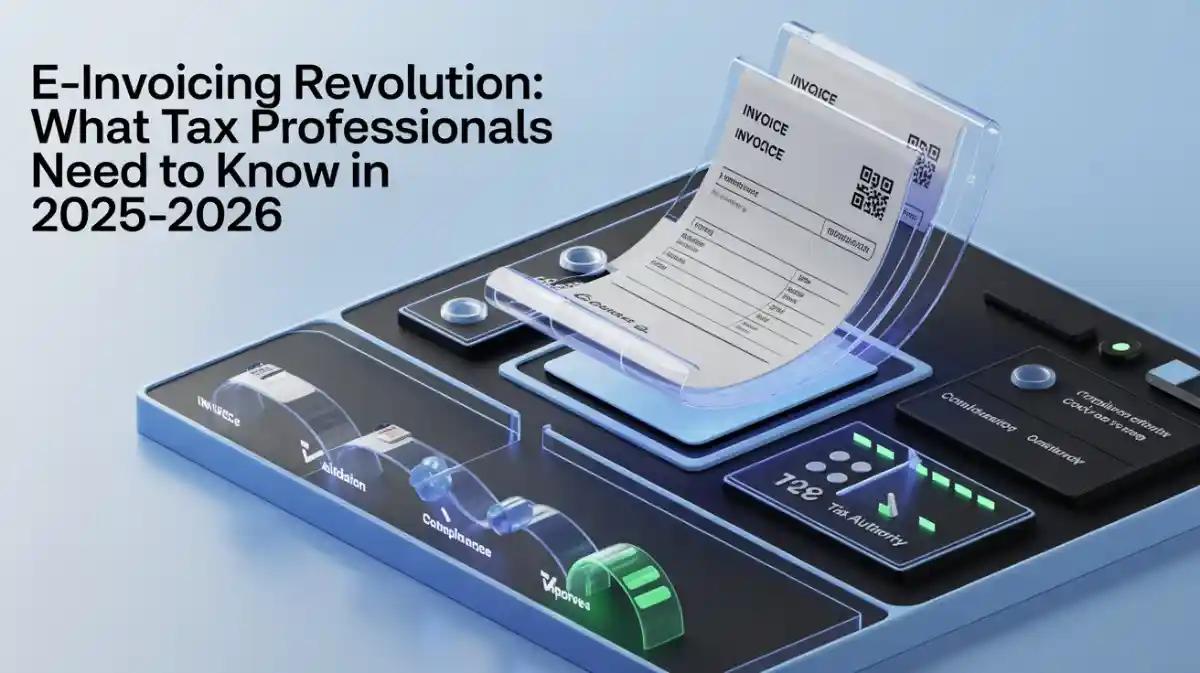
The way businesses report, verify, and submit invoices to tax authorities is changing fast — and if you're a tax professional, falling behind on e-invoicing could cost your clients real money.
Whether you work as a tax consultant in Islamabad, file returns for multinational companies, or advise small businesses on VAT compliance, the e-invoicing revolution is already at your doorstep. In Pakistan, the FBR (Federal Board of Revenue) is actively pushing its digital invoicing framework. Globally, countries from Saudi Arabia to the EU are making electronic invoicing mandatory. This is not a future trend — it is happening right now.
This guide explains everything tax professionals need to know about e-invoicing, why it matters, and how to stay ahead of the curve.
What Is E-Invoicing? A Clear Definition for Tax Professionals
E-invoicing, or electronic invoicing, is the structured digital exchange of invoice data between a seller, a buyer, and — in most modern systems — the tax authority, all in real time.
This is fundamentally different from simply emailing a PDF invoice. A true e-invoice uses structured data formats like XML or UBL JSON that can be read and validated automatically by accounting software and government portals without any human data entry.
In tax compliance terms, e-invoicing means that every transaction can be reported to the tax authority at the moment it happens. This is what regulators call Continuous Transaction Controls, or CTC — and it is the backbone of modern fiscal digitalization worldwide.
For tax accountants and tax consultants, this shifts your role from "after-the-fact filer" to "real-time compliance advisor." That is a significant change in job scope, client expectations, and the tools you need to master.
The Global E-Invoicing Mandate: Where It's Already Law
Before we discuss Pakistan specifically, it helps to understand just how widespread mandatory e-invoicing has become in 2025 and 2026. This is not an isolated experiment — it is a global tax administration shift.
Saudi Arabia — ZATCA (Zakat, Tax and Customs Authority) rolled out its Fatoorah e-invoicing system in phases. Phase 2, the integration phase, requires businesses to connect their systems directly to ZATCA for real-time invoice clearance. Tax professionals advising Saudi-based clients or working in UAE and Gulf markets must understand ZATCA compliance deeply.
European Union — The EU's VAT in the Digital Age (ViDA) directive is pushing member states toward mandatory B2B e-invoicing. Italy already made it fully mandatory. Germany, France, and Poland are implementing their mandates through 2025–2026.
India — The GST e-invoicing system now applies to businesses with turnover above a certain threshold, with real-time reporting to the Invoice Registration Portal (IRP). India's model is considered one of the most advanced GST e-invoicing systems in the world.
UK — While Making Tax Digital (MTD) under HMRC focuses on digital VAT records, the UK is closely following EU developments on full e-invoicing mandates.
Pakistan — The FBR has been rolling out its digital invoicing system through the IRIS portal and POS integration programs. The goal is real-time invoice reporting and verification to reduce tax fraud and expand the tax base.
If you are a Pakistani tax professional advising clients in any of these jurisdictions — or if your clients deal with cross-border trade — e-invoicing knowledge is now a core competency, not optional.
How E-Invoicing Affects Tax Compliance in Pakistan
Pakistan's tax digitalization journey under FBR has been accelerating. The FBR's digital invoicing framework is part of a broader strategy to bring more businesses into the formal tax net, reduce manual manipulation of invoices, and improve VAT and sales tax compliance.
Here is what this means practically for tax professionals working in Pakistan:
Real-Time Sales Tax Reporting — Under FBR's system, businesses registered for sales tax are increasingly required to report invoices digitally. This eliminates the old practice of manual adjustments before filing monthly returns.
FBR IRIS Portal Integration — The IRIS portal is Pakistan's central tax administration system. E-invoicing data ties directly into the IRIS ecosystem, meaning your clients' invoice records and tax return data must be consistent in real time. Any mismatch can trigger notices.
POS Integration for Retailers — FBR has mandated point-of-sale (POS) system integration for certain categories of registered retailers. This is a direct form of e-invoicing where transaction data is transmitted to FBR servers automatically.
Reduced Fake Invoice Fraud — One of the primary reasons FBR is pushing digital invoicing is to eliminate fake invoice networks used to claim fraudulent input tax credits. For honest businesses, this is good news — compliance gets easier when everyone plays by verified rules.
For a deeper understanding of how FBR's digital transformation is progressing, ICT's blog on FBR's digital transformation in Pakistan covers this in practical detail.
Key E-Invoicing Models Tax Professionals Must Understand
Not all e-invoicing systems work the same way. As a tax consultant or tax accountant, you need to understand the two primary models in use globally, because your advisory approach will differ depending on which model your client operates under.
The Clearance Model — In this system, invoices must be submitted to and approved by the tax authority before they are legally valid and can be sent to the buyer. Saudi Arabia's ZATCA system uses this model. The tax authority acts as a clearinghouse — if the invoice is not cleared, the transaction is not recognized for tax purposes. This gives governments real-time visibility into every B2B transaction.
The Decentralized or Post-Audit Model — In this model, businesses can issue invoices directly to buyers, but must report invoice data to the tax authority within a defined time window (often 24 to 72 hours). The EU's approach in several countries follows a variation of this model.
The PEPPOL Network — Pan-European Public Procurement Online (PEPPOL) is an international e-invoicing standard used across Europe, Australia, and Singapore. It defines how invoices are structured and transmitted between systems. Tax professionals advising businesses with European operations need to be familiar with PEPPOL-compliant invoice formats.
Understanding these models helps you advise clients on which software systems to implement, how to structure their accounts payable and accounts receivable (AP/AR) workflows, and what their compliance obligations are under each jurisdiction.
The Role of Tax Professionals in E-Invoicing Implementation
Here is where your expertise becomes genuinely valuable. E-invoicing is not just an IT project — it is a tax compliance transformation. Businesses need qualified tax consultants and tax accountants to guide them through this transition, and that creates real career opportunity.
Advising on Legal Requirements — Which businesses are required to use e-invoicing? What is the threshold? What format is required — XML, JSON, UBL? When does it become mandatory? These are questions your clients will bring to you, and they require deep knowledge of current tax legislation.
Selecting the Right Software — Tax professionals increasingly need to evaluate and recommend cloud-based invoicing platforms and accounting software with e-invoicing capabilities. Tools like SAP, Oracle, Xero, and QuickBooks all have e-invoicing modules, but their compliance with local regulations (FBR, ZATCA, HMRC) varies. Your guidance here protects clients from costly non-compliance.
Ensuring Audit Trail Integrity — E-invoicing creates a digital audit trail by default, which is excellent for audit readiness. However, tax professionals must ensure that clients' systems are maintaining invoice records in the required formats and for the required retention periods. A broken or incomplete audit trail is a compliance risk.
Training Client Accounting Teams — Many businesses have bookkeeping staff who are used to manual invoice entry. Transitioning to automated invoice management requires change management, and tax advisors are often the trusted voice guiding that process.
Representing Clients in Disputes — If an e-invoice is rejected by the tax authority or an input tax claim is disputed because of invoice data mismatches, you as the tax professional will be the one representing your client's position.
This expanded role is why digital upskilling is now essential for tax accountants. ICT's blog on new tax careers and digital compliance roles in 2026 explores how the profession is changing and where the opportunities lie.
E-Invoicing and Tax Compliance: The Practical Impact
Let's be direct about what e-invoicing does to the tax compliance landscape, because this affects every aspect of how you serve your clients.
Input Tax Credits Become Harder to Manipulate — Under a paper-based system, businesses could claim input tax credits on invoices that were never actually issued or paid. E-invoicing cross-matches supplier-side and buyer-side records automatically. This protects compliant businesses and eliminates fraud, but it also means your clients need clean, accurate records from day one.
Filing Becomes More Automated but Requires More Precision — When invoice data flows directly into the tax authority's system, filing a monthly sales tax return becomes partly automated. However, any error in the original invoice data is immediately visible to authorities. The margin for manual correction shrinks significantly.
Tax Planning Changes — Digital invoicing creates granular, real-time financial data. This is actually a huge advantage for tax planning purposes. Tax advisors who can analyze this data can offer much sharper advice on timing of purchases, deductible expenses, and cash flow optimization around tax liabilities.
Cross-Border Compliance Gets More Complex — For multinational companies, e-invoicing compliance means navigating multiple country-specific systems simultaneously. A Pakistani company exporting to EU clients may need to comply with local e-invoicing rules in each destination country. This is exactly the kind of complex advisory work that commands premium consulting fees.
ICT's article on cross-border tax compliance in 2026 is worth reading for professionals working with international clients.

E-Invoicing Revolution What Tax Professionals Need to Know in 2025–2026
E-Invoicing Software: What Tax Professionals Need to Evaluate
You do not need to become a software engineer, but you do need to understand the technology landscape well enough to advise clients. Here are the key evaluation criteria for e-invoicing software:
Regulatory Compliance — Does the software comply with FBR requirements, ZATCA standards, EU VAT directives, or whichever jurisdiction applies? Does it support the required XML or UBL formats?
Integration with Existing Accounting Systems — Can it connect with the client's existing ERP, accounting, or bookkeeping software without creating data silos?
Real-Time Reporting Capability — Can it transmit invoice data to the tax authority in real time or within the required reporting window?
Audit Trail and Record Retention — Does it maintain a complete, tamper-proof record of all invoices issued and received, with timestamps and approval status?
Scalability — Does it work for a small business with 50 invoices a month as well as a larger company with thousands?
The blog on software that tax professionals use on ICT's website gives a practical overview of the tools gaining traction in 2025 and 2026.
Benefits of E-Invoicing for Tax Professionals and Their Clients
There is a tendency to see e-invoicing mandates as a burden. In reality, they create significant benefits for both tax professionals and the businesses they serve.
For businesses, e-invoicing reduces invoice processing costs substantially. Studies from countries where e-invoicing has been implemented for several years — including Italy and Brazil — show cost reductions of 60 to 80 percent on invoice processing compared to paper-based systems. Faster invoice processing also improves cash flow, since disputes are reduced and payment terms become clearer.
For tax professionals, e-invoicing is an opportunity to offer higher-value advisory services. Instead of spending time on manual data entry and reconciliation, you can focus on strategic tax planning, compliance advisory, and representing clients in an increasingly complex digital regulatory environment. Your value shifts from execution to expertise.
For tax authorities like FBR, the benefit is a larger, more accurate tax base with significantly reduced fraud — which is precisely why governments worldwide are investing heavily in digital invoice infrastructure.
How to Prepare for E-Invoicing: A Practical Checklist for Tax Professionals
If you are a tax consultant or tax accountant advising clients in Pakistan or internationally, here is a practical framework for preparing yourself and your clients for e-invoicing compliance.
First, audit your clients' current invoicing processes. Understand whether they are already using any digital invoicing tools and whether those tools comply with current FBR or relevant jurisdiction requirements.
Second, assess which of your clients are currently subject to mandatory e-invoicing. In Pakistan, FBR's POS integration mandate applies to specific categories of registered retailers. Larger sales tax registered businesses are progressively being brought into the digital invoicing net.
Third, evaluate software options and make a recommendation. Do not leave this entirely to the client's IT team — your tax compliance perspective is essential in choosing a system that meets regulatory requirements, not just operational convenience.
Fourth, update your own knowledge on e-invoicing data formats, clearance models, and real-time reporting requirements. This is an area where tax professional digital upskilling is not optional if you want to remain relevant and competitive.
Fifth, develop a compliance calendar for each client that accounts for e-invoicing reporting deadlines alongside standard tax return filing dates.
Career Opportunities: E-Invoicing as a Specialization
E-invoicing is emerging as a distinct specialization within the tax advisory field, and professionals who develop expertise early will command premium market positioning.
Tax technology consultants who understand both the regulatory framework and the technical implementation of e-invoicing systems are in significant demand across accounting firms, multinationals, fintech companies, and government advisory roles. This is documented in labor market data from jurisdictions where e-invoicing is already mandatory — demand for compliance-focused technology specialists rises sharply in the two to three years following a mandatory rollout.
In Pakistan specifically, as FBR continues expanding its digital invoicing requirements, there will be growing demand for tax professionals who can bridge the gap between FBR regulations and the business systems that need to comply with them.
If you are looking to build this expertise systematically, the Advanced Taxation and Litigation course at ICT covers the legal and compliance framework you need, while ICT's Certified Tax Advisor course builds the broader advisory skills that make you genuinely valuable to clients navigating digital transformation.
You can also read about career opportunities after becoming a certified tax advisor to understand the full scope of where this expertise can take you professionally.
FAQs: E-Invoicing for Tax Professionals
What is e-invoicing in tax compliance? E-invoicing in tax compliance refers to the structured digital transmission of invoice data directly between businesses and tax authorities in real time or near real time. Unlike a scanned or emailed PDF, a true e-invoice uses machine-readable formats like XML or UBL that tax systems can validate automatically, enabling continuous transaction controls and reducing fraud.
Why is e-invoicing mandatory for businesses? Governments make e-invoicing mandatory primarily to close the VAT gap — the difference between the tax that should theoretically be collected and what is actually collected. Real-time invoice reporting makes it nearly impossible to manipulate transactions after the fact, significantly reducing tax fraud, fake invoice networks, and underreporting of sales.
How does e-invoicing affect tax returns filing in Pakistan? Under FBR's digital invoicing framework, invoice data submitted through integrated systems feeds directly into the tax authority's records. This means that when businesses file monthly sales tax returns through IRIS, the invoicing data must match what has already been reported digitally. Discrepancies can trigger audit notices automatically.
What software do tax professionals use for e-invoicing? Common platforms include SAP (with its e-invoicing modules), Oracle Fusion, Xero, and QuickBooks, each of which offers varying levels of compliance with different jurisdictions. In Pakistan, FBR-approved POS systems and integrated ERP solutions that connect to the IRIS portal are relevant. The choice depends on the client's size, industry, and specific compliance obligations.
What are the penalties for non-compliance with e-invoicing in Pakistan? Non-compliance with FBR's e-invoicing and POS integration requirements can result in penalties under the Sales Tax Act 1990, including fines, sealing of business premises, and potential de-registration from the sales tax system. The severity increases with the duration and scale of non-compliance.
How does e-invoicing reduce tax audit risk? E-invoicing creates a complete, tamper-proof digital audit trail from the moment an invoice is issued. When a tax authority conducts an audit, all invoice records are already in structured, verifiable format. This dramatically reduces discrepancies between what businesses report and what the authority can independently verify, lowering the risk of adverse audit findings for compliant businesses.
Can enrolled agents or tax consultants help with e-invoicing compliance? Absolutely. E-invoicing compliance is fundamentally a tax compliance matter, not just an IT issue. Tax consultants and enrolled agents are well-positioned to advise on regulatory requirements, evaluate software compliance, review invoicing workflows, and represent clients if invoice-related disputes arise with tax authorities.
Conclusion: The Time to Act Is Now
The e-invoicing revolution is not coming — it is already here. From the FBR's expanding digital invoicing framework in Pakistan to ZATCA's real-time clearance model in Saudi Arabia and the EU's sweeping VAT digitalization directive, tax authorities worldwide are moving toward a world where every invoice is digital, verified, and reported in real time.
For tax professionals, this is both a challenge and a substantial opportunity. The challenge is staying current with rapidly evolving regulations, formats, and software systems. The opportunity is positioning yourself as the trusted advisor who helps businesses navigate this transformation competently and confidently.
The professionals who thrive in this environment will be those who combine deep tax law knowledge with genuine understanding of digital compliance systems — exactly the combination that the Institute of Corporate and Taxation (ICT) is built to develop.
Book a seat in the Advanced Taxation Course at ICT today. Whether you are a fresh graduate, a working accountant, or an experienced tax consultant ready to level up, ICT's courses are designed to give you practical, FBR-relevant, globally aware tax expertise. Visit ict.net.pk/courses to explore all available programs and take the next step in your tax career.
Comments (0)
No comments yet. Start the conversation!
Leave a Reply
Your email address will not be published. Required fields are marked *